
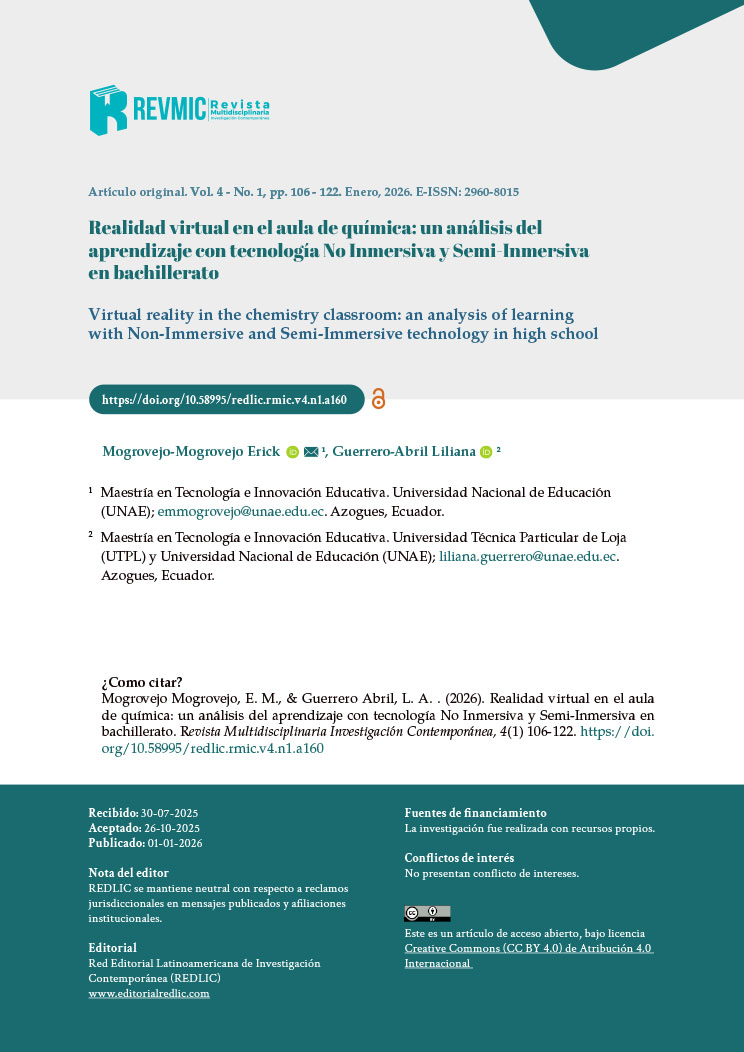
Virtual reality in the chemistry classroom: an analysis of learning with Non-Immersive and Semi-Immersive technology in high school.
 Erick Michael Mogrovejo Mogrovejo
- Liliana Anabel Guerrero Abril
Make a Submission
Plantillas

Redes sociales



Indexaciones, directorio y referencias








Keywords
estadisticas
Tendencias
| Nombre | 2026-01-01 — 2026-08-15 | Total |
|---|---|---|
| Envíos recibidos | 75 | 223(46/año) |
| Envíos aceptados | 33 | 128(46/año) |
| Envíos rechazados | 31 | 80(14/año) |
| Envíos rechazados (antes de revisión) | 22 | 61(11/año) |
| Envíos rechazados (después de revisión) | 9 | 19(4/año) |
| Envíos publicados | 36 | 125 (33/año) |
Developed By
ORCID

Visitantes
Visitantes
Latest publications


Browse
Abstract
The teaching of chemistry in Ecuadorian high schools faces limitations related to memorization, poor conceptual understanding, and a lack of teaching and technological resources, which has an impact on academic performance. Against this backdrop, virtual reality emerges as an innovative alternative. This study analyzes the impact of non-immersive and semi-immersive virtual reality on the teaching of neutral oxy-salts, considering student perceptions of time use, motivation, participation, progress, ubiquity, and satisfaction. A quasi-experimental design was applied with 64 first-year high school students divided into two groups. Data were collected using a validated questionnaire and analyzed with descriptive statistics. The results show significant differences in favor of non-immersive virtual reality, especially in progress and satisfaction, with an academic average of 9.30/10 compared to 8.55/10 for the semi-immersive group. In this sense, spatial.io is consolidated as an efficient and interactive tool.
Downloads
References
- Agurto, J. y Guevara, C. (2023). Realidad virtual para la mejora del rendimiento académico en estudiantes de educación superior. Revista Metropolitana de Ciencias Aplicadas, 6(S2), 233-243. https://doi.org/10.62452/xr07j373 DOI: https://doi.org/10.62452/xr07j373
- Andrés, J. (2004). La investigación ex post-facto. Alzina, R.B. (Ed.), Metodología de la investigación educativa, 196-230. Madrid. Madrid: La Muralla.
- Bailenson, J., Yee, N., Blascovich, J., Beall, A., Lundblad, N. & Jin, M. (2008). The Use of Immersive Virtual Reality in the Learning Sciences: Digital Transformations of Teachers, Students, and Social Context, Journal of the Learning Sciences, 17(1), 102-141. https://doi.org/10.1080/10508400701793141 DOI: https://doi.org/10.1080/10508400701793141
- Balseca, N., Quilligana, M. y Aman, D. (2024). Una mirada histórica en la enseñanza-aprendizaje de la química: Mejorando la calidad educativa. Polo del conocimiento, 9(1), 1496-1506. https://doi.org/10.23857/pc.v9i1.6446
- Cambra, U. y Viniegra, L. (2016). Integración de la realidad virtual inmersiva en los Grados de Comunicación. Revista ICONO 14. Revista científica de Comunicación y Tecnologías emergentes, 14(2), 1–21. https://doi.org/10.7195/ri14.v14i2.953 DOI: https://doi.org/10.7195/ri14.v14i2.953
- Cohen, L., Manion, L. y Rodríguez, M. (1990). Métodos de Investigación Educativa. Madrid: La Muralla.
- Gutiérrez, J., Mora, C., Añorbe, B., González, A. (2017). Virtual Technologies Trends in Education. EURASIA Journal of Mathematics Science and Technology Education, 13(2), 469-486. https://doi.org/10.12973/eurasia.2017.00626a DOI: https://doi.org/10.12973/eurasia.2017.00626a
- Hernández-Sampieri, R. y Mendoza, C. (2020). Metodología de la investigación: las rutas cuantitativa, cualitativa y mixta. McGraw-Hill Education.
- Ho, L., Sun, H., & Tsai, T. (2019). Research on 3D Painting in Virtual Reality to Improve Students’ Motivation of 3D Animation Learning. Sustainability, 11(6), 1605. https://doi.org/10.3390/su11061605 DOI: https://doi.org/10.3390/su11061605
- Kim, B. (2020). Short Communication on Modern Chemistry. Mod Chem Appl, 8: e281. https://doi.org/10.35248/2329-6798.20.8.e281.
- León, O. y Montero, I. (2003). Métodos de investigación en psicología y educación. San Francisco: McGraw-Hill.
- Lorenzo, R., Rudolphi, T., Ruiz, M., Sendra, F. (2019). Game-Based Learning in Virtual Worlds: A Multiuser Online Game for Medical Undergraduate Radiology Education within Second Life. Anatomical sciences education, 13(5), 602–617. https://doi.org/10.1002/ase.1927 DOI: https://doi.org/10.1002/ase.1927
- Makransky G, Borre, S., Mayer, R. (2019). Motivational and cognitive benefits of training in immersive virtual reality based on multiple assessments. Journal of Computer Assisted Learning, 1–17. https://doi.org/10.1111/jcal.12375 DOI: https://doi.org/10.1111/jcal.12375
- Menjívar, E., Sánchez, E., Ruiz, J., Guillén, F. (2022). Percepciones de estudiantes universitarios sobre la realidad virtual como recurso didáctico: un estudio preexperimental con un grupo de control y experimental. International Journal of Educational Research and Innovation (IJERI), 17, 152-171. https://doi.org/10.46661/ijeri.5904 DOI: https://doi.org/10.46661/ijeri.5904
- Ministerio de Educación del Ecuador. (2025). Currículo priorizado con énfasis en competencias comunicacionales, matemáticas, digitales y socioemocionales. Nivel de Bachillerato. https://educacion.gob.ec/curriculo-priorizado/
- Pacheco, A., Lorduy, D., Flórez, E., Páez, J. (2021). Uso de simuladores phet para el aprendizaje del concepto de soluciones desde las representaciones en química. Revista boletín redipe,10 (7), 201-213. https://doi.org/10.36260/rbr.v10i7.1358 DOI: https://doi.org/10.36260/rbr.v10i7.1358
- Rizvan, A., Asueva, L, Yudina, A. (2023). Enhancing Chemistry Education’s Relevance and Comprehension through Immersive Virtual Reality. BIO Web Conf, 76, 09006. https://doi.org/10.1051/bioconf/20237609006 DOI: https://doi.org/10.1051/bioconf/20237609006
- Sevillano, M., González, M., Vázquez, E., Rey, L. (2016). Ubicuidad y movilidad de herramientas virtuales abren nuevas expectativas formativas para el estudiantado universitario. Revista Ensayos Pedagógicos, 11 (2), 99-131. https://doi.org/10.15359/rep.11-2.5 DOI: https://doi.org/10.15359/rep.11-2.5
- Susilana, R., Dewi, L., Rullyana, G. (2024). Exploring Student Perceptions of Virtual Learning Experiences: A Study of the Use of the Spatial.io 3D Metaverse Platform. Journal of Education Technology, 8(4), 673–683. https://doi.org/10.23887/jet.v8i4.85190 DOI: https://doi.org/10.23887/jet.v8i4.85190
- Tarira, A., Macias, J., Yépez, R. (2024). Impacto de las enseñanzas tradicionales en las dificultades de aprendizaje de estudiantes con discalculia. LATAM Revista Latinoamericana De Ciencias Sociales Y Humanidades, 5(5), 3984 – 4000. https://doi.org/10.56712/latam.v5i5.2904 DOI: https://doi.org/10.56712/latam.v5i5.2904
- Vega, E., Cueva, R., Piña, E., Montero, J., Montero, M., Solano, M. (2023). Estrategias para abordar los efectos de la falta de recursos en la educación. Revista Invecom, 3(2). https://doi.org/10.5281/zenodo.8057807
Published 2026-01-01
Keywords
- chemistry education,
- educational technology,
- inorganic chemistry,
- educational innovation,
- secundary school
Issue
Section
Copyright (c) 2026 Los autores que publiquen en la revista Multidisciplinaria Investigación Contemporánea aceptan los siguientes términos: 1. Los autores mantienen sus derechos de autor (copyright) y otorgan a la revista Multidisciplinaria Investigación Contemporánea el derecho de la primera publicación de su trabajo, bajo una licencia Creative Commons Attribution 4.0. Esta licencia permite que terceros utilicen el contenido publicado, siempre que se mencione la autoría y la primera publicación en esta revista. 2. Los autores pueden establecer acuerdos adicionales para la distribución no exclusiva de la versión publicada de su artículo en otros lugares, como repositorios institucionales, siempre y cuando se indique claramente que el trabajo fue publicado por primera vez en esta revista. 3. Los autores conservan sus derechos de autor (copyright) y garantizan a la revista Multidisciplinaria Investigación Contemporánea el derecho a publicar el manuscrito a través de los canales que considere apropiados. 4. Se permite y se recomienda a los autores compartir su trabajo en línea (por ejemplo, en repositorios institucionales o páginas web personales), una vez que el manuscrito haya sido aceptado para su publicación. Esto puede conducir a intercambios productivos y a una mayor y más rápida citación del trabajo publicado. Detalle de Licencia CC BY (https://creativecommons.org/licenses/by/4.0/) Usted es libre de: Compartir — copiar y redistribuir el material en cualquier medio o formato para cualquier propósito, incluso comercialmente. Adaptar — remezclar, transformar y construir a partir del material para cualquier propósito, incluso comercialmente. La licenciante no puede revocar estas libertades en tanto usted siga los términos de la licencia Bajo los siguientes términos: Atribución — Usted debe dar crédito de manera adecuada , brindar un enlace a la licencia, e indicar si se han realizado cambios . Puede hacerlo en cualquier forma razonable, pero no de forma tal que sugiera que usted o su uso tienen el apoyo de la licenciante. No hay restricciones adicionales — No puede aplicar términos legales ni medidas tecnológicas que restrinjan legalmente a otras a hacer cualquier uso permitido por la licencia.

This work is licensed under a Creative Commons Attribution 4.0 International License.
How to Cite