Ciencias Sociales- Artículo de Revisión
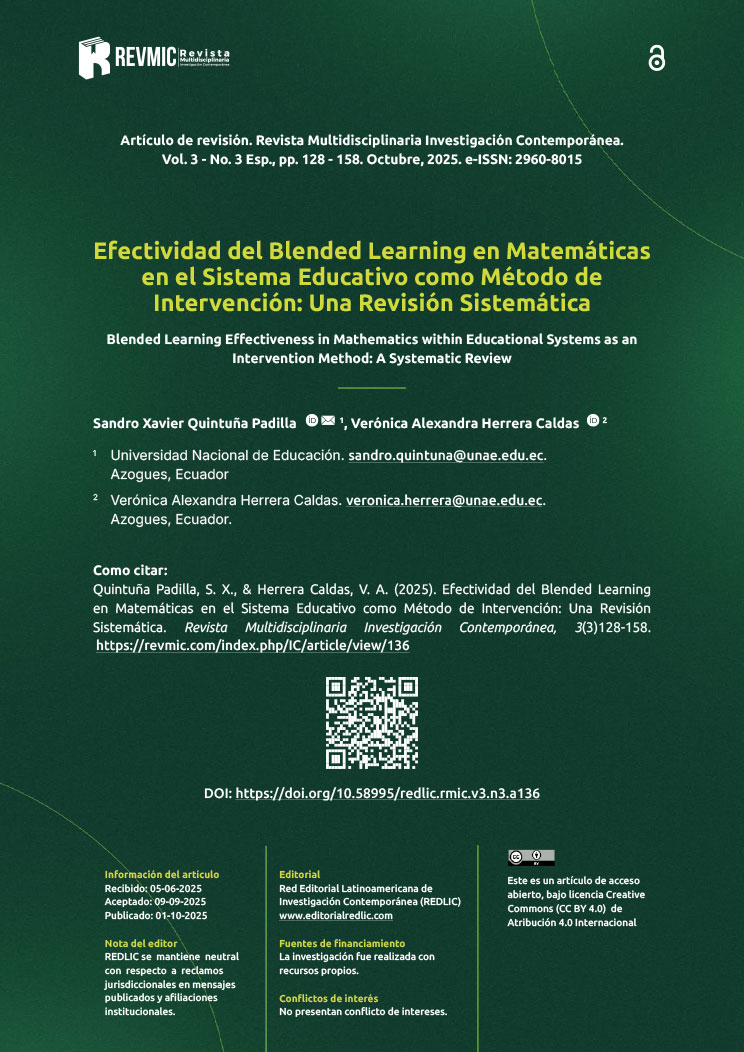
Efectividad del Blended Learning en Matemáticas en el Sistema Educativo como Método de Intervención: Una Revisión Sistemática
Effectiveness of Blended Learning in Mathematics as an Educational Intervention: A Systematic Review
Resumen
EEsta revisión sistemática evaluó la efectividad del Blended Learning en comparación con la educación tradicional presencial en el rendimiento académico en matemáticas de estudiantes de varios contextos educativos. Se realizó una búsqueda en bases de datos electrónicas, aplicando criterios de inclusión y exclusión predefinidos. El análisis de 54 artículos comprende niveles educativos, modalidades de Blended Learning en diferentes países y un total de 10,425 participantes. Los resultados mostraron que el Blended Learning fue generalmente más efectivo que la enseñanza presencial tradicional en términos de rendimiento académico, motivación, habilidades cognitivas y metacognitivas. El análisis evidenció que el Blended Learning tiene un efecto positivo a diferencia de otras modalidades. Aunque los estudios sí demuestran diferencias a nivel global, se encontraron factores moderadores como el diseño del estudio, nivel educativo y duración de la intervención. A partir de los hallazgos, se plantea que la competencia digital docente, la percepción estudiantil y los aspectos propios de cada contexto son relevantes en el diseño e implementación del Blended Learning en matemáticas
This systematic review evaluated the effectiveness of Blended Learning compared to traditional face-to-face instruction in improving academic performance in mathematics across diverse educational contexts. A structured search was conducted in electronic databases using predefined inclusion and exclusion criteria. A total of 54 empirical studies were included, covering various countries, educational levels, and Blended Learning modalities, with a combined sample of 10,425 participants. The findings indicate that Blended Learning was generally more effective than traditional instruction in terms of academic achievement, motivation, and cognitive and metacognitive skill development. The overall effect size favored Blended Learning, although there was notable heterogeneity across studies. Moderating factors such as study design, educational level, and intervention duration were identified. The review discusses practical implications for educational practice and future research, highlighting the need to address teacher digital competencies, student perceptions, and contextual factors for the successful implementation of Blended Learning in mathematics.
Palabras clave
- aprendizaje combinado
- matemáticas
- enseñanza secundaria
- rendimiento académico
- tecnología educativa
Referencias
Adduci, S. B. (2016). The Effect of Learning Style Awareness, Strategies, and Classroom Type on Grades (Achievement) in High School Algebra II (Tesis doctoral). Northcentral University, Arizona, Estados Unidos. https://www.proquest.com/openview/3b946497bdf67d7320929836291c6c39/1?pq-origsite=gscholar&cbl=18750
Aldalalah, O. M. A., Shatat, F. y Ababneh, Z. W. (2019). The impact of blended learning on the development of the cognitive and metacognitive thinking skills in mathematics of the (ECT) students. Journal of Institutional Research South East Asia, 17(1), 5–21. Recuperado de https://www.researchgate.net/profile/Feras-Shatat/publication/333805159_The_Impact_of_Blended_Learning_on_the_Development_of_the_Cognitive_and_Metacognitive_Thinking_Skills_in_Mathematics_of_the_ECT_Students/links/5d054713458515b055d55141/The-Impact-of-Blended-Learning-on-the-Development-of-the-Cognitive-and-Metacognitive-Thinking-Skills-in-Mathematics-of-the-ECT-Students.pdf
Alsalhi, N. R., Al-Qatawneh, S., Eltahir, M. y Aqel, K. (2021). Does blended learning improve the academic achievement of undergraduate students in the mathematics course?: A case study in higher education. EURASIA Journal of Mathematics, Science and Technology Education, 17(4), en1951. https://doi.org/10.29333/ejmste/10781
Althauser, K. y Harter, C. (2016). Math and economics: Implementing authentic instruction in grades K-5. Journal of Education and Training Studies, 4(4), 111–122. https://doi.org/10.11114/jets.v4i4.1328
Amin, A. K., Sudana, I. N. D., Setyosari, P. y Djatmika, E. T. (2021). The effectiveness of mobile blended problem based learning on mathematical problem solving. International Journal of Interactive Mobile Technologies (iJIM), 15(1), 119–141. https://doi.org/10.3991/ijim.v15i01.17437
Ashby, J., Sadera, W. A. y McNary, S. W. (2011). Comparing student success between developmental math courses offered online, blended, and face-to-face. Journal of Interactive Online Learning, 10(3), 128–140. Recuperado de https://www.ncolr.org/jiol/issues/pdf/10.3.2.pdf
Attard, C. y Holmes, K. (2022). An exploration of teacher and student perceptions of blended learning in four secondary mathematics classrooms. Mathematics Education Research Journal, 34(4), 719–740. https://doi.org/10.1007/s13394-020-00359-2
Bolley, S. (2013). Examining the effects of blended learning for ninth grade students who struggle with math (Tesis doctoral). Arizona State University, Arizona, Estados Unidos. Recuperado de https://core.ac.uk/download/79566458.pdf
Capone, R. (2022). Blended learning and student-centered active learning environment: A case study with STEM undergraduate students. Canadian Journal of Science, Mathematics and Technology Education, 22(1), 210–236. https://doi.org/10.1007/s42330-022-00195-5
Chaney, T. A. (2017). The effect of blended learning on math and reading achievement in a charter school context (Tesis doctoral). Liberty University, Virginia, Estados Unidos. Recuperado de https://digitalcommons.liberty.edu/doctoral/1392
Comfort, J. M. (2016). An exploratory study of the relationship between a blended learning approach to instruction and 5th grade student performance in a Kansas public school district (Tesis doctoral). University of Kansas, Kansas, Estados Unidos. Recuperado de https://kuscholarworks.ku.edu/server/api/core/bitstreams/f98f29e4-02ea-4d9d-919c-155f7ccf87ff/content
Crossley, S. A., Karumbaiah, S., Ocumpaugh, J., Labrum, M. J. y Baker, R. S. (2020). Predicting math identity through language and click-stream patterns in a blended learning mathematics program for elementary students. Journal of Learning Analytics, 7(1), 19–37. https://doi.org/10.18608/jla.2020.71.3
Dai, C. Y. y Huang, D. H. (2015). Causal complexities to evaluate the effectiveness of remedial instruction. Journal of Business Research, 68(4), 894-899. https://doi.org/10.1016/j.jbusres.2014.11.048
de Brito Lima, F., Lautert, S. L. y Gomes, A. S. (2022). Learner behaviors associated with uses of resources and learning pathways in blended learning scenarios. Computers & Education, 191, 104625. https://doi.org/10.1016/j.compedu.2022.104625
Dey, P. y Bandyopadhyay, S. (2019). Blended learning to improve quality of primary education among underprivileged school children in India. Education and Information Technologies, 24(3), 1995–2016. https://doi.org/10.1007/s10639-018-9832-1
Fazal, M. y Bryant, M. (2019). Blended learning in middle school math: The question of effectiveness. Journal of Online Learning Research, 5(1), 49–64. Recuperado de https://files.eric.ed.gov/fulltext/EJ1208816.pdf
Gonda, D., Pavlovičová, G., Tirpáková, A. y Ďuriš, V. (2021). Setting up a flipped classroom design to reduce student academic procrastination. Sustainability, 13(15), 8668. https://doi.org/10.3390/su13158668
Hassan, A. K., Hammadi, S. S. y Majeed, B. H. (2023). The impact of a scenario-based learning model in mathematics achievement and mental motivation for high school students. International Journal of Emerging Technologies in Learning, 18(7), 103–115. https://doi.org/10.3991/ijet.v18i07.39263
Hassan, M. N., Abdullah, A. H. y Ismail, N. (2020). Effects of VH-iSTEM learning strategy on basic secondary school students' degree of acquisition of van Hiele levels of thinking in Sokoto State, Nigeria. Universal Journal of Educational Research, 8(9), 4213–4223. https://doi.org/10.13189/ujer.2020.080948
Hawkins-Lear, S. y Grisham-Brown, J. (2019). Teaching early math skills to young children with disabilities in rural blended early childhood settings. Rural Special Education Quarterly, 38(1), 15–25. https://doi.org/10.1177/8756870518792907
Hegedus, S. J., Dalton, S. y Tapper, J. R. (2015). The impact of technology-enhanced curriculum on learning advanced algebra in US high school classrooms. Educational Technology Research and Development, 63(2), 203–228. https://doi.org/10.1007/s11423-015-9371-z
Huertas, A., Vesga, G., Vergara, A. y Romero, M. (2015). Effect of a computational scaffolding in the development of secondary students' metacognitive skills. International Journal of Technology Enhanced Learning, 7(2), 143–159. https://doi.org/10.1504/IJTEL.2015.072030
Ige, O. A. y Hlalele, D. J. (2017). Effects of computer-aided and blended teaching strategies on students' achievement in civic education concepts in mountain learning ecologies. Education and Information Technologies, 22(6), 2693–2709. https://doi.org/10.1007/s10639-017-9598-x
Indrapangastuti, D., Surjono, H. D. y Yanto, B. E. (2021). Effectiveness of the blended learning model to improve students' achievement of mathematical concepts. Journal of Education and e-Learning Research, 8(4), 423–430. https://doi.org/10.20448/journal.509.2021.84.423.430
Jamaluddin, M., Mustaji, M. y Bahri, B. S. (2022). Effect of blended learning models and self-efficacy on mathematical problem-solving ability. International Journal of Learning, Teaching and Educational Research, 21(7), 127–144. https://doi.org/10.26803/ijlter.21.7.8
Jamaluddin, M., Mustaji, M., Bachri, B. S. y Sutarto, A. P. (2023). The role of gender and self-efficacy on the relationship between flipped and flex blended learning and mathematics abilities. International Journal of Information and Education Technology, 13(5). https://doi.org/10.18178/ijiet.2023.13.5.1882
Karam, R., Pane, J. F., Griffin, B. A., Robyn, A., Phillips, A. y Daugherty, L. (2017). Examining the implementation of technology-based blended algebra I curriculum at scale. Educational Technology Research and Development, 65(2), 399–425. https://doi.org/10.1007/s11423-016-9498-6
Kirsten, K. y Greefrath, G. (2023). On-Campus vs Distance Tutorials in Preparatory Courses for Mathematics Student Teachers—Performance Gains and Influencing Factors. International Journal of Research in Undergraduate Mathematics Education, 547–576. https://doi.org/10.1007/s40753-023-00221-3
Lee, J., Lim, C. y Kim, H. (2017). Development of an instructional design model for flipped learning in higher education. Educational Technology Research and Development, 65(2), 427–453. https://doi.org/10.1007/s11423-016-9502-1
Lin, Y. W., Tseng, C. L. y Chiang, P. J. (2016). The effect of blended learning in mathematics course. Eurasia Journal of Mathematics, Science and Technology Education, 13(3), 741–770. https://doi.org/10.12973/eurasia.2017.00641a
Lo, C. K. y Hew, K. F. (2017). A critical review of flipped classroom challenges in K-12 education: Possible solutions and recommendations for future research. Research and Practice in Technology Enhanced Learning, 12(1), Artículo 4. https://doi.org/10.1186/s41039-016-0044-2
Malonisio, M. O. (2023). Blended learning modality in teaching statistics in a graduate program of a state university in the Philippines. Jurnal Ilmiah Peuradeun, 11(2), 403–424. https://doi.org/10.26811/peuradeun.v11i2.889
Ministerio de Educación del Ecuador. (2021). Estadísticas educativas: Periodo 2020-2021. Recuperado de https://educacion.gob.ec/estadisticas-educativas/
Moliner, L., Lorenzo-Valentín, G. y Alegre, F. (2021). E-Learning during the Covid-19 pandemic in Spain: A case study with high school mathematics students. Journal of Education and e-Learning Research, 8(2), 179–184. https://doi.org/10.20448/journal.509.2021.82.179.184
Mulqueeny, K., Kostyuk, V., Baker, R. S. y Ocumpaugh, J. (2015). Incorporating effective e-learning principles to improve student engagement in middle-school mathematics. International Journal of STEM Education, 2, 1–14. https://doi.org/10.1186/s40594-015-0028-6
Ojaleye, O. y Awofala, A. O. (2018). Blended Learning and Problem-Based Learning Instructional Strategies as Determinants of Senior Secondary School Students' Achievement in Algebra. International Journal of Research in Education and Science, 4(2), 486–501. https://doi.org/10.21890/ijres.428286
Owens, S. T. (2017). A quantitative comparative study of blended and traditional models in the secondary advanced placement statistics classroom (Tesis doctoral). Northcentral University, Arizona, Estados Unidos. Recuperado de https://eric.ed.gov/?id=ED580741
Owston, R., York, D. N., Malhotra, T. y Sitthiworachart, J. (2020). Blended Learning in STEM and Non-STEM Courses: How Do Student Performance and Perceptions Compare? Online Learning, 24(3), 203–221. https://doi.org/10.24059/olj.v24i3.2151
Patchan, M. M., Schunn, C. D., Sieg, W. y McLaughlin, D. (2016). The effect of blended instruction on accelerated learning. Technology, Pedagogy and Education, 25(3), 269–286. https://doi.org/10.1080/1475939X.2015.1013977
Putri, A. S., Prasetyo, Z. K., Purwastuti, L. A., Prodjosantoso, A. K. y Putranta, H. (2023). Effectiveness of STEAM-based blended learning on students' critical and creative thinking skills. Journal of Technology and Science Education, 13(2), 532–547. https://doi.org/10.3926/jotse.1793
Quarles, C. L. y Davis, M. (2017). Is learning in developmental math associated with community college outcomes? Community College Review, 45(1), 33–51. https://doi.org/10.1177/0091552116673711
Quinn, D. y Aarão, J. (2020). Blended learning in first year engineering mathematics. ZDM – Mathematics Education, 52(5), 927–941. https://doi.org/10.1007/s11858-020-01160-y
Ramadhani, R., Umam, R., Abdurrahman, A. y Syazali, M. (2019). The effect of flipped-problem based learning model integrated with LMS-Google Classroom for senior high school students. Journal for the Education of Gifted Young Scientists, 7(2), 137–158. https://doi.org/10.17478/jegys.548350
Rodríguez Licea, R. A., López Frías, B. S. y Mortera Gutiérrez, F. J. (2017). El video como recurso educativo abierto y la enseñanza de Matemáticas. Revista electrónica de investigación educativa, 19(3), 92–100. https://doi.org/10.24320/redie.2017.19.3.936
Skelton, R. R. G. (2017). Effectiveness of blended learning in a rural alternative education school setting (Tesis doctoral). Liberty University, Virginia, Estados Unidos. Recuperado de https://digitalcommons.liberty.edu/doctoral/1419
Smith, J. G. y Suzuki, S. (2015). Embedded blended learning within an algebra classroom: A multimedia capture experiment. Journal of Computer Assisted Learning, 31(2), 133–147. https://doi.org/10.1111/jcal.12083
Spotts, J. D. y Gutierrez de Blume, A. P. (2020). A pilot study on the effect of the flipped classroom model on pre-calculus performance. SAGE Open, 10(4), 2158244020982604. https://doi.org/10.1177/2158244020982604
Tabieh, A. A. y Hamzeh, M. (2022). The impact of blended-flipped learning on mathematical creative thinking skills. Journal of Educators Online, 19(3), n3. https://doi.org/10.9743/JEO.2022.19.3.3
Tan, K. F., Sabari, M. A., Osran, S. A., Noh, N. y Fuad, A. A. A. (2023). Comparing blended e-learning and conventional classroom methods in teaching the basic statistics subject. Education in Medicine Journal, 15(3). https://doi.org/10.21315/eimj2023.15.3.1
Tong, D. H., Uyen, B. P. y Ngan, L. K. (2022). The effectiveness of blended learning on students' academic achievement, self-study skills and learning attitudes: A quasi-experiment study in teaching the conventions for coordinates in the plane. Heliyon, 8(12), e12053. https://doi.org/10.1016/j.heliyon.2022.e12657
Valls Martínez, M. D. C., Martín-Cervantes, P. A., Sánchez Pérez, A. M. y Martínez Victoria, M. D. C. (2021). Learning mathematics of financial operations during the COVID-19 Era: An assessment with Partial Least Squares Structural Equation Modeling. Mathematics, 9(17), 2120. https://doi.org/10.3390/math9172120
Wang, Y. J., Gao, C. L. y Ye, X. D. (2023). A data-driven precision teaching intervention mechanism to improve secondary school students' learning effectiveness. Education and Information Technologies, 1–29. https://doi.org/10.1007/s10639-023-12238-x
Yorganci, S. (2020). Implementing flipped learning approach based on “First Principles of Instruction” in mathematics courses. Journal of Computer Assisted Learning, 36(5), 763–779. https://doi.org/10.1111/jcal.12448
Yudt, K. E., Sawyer, B. E. y Shera, S. B. (2023). Preservice elementary teachers' mathematical achievement and attitudes: A study of blended learning. Journal of Mathematics Teacher Education, 1–23. https://doi.org/10.1007/s10857-022-09565-0
Zahedi, S., Bryant, C. L., Iyer, A. y Jaffer, R. (2023). The use of blended learning to promote learner-centered pedagogy in elementary math classrooms. Educational Research for Policy and Practice, 22(3), 389–408. https://doi.org/10.1007/s10671-023-09346-3
Zhao, J., Hwang, G. J., Chang, S. C., Yang, Q. F. y Nokkaew, A. (2021). Effects of gamified interactive e-books on students' flipped learning performance, motivation, and meta-cognition tendency in a mathematics course. Educational Technology Research and Development, 69, 3255–3280. https://doi.org/10.1007/s11423-021-10053-0
Publicado
Historial
- Recibido
- 5 jun 2025
- Aceptado
- 21 sep 2025
- Publicado
- 1 oct 2025
Métricas
284 descargas
últimos 7 meses
Número
Sección
Cómo citar
Licencia
Derechos de autor 2025 Los autores que publiquen en la revista Multidisciplinaria Investigación Contemporánea aceptan los siguientes términos: 1. Los autores mantienen sus derechos de autor (copyright) y otorgan a la revista Multidisciplinaria Investigación Contemporánea el derecho de la primera publicación de su trabajo, bajo una licencia Creative Commons Attribution 4.0. Esta licencia permite que terceros utilicen el contenido publicado, siempre que se mencione la autoría y la primera publicación en esta revista. 2. Los autores pueden establecer acuerdos adicionales para la distribución no exclusiva de la versión publicada de su artículo en otros lugares, como repositorios institucionales, siempre y cuando se indique claramente que el trabajo fue publicado por primera vez en esta revista. 3. Los autores conservan sus derechos de autor (copyright) y garantizan a la revista Multidisciplinaria Investigación Contemporánea el derecho a publicar el manuscrito a través de los canales que considere apropiados. 4. Se permite y se recomienda a los autores compartir su trabajo en línea (por ejemplo, en repositorios institucionales o páginas web personales), una vez que el manuscrito haya sido aceptado para su publicación. Esto puede conducir a intercambios productivos y a una mayor y más rápida citación del trabajo publicado. Detalle de Licencia CC BY (https://creativecommons.org/licenses/by/4.0/) Usted es libre de: Compartir — copiar y redistribuir el material en cualquier medio o formato para cualquier propósito, incluso comercialmente. Adaptar — remezclar, transformar y construir a partir del material para cualquier propósito, incluso comercialmente. La licenciante no puede revocar estas libertades en tanto usted siga los términos de la licencia Bajo los siguientes términos: Atribución — Usted debe dar crédito de manera adecuada , brindar un enlace a la licencia, e indicar si se han realizado cambios . Puede hacerlo en cualquier forma razonable, pero no de forma tal que sugiera que usted o su uso tienen el apoyo de la licenciante. No hay restricciones adicionales — No puede aplicar términos legales ni medidas tecnológicas que restrinjan legalmente a otras a hacer cualquier uso permitido por la licencia.

Esta obra está bajo una licencia internacional Creative Commons Atribución 4.0.
Los autores que publiquen en la revista Multidisciplinaria Investigación Contemporánea aceptan los siguientes términos:
- Los autores mantienen sus derechos de autor (copyright) y otorgan a la revista Multidisciplinaria Investigación Contemporánea el derecho de la primera publicación de su trabajo, bajo una licencia Creative Commons Attribution 4.0. Esta licencia permite que terceros utilicen el contenido publicado, siempre que se mencione la autoría y la primera publicación en esta revista.
- Los autores pueden establecer acuerdos adicionales para la distribución no exclusiva de la versión publicada de su artículo en otros lugares, como repositorios institucionales, siempre y cuando se indique claramente que el trabajo fue publicado por primera vez en esta revista.
- Los autores conservan sus derechos de autor (copyright) y garantizan a la revista Multidisciplinaria Investigación Contemporánea el derecho a publicar el manuscrito a través de los canales que considere apropiados.
- Se permite y se recomienda a los autores compartir su trabajo en línea (por ejemplo, en repositorios institucionales o páginas web personales), una vez que el manuscrito haya sido aceptado para su publicación. Esto puede conducir a intercambios productivos y a una mayor y más rápida citación del trabajo publicado.
Detalle de Licencia CC BY (https://creativecommons.org/licenses/by/4.0/)
Usted es libre de:
- Compartir — copiar y redistribuir el material en cualquier medio o formato para cualquier propósito, incluso comercialmente.
- Adaptar — remezclar, transformar y construir a partir del material para cualquier propósito, incluso comercialmente.
- La licenciante no puede revocar estas libertades en tanto usted siga los términos de la licencia
Bajo los siguientes términos:
- Atribución — Usted debe dar crédito de manera adecuada , brindar un enlace a la licencia, e indicar si se han realizado cambios . Puede hacerlo en cualquier forma razonable, pero no de forma tal que sugiera que usted o su uso tienen el apoyo de la licenciante.
- No hay restricciones adicionales — No puede aplicar términos legales ni medidas tecnológicas que restrinjan legalmente a otras a hacer cualquier uso permitido por la licencia.