
Structural analysis of the personality of incarcerated women and their dominant traits
 Omar Francisco Saquicela Ochoa
- Pedro Andrés Muñoz Arteaga
- Jessica Vanessa Quito Calle
- Andrés Alexis Ramírez Coronel
Make a Submission
Plantillas

Redes sociales



Indexaciones, directorio y referencias










Keywords
estadisticas
Tendencias
| Nombre | 2026-01-01 — 2026-08-15 | Total |
|---|---|---|
| Envíos recibidos | 75 | 223(46/año) |
| Envíos aceptados | 33 | 128(46/año) |
| Envíos rechazados | 31 | 80(14/año) |
| Envíos rechazados (antes de revisión) | 22 | 61(11/año) |
| Envíos rechazados (después de revisión) | 9 | 19(4/año) |
| Envíos publicados | 36 | 125 (33/año) |
Developed By
ORCID

Visitantes
Visitantes
Latest publications


Browse
Abstract
Introduction: The structural analysis of the personality of incarcerated women is essential for understanding their psychological characteristics and behavior in confinement settings. This study aims to identify and comprehend the dominant traits in these women to improve intervention and rehabilitation programs. Objective: The main objective of the study is to identify the predominant personality traits in women in incarceration, to provide a solid foundation for developing rehabilitation and psychosocial support strategies. Method: A structural analysis of personality was conducted using the Minnesota Multiphasic Personality Inventory (MMPI) on a sample of incarcerated women (n = 40). The analysis included statistical techniques to identify dominant traits and their relationship with behavior and adaptation in the penitentiary environment. Results: The results revealed that the dominant traits in the studied women include high levels of neuroticism and low levels of openness to new experiences. These traits are associated with greater difficulty in adapting to the penitentiary environment and a higher incidence of internal and social conflicts. Conclusion: Understanding the predominant personality traits in incarcerated women is crucial for designing effective interventions. The identified characteristics suggest the need for personalized approaches in rehabilitation programs, focusing on stress management and the promotion of adaptive skills.
Downloads
References
- Adams, L., Stuewing, J., & Tangney, J. (2016). Relation of Borderline Personality Features to Preincarceration HIV Risk Behavior of Jail Inmates: Evidence for Gender Differences? Personality Disorders-Theory Research and Treatment, 7(1), 40-49. DOI: https://doi.org/10.1037/per0000124
- Anderson, J. D., Pitner, R. O., & Wooten, N. R. (2020). A gender-specific model of trauma and victimization in incarcerated women. Journal of Human Behavior in the Social Environment, 30(2), 191-212. DOI: https://doi.org/10.1080/10911359.2019.1673272
- Balarezo, L. (2015). Psicoterapia Integrativa Focalizada en la Personlidad. Revista PUCE, 100, 173-188.
- Blake, K. R., & Gangestad, S. (2020). On attenuated interactions, measurement error, and statistical power: Guidelines for social and personality psychologists. Personality and Social Psychology Bulletin, 46(12), 1702-1711. DOI: https://doi.org/10.1177/0146167220913363
- Coid, J., Yang, M., Ullrich, S., Roberts, A., & Hare, R. (2009). Prevalence and correlates of psychopathic traits in the household population of Great Britain. International Journal of Law and Psychiatry, 32(2), 65-73. DOI: https://doi.org/10.1016/j.ijlp.2009.01.002
- Comrey, A. L., & Duffy, K. E. (1968). Cattell and Eysenck factor scores related to Comrey personality factors. Multivariate Behavioral Research, 3(4), 379-392. DOI: https://doi.org/10.1207/s15327906mbr0304_1
- Coppola, F., & Martufi, A. (2024). Introduction: What is Social Rehabilitation?. In Social Rehabilitation and Criminal Justice (pp. 1-10). Routledge. DOI: https://doi.org/10.4324/9781003196891-1
- Clubb, G., Altier, M. B., Kobayashi, Y., Davies, G., & Brownsord, E. (2024). Combating the Terrorist Stigma: Communicating Rehabilitation and Reducing Barriers to Reintegration. Terrorism and Political Violence, 1-18. DOI: https://doi.org/10.1080/09546553.2024.2317801
- Day, D. M., Zahn, M. A., & Belenko, S. (2017). Low agreeableness and criminal behavior among women: A criminological analysis. Crime & Delinquency, 63(5), 558-578.
- Dolan, B., & Blackburn, R. (2006). Personality disorders and psychopathy in women: A comparison of criminality and institutionalization. Journal of Personality Disorders, 20(3), 298-312.
- Eysenck, H. J. (1984). Cattell and the theory of personality. Multivariate Behavioral Research, 19(2-3), 323-336. DOI: https://doi.org/10.1080/00273171.1984.9676938
- Kalsoom, U., & Gul, S. (2020). Correlating Personality Disorders with Types (I, II) of Crimes in Prisoner Population. Pakistan Journal of Criminology, 12(2), 34-44.
- Loya, J., Tangney, J., & Stuewing, J. (2022). Are bordeline personality disorder features differentially related to pre-incarceration alcohol, cannabis, cocaine, and opioid dependence among people recently incarcerated in jail? Journal of Pesonality Disorders, 36(5), 623-640. DOI: https://doi.org/10.1521/pedi.2022.36.5.623
- Malik, M. N., & Majeed, S. (2023). Borderline Personality Traits, Dysfunctional Family and Risk-Taking Behaviors in Prison Inmates. Pakistan Journal of Criminology, 15(1), 49-62.
- Molina, V., Pérez, J., & Salaberría, K. (2022). Sociodemographic, Criminal and Psychopathological Profile in a Sample of Women in Prision. Revista Iberoamericana de Diagnóstico y Evaluación Psicológica, 1(62), 127-136. DOI: https://doi.org/10.21865/RIDEP62.1.10
- Molina, V., Lara, R., Lara, B., & Valdez, C. (2023). Criminal characteristics and psychopaty in xomen in prision. Revista Española de Sanidad Penitenciaria, 25(1), 8-15. DOI: https://doi.org/10.18176/resp.00061
- Moreira, P. A., Lopes, J. C., Inman, R. A., & Cunha, O. (2022). The personality of male prisoners: Moving towards an integrated temperament-and-character-based theory of criminal and antisocial behavior. Journal of Criminal Justice, 79, 101897. DOI: https://doi.org/10.1016/j.jcrimjus.2022.101897
- Pieters, J., Mastrofski, S. D., & Reisig, M. D. (2018). Personality and criminal behavior: The role of openness to experience. Journal of Criminal Justice, 55, 44-52.
- Roberts, B. W., & Yoon, H. J. (2022). Personality psychology. Annual review of psychology, 73(1), 489-516. DOI: https://doi.org/10.1146/annurev-psych-020821-114927
- Shahid, S., & Ashraf, M. (2022). During Incarceration: A phenomenological study of Recidivism in Convicted Women. Journal of Research in Psychology, 4(1), 20-29. DOI: https://doi.org/10.31580/jrp.v4i1.2416
- Warren, J. I., & South, S. C. (2009). Personality disorders in women prisoners: Comorbidity and clinical correlates. Journal of the American Academy of Psychiatry and the Law Online, 37(1), 78-88.
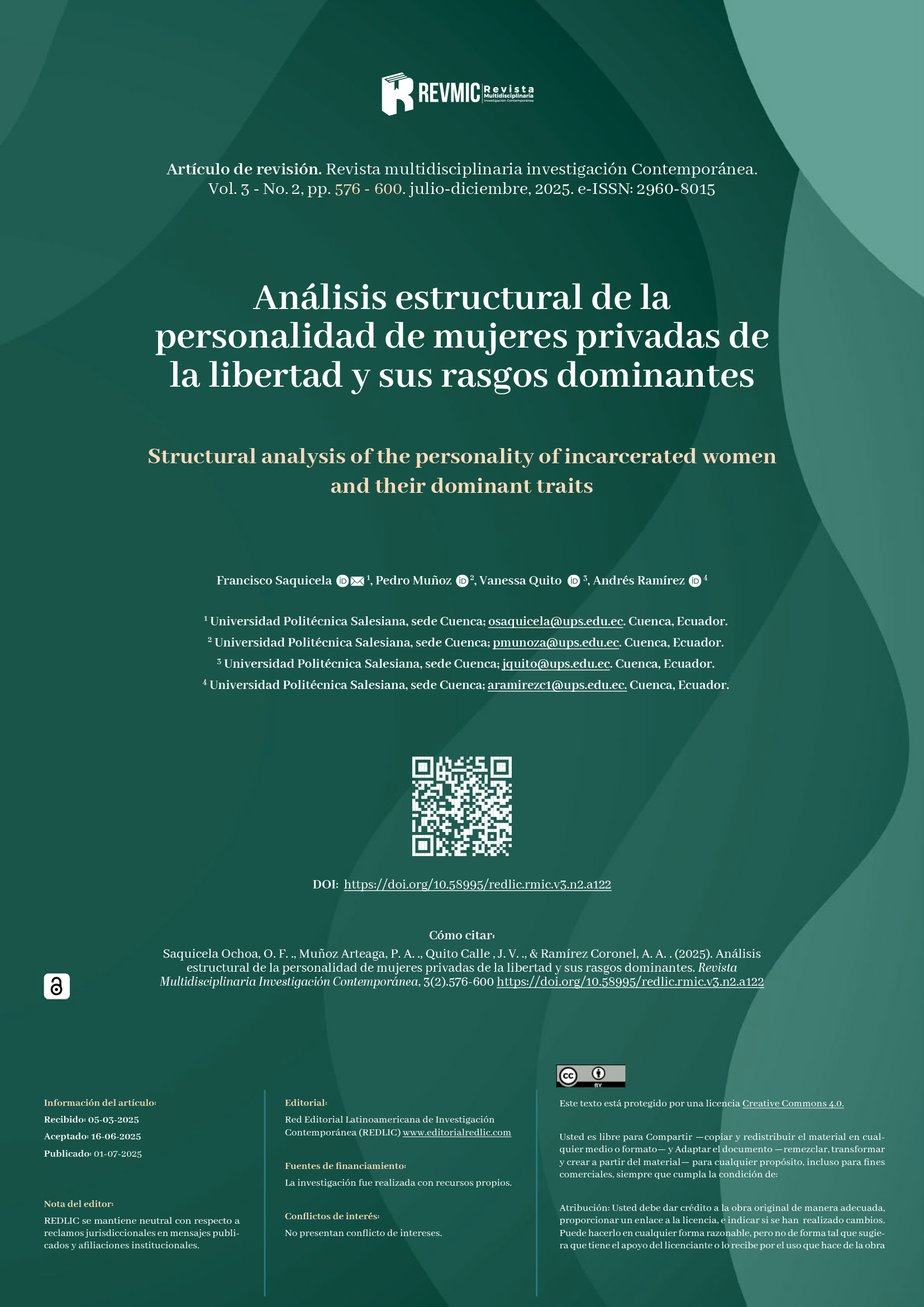
Published 2025-06-27
Keywords
- women,
- personality,
- agreeableness,
- conscientiousness
Issue
Section
Copyright (c) 2025 Los autores que publiquen en la revista Multidisciplinaria Investigación Contemporánea aceptan los siguientes términos: 1. Los autores mantienen sus derechos de autor (copyright) y otorgan a la revista Multidisciplinaria Investigación Contemporánea el derecho de la primera publicación de su trabajo, bajo una licencia Creative Commons Attribution 4.0. Esta licencia permite que terceros utilicen el contenido publicado, siempre que se mencione la autoría y la primera publicación en esta revista. 2. Los autores pueden establecer acuerdos adicionales para la distribución no exclusiva de la versión publicada de su artículo en otros lugares, como repositorios institucionales, siempre y cuando se indique claramente que el trabajo fue publicado por primera vez en esta revista. 3. Los autores conservan sus derechos de autor (copyright) y garantizan a la revista Multidisciplinaria Investigación Contemporánea el derecho a publicar el manuscrito a través de los canales que considere apropiados. 4. Se permite y se recomienda a los autores compartir su trabajo en línea (por ejemplo, en repositorios institucionales o páginas web personales), una vez que el manuscrito haya sido aceptado para su publicación. Esto puede conducir a intercambios productivos y a una mayor y más rápida citación del trabajo publicado.

This work is licensed under a Creative Commons Attribution 4.0 International License.
How to Cite