
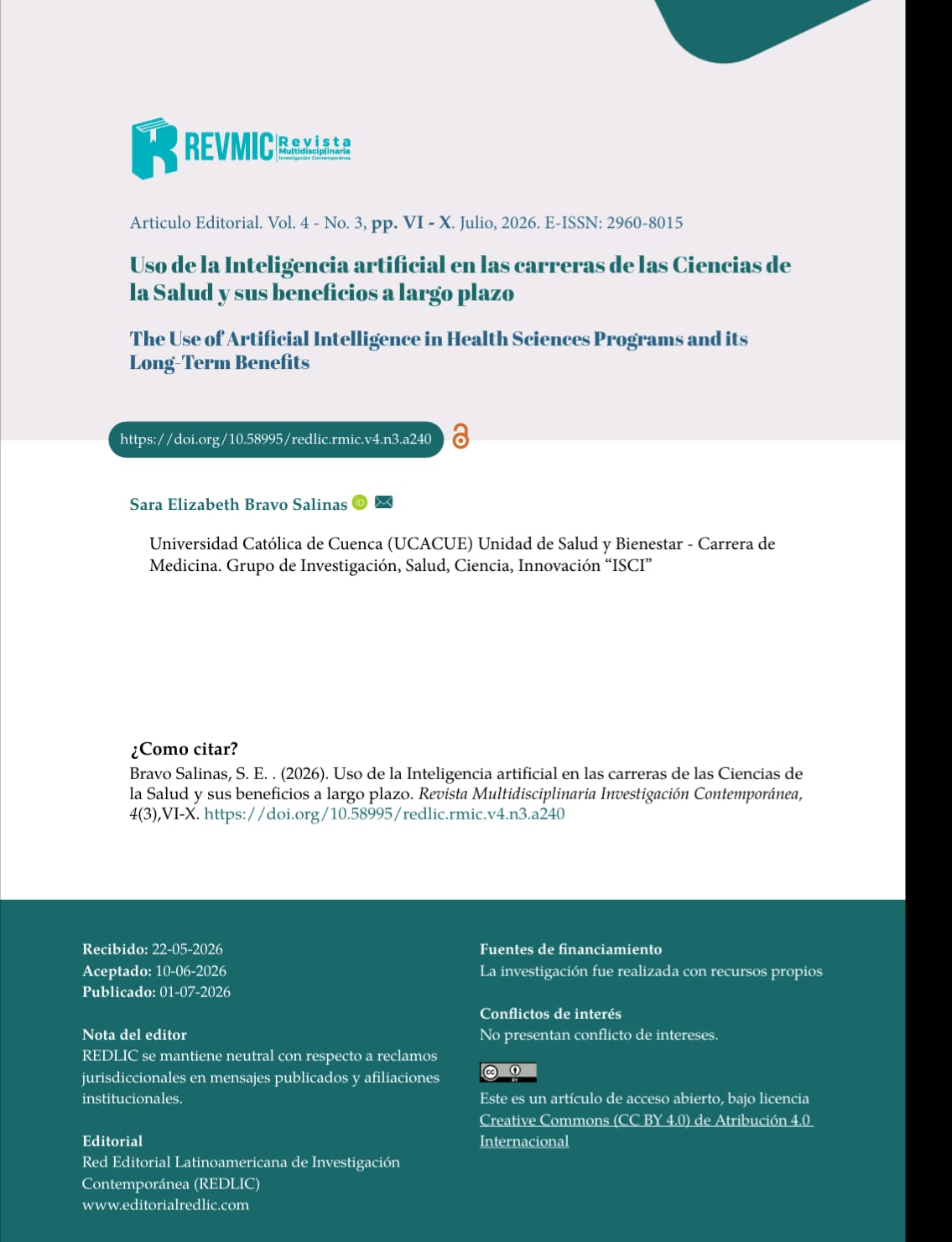
The Use of Artificial Intelligence in Health Sciences Programs and its Long-Term Benefits
 Sara Elizabeth Bravo Salinas
Make a Submission
Plantillas

Redes sociales



Indexaciones, directorio y referencias









Keywords
estadisticas
Tendencias
| Nombre | 2026-01-01 — 2026-08-15 | Total |
|---|---|---|
| Envíos recibidos | 75 | 223(46/año) |
| Envíos aceptados | 33 | 128(46/año) |
| Envíos rechazados | 31 | 80(14/año) |
| Envíos rechazados (antes de revisión) | 22 | 61(11/año) |
| Envíos rechazados (después de revisión) | 9 | 19(4/año) |
| Envíos publicados | 36 | 125 (33/año) |
Developed By
ORCID

Visitantes
Visitantes
Latest publications


Browse
Abstract
Artificial intelligence (AI) has significantly transformed educational and healthcare processes, particularly in the health sciences, by facilitating access to knowledge, fostering the development of digital skills, and optimizing clinical decision-making. Hence the importance of using artificial intelligence in health sciences programs and its long-term benefits for academic training, research, and professional practice. A narrative literature review was essential, involving the consultation of scientific literature indexed in high-impact databases, including Scopus, Web of Science, PubMed, SciELO, and Springer, and selecting recent publications related to the application of AI in education and health. Evidence from various tools shows that AI improves personalized learning, strengthens scientific research, supports clinical reasoning, and optimizes processes. Additionally, the need for ongoing training of teaching staff was identified to ensure they remain up to date. Artificial intelligence constitutes a strategic tool for health education, the effective use of which requires continuous technological updates and ethical and responsible application.
Downloads
References
- Astbury, H., Fortune, E., Ponte, C. D., Lyons, K., & Shaw, L. (2026). Generative artificial intelligence for teaching and assessment in health professions education: A scoping review. Nurse Education in Practice, 91, 104697. https://doi.org/10.1016/j.nepr.2025.104697 DOI: https://doi.org/10.1016/j.nepr.2025.104697
- Basil, M., Ahmed, W., Hajeomar, R., Strawbridge, J., Lynch, M., & Mukhalalati, B. (2026). A scoping review of the use of generative artificial intelligence tools in health profession education. BMC Medical Education, 26(1), 291. https://doi.org/10.1186/s12909-025-08527-3 DOI: https://doi.org/10.1186/s12909-025-08527-3
- Costa-Dookhan, K. A., Adirim, Z., Maslej, M., Donner, K., Rodak, T., Soklaridis, S., Sockalingam, S., & Thakur, A. (2025). Applications of Artificial Intelligence for Nonpsychomotor Skills Training in Health Professions Education: A Scoping Review. Academic Medicine, 100(5), 635-644. https://doi.org/10.1097/ACM.0000000000005983 DOI: https://doi.org/10.1097/ACM.0000000000005983
- García-Montalvo, I. (2023). Artificial intelligence as a didactic resource in medical education. Educación Médica, 24, 100849. https://doi.org/10.1016/j.edumed.2023.100849 DOI: https://doi.org/10.1016/j.edumed.2023.100849
- Hossain, M. M., Hossain, P., Roy, T. J., Das, J., Tasnim, S., Ma, P., & Liaw, W. (2025). Artificial intelligence in health professions education: A state-of-the-art meta-review (p. 2025.10.20.25338371). medRxiv. https://doi.org/10.1101/2025.10.20.25338371 DOI: https://doi.org/10.1101/2025.10.20.25338371
- Mir, M. M., Mir, G. M., Raina, N. T., Mir, S. M., Mir, S. M., Miskeen, E., Alharthi, M. H., & Alamri, M. M. S. (2023). Application of Artificial Intelligence in Medical Education: Current Scenario and Future Perspectives. Journal of Advances in Medical Education & Professionalism, 11(3), 133-140. https://doi.org/10.30476/JAMP.2023.98655.1803
- Nagi, F., Salih, R., Alzubaidi, M., Shah, H., Alam, T., Shah, Z., & Househ, M. (2023). Applications of Artificial Intelligence (AI) in Medical Education: A Scoping Review. En J. Mantas, P. Gallos, E. Zoulias, A. Hasman, M. S. Househ, M. Charalampidou, & A. Magdalinou (Eds.), Healthcare Transformation with Informatics and Artificial Intelligence. SAGE Publications. https://doi.org/10.3233/SHTI230581 DOI: https://doi.org/10.3233/SHTI230581
- Patino, G. A., Amiel, J. M., Brown, M., Lypson, M. L., & Chan, T. M. (2024). The Promise and Perils of Artificial Intelligence in Health Professions Education Practice and Scholarship. Academic Medicine: Journal of the Association of American Medical Colleges, 99(5), 477-481. https://doi.org/10.1097/ACM.0000000000005636 DOI: https://doi.org/10.1097/ACM.0000000000005636
- Preiksaitis, C., & Rose, C. (2023). Opportunities, Challenges, and Future Directions of Generative Artificial Intelligence in Medical Education: Scoping Review. JMIR Medical Education, 9, e48785. https://doi.org/10.2196/48785 DOI: https://doi.org/10.2196/48785
- Pupic, N., Ghaffari-zadeh, A., Hu, R., Singla, R., Darras, K., Karwowska, A., & Forster, B. B. (2023). An evidence-based approach to artificial intelligence education for medical students: A systematic review. PLOS Digital Health, 2(11), e0000255. https://doi.org/10.1371/journal.pdig.0000255 DOI: https://doi.org/10.1371/journal.pdig.0000255
- Sun, L., Yin, C., Xu, Q., & Zhao, W. (2023). Artificial intelligence for healthcare and medical education: A systematic review. American Journal of Translational Research, 15(7), 4820-4828. https://pmc.ncbi.nlm.nih.gov/articles/PMC10408516/
- Varma, J. R., Fernando, S., Ting, B. Y., Aamir, S., & Sivaprakasam, R. (2023). The Global Use of Artificial Intelligence in the Undergraduate Medical Curriculum: A Systematic Review. Cureus, 15(5), e39701. https://doi.org/10.7759/cureus.39701 DOI: https://doi.org/10.7759/cureus.39701
Published 2026-07-01
Keywords
- Artificial intelligence,
- medical sciences,
- technological advances,
- professional development
Issue
Section
Copyright (c) 2026 Sara Elizabeth Bravo Salinas. Los autores que publiquen en la revista Multidisciplinaria Investigación Contemporánea aceptan los siguientes términos: 1. Los autores mantienen sus derechos de autor (copyright) y otorgan a la revista Multidisciplinaria Investigación Contemporánea el derecho de la primera publicación de su trabajo, bajo una licencia Creative Commons Attribution 4.0. Esta licencia permite que terceros utilicen el contenido publicado, siempre que se mencione la autoría y la primera publicación en esta revista. 2. Los autores pueden establecer acuerdos adicionales para la distribución no exclusiva de la versión publicada de su artículo en otros lugares, como repositorios institucionales, siempre y cuando se indique claramente que el trabajo fue publicado por primera vez en esta revista. 3. Los autores conservan sus derechos de autor (copyright) y garantizan a la revista Multidisciplinaria Investigación Contemporánea el derecho a publicar el manuscrito a través de los canales que considere apropiados. 4. Se permite y se recomienda a los autores compartir su trabajo en línea (por ejemplo, en repositorios institucionales o páginas web personales), una vez que el manuscrito haya sido aceptado para su publicación. Esto puede conducir a intercambios productivos y a una mayor y más rápida citación del trabajo publicado. Detalle de Licencia CC BY (https://creativecommons.org/licenses/by/4.0/) Usted es libre de: Compartir — copiar y redistribuir el material en cualquier medio o formato para cualquier propósito, incluso comercialmente. Adaptar — remezclar, transformar y construir a partir del material para cualquier propósito, incluso comercialmente. La licenciante no puede revocar estas libertades en tanto usted siga los términos de la licencia Bajo los siguientes términos: Atribución — Usted debe dar crédito de manera adecuada , brindar un enlace a la licencia, e indicar si se han realizado cambios . Puede hacerlo en cualquier forma razonable, pero no de forma tal que sugiera que usted o su uso tienen el apoyo de la licenciante. No hay restricciones adicionales — No puede aplicar términos legales ni medidas tecnológicas que restrinjan legalmente a otras a hacer cualquier uso permitido por la licencia.

This work is licensed under a Creative Commons Attribution 4.0 International License.
How to Cite