
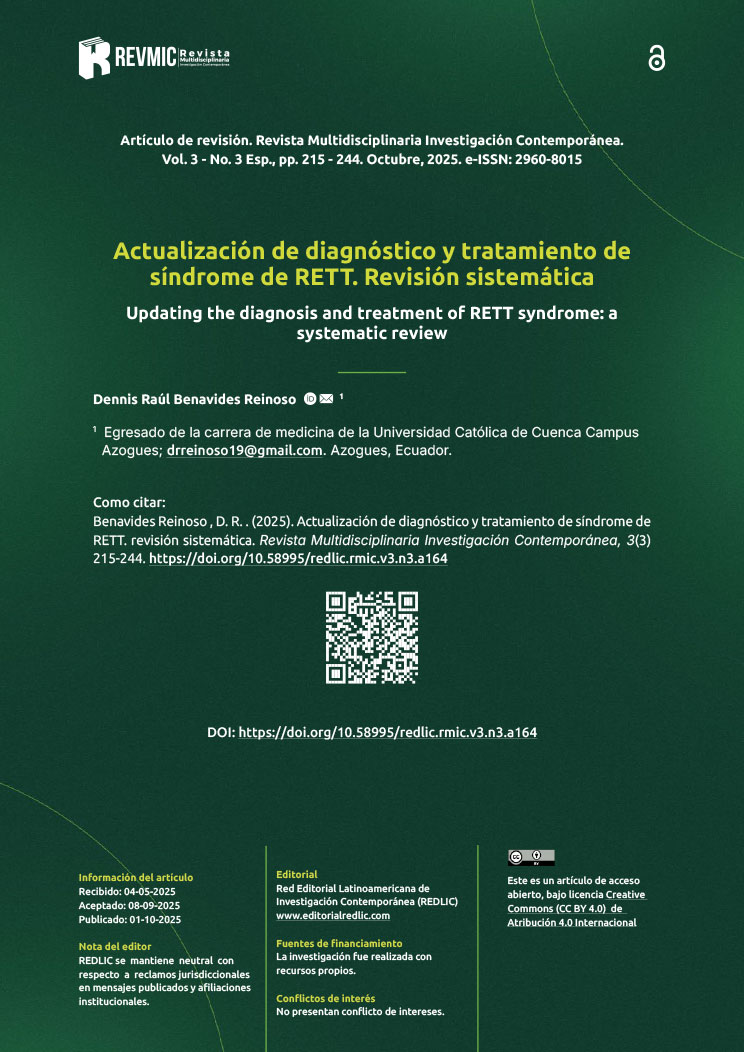
Actualización de diagnóstico y tratamiento de síndrome de RETT. Revisión sistemática
 Dennis Raúl Benavides Reinoso
Enviar un artículo
Plantillas

Redes sociales



Indexaciones, directorio y referencias










Palabras clave
estadisticas
Tendencias
| Nombre | 2026-01-01 — 2026-08-15 | Total |
|---|---|---|
| Envíos recibidos | 75 | 223(46/año) |
| Envíos aceptados | 33 | 128(46/año) |
| Envíos rechazados | 31 | 80(14/año) |
| Envíos rechazados (antes de revisión) | 22 | 61(11/año) |
| Envíos rechazados (después de revisión) | 9 | 19(4/año) |
| Envíos publicados | 36 | 125 (33/año) |
Desarrollado por
ORCID

Visitantes
Visitantes
Últimas publicaciones


Navegar
Resumen
El Síndrome de Rett (SR) es una enfermedad neurológica poco frecuente que afecta casi exclusivamente a niñas, con una incidencia estimada de 1 por cada 10.000–15.000 nacidas vivas. Más del 95% se diagnostica en la infancia temprana (6–24 meses), con pérdida progresiva de habilidades motoras, cognitivas y comunicativas, lo que repercute en la calidad de vida y en la expectativa funcional. Objetivo: Describir la evidencia actual sobre métodos diagnósticos y terapias eficaces para el SR, orientadas a mejorar la calidad de vida de las pacientes pediátricas. Metodología: Revisión sistemática según PRISMA 2020. Se incluyeron artículos de 2019–2024 en español e inglés, localizados en PubMed, Scopus, ScienceDirect, Scielo, Taylor & Francis, Cochrane y UpToDate. La calidad y el riesgo de sesgo se evaluaron con CASP. Resultados: Se seleccionaron 25 artículos (22,3% de 112 registros), que abarcaron aproximadamente 512 pacientes (98% mujeres). En diagnóstico, el 64% destacó el uso de escalas clínicas como Rett Syndrome Behaviour Questionnaire (RSBQ) y Clinical Global Impression-Improvement (CGI-I), mientras que el 36% señaló utilidad de EEG en reposo y patch-clamp. En tratamiento, el 48% documentó reducción ≥40% en crisis epilépticas con cannabinoides (CBDV, CBD); el 28% reportó eficacia de toxina botulínica en hipersalivación y espasticidad; y el 24% evidenció beneficios de trofinetide en comunicación social y función adaptativa. Conclusiones: La combinación de herramientas diagnósticas avanzadas y terapias emergentes (CBDV, CBD, BTX, trofinetide) aporta en control de síntomas y funcionalidad. Los hallazgos apoyan protocolos multimodales estandarizados, orientados a manejo personalizado y con enfoque pediátrico.
Descargas
Referencias
- Arancibia T, Pardo R, Barrientos P, Arancibia T, Pardo R, Barrientos P. Síndrome de Rett, una mirada actual. Andes pediatrica [Internet]. enero de 2023 [citado 5 de diciembre de 2023];94(1):94-103. Disponible en: http://www.scielo.cl/scielo.php?script=sci_abstract&pid=S2452-60532023000100094&lng=es&nrm=iso&tlng=es DOI: https://doi.org/10.32641/andespediatr.v94i1.4014
- Kong Y, Li QB, Yuan ZH, Jiang XF, Zhang GQ, Cheng N, et al. Multimodal Neuroimaging in Rett Syndrome With MECP2 Mutation. Front Neurol [Internet]. 2022;13(1):83-6. Disponible en: 10.3389/fneur.2022.838206 DOI: https://doi.org/10.3389/fneur.2022.838206
- Liberona AR, Albornoz-Miranda M. Neurobiological Aspects of Rett Syndrome. Revista Chilena de Neuro-Psiquiatria [Internet]. 2023;61(1):107-17. Disponible en: https://www.scielo.cl/scielo.php?script=sci_arttext&pid=S0717-92272023000100107 DOI: https://doi.org/10.4067/S0717-92272023000100107
- Aron W C, Rauch L G, Benavides G F, Repetto L MG. [Rett Syndrome: MECP2 gene molecular analysis in Chilean patients]. Rev Chil Pediatr [Internet]. abril de 2019;90(2):152-6. Disponible en: https://pubmed.ncbi.nlm.nih.gov/31095231/ DOI: https://doi.org/10.32641/rchped.v90i2.724
- Schultz R, Suter B. Síndrome de Rett: tratamiento y pronóstico. UpToDate [Internet]. noviembre de 2023;1(1):1-10. Disponible en: https://acortar.link/58B46b
- Schultz R, Suter B. Síndrome de Rett: genética, características clínicas y diagnóstico. UpToDate [Internet]. noviembre de 2023;1(2):2-20. Disponible en: https://acortar.link/CXhlMO
- Haase FD, Coorey B, Riley L, Cantrill LC, Tam PPL, Gold WA. Pre-clinical Investigation of Rett Syndrome Using Human Stem Cell-Based Disease Models. Front Neurosci [Internet]. 2021;15:698812. Disponible en: https://www.frontiersin.org/journals/neuroscience/articles/10.3389/fnins.2021.698812/full DOI: https://doi.org/10.3389/fnins.2021.698812
- Gomes AR, Fernandes TG, Vaz SH, Silva TP, Bekman EP, Xapelli S, et al. Modeling Rett Syndrome With Human Patient-Specific Forebrain Organoids. Front Cell Dev Biol [Internet]. 2020;8:610427. Disponible en: https://www.ncbi.nlm.nih.gov/pmc/articles/PMC7758289/ DOI: https://doi.org/10.3389/fcell.2020.610427
- Wiedemann A, Renard E, Hernandez M, Dousset B, Brezin F, Lambert L, et al. Annual Injection of Zoledronic Acid Improves Bone Status in Children with Cerebral Palsy and Rett Syndrome. Calcif Tissue Int [Internet]. abril de 2019;104(4):355-63. Disponible en: https://link.springer.com/article/10.1007/s00223-018-0505-2 DOI: https://doi.org/10.1007/s00223-018-0505-2
- Pérez Brito C. Tratamiento De Fisioterapia En El Síndrome De Rett. 2019 [citado 13 de diciembre de 2023];1(1). Disponible en: https://accedacris.ulpgc.es/jspui/handle/10553/99678
- Spagnoli C, Fusco C, Pisani F. Rett Syndrome Spectrum in Monogenic Developmental-Epileptic Encephalopathies and Epilepsies: A Review. Genes (Basel) [Internet]. 28 de julio de 2021;12(8):1157. Disponible en: https://pmc.ncbi.nlm.nih.gov/articles/PMC10816990/ DOI: https://doi.org/10.3390/genes12081157
- Mancipe JA, García SS, Correa JE, Meneses-Echávez JF, González-Jiménez E, Schmidt-RioValle J. Efectividad de las intervenciones educativas realizadas en América Latina para la prevención del sobrepeso y obesidad infantil en niños escolares de 6 a 17 años: una revisión sistemática. Nutrición Hospitalaria. 2015;31(1):102-14.
- Neul JL, Percy AK, Benke TA, Berry-Kravis EM, Glaze DG, Marsh ED, et al. Trofinetide for the treatment of Rett syndrome: a randomized phase 3 study. Nat Med. 2023;29(6):1468-75. DOI: https://doi.org/10.1038/s41591-023-02398-1
- Keogh C, Pini G, Gemo I, Kaufmann WE, Tropea D. Functional Network Mapping Reveals State-Dependent Response to IGF1 Treatment in Rett Syndrome. Brain Sciences. 2020;10(8):515. DOI: https://doi.org/10.3390/brainsci10080515
- Musokhranova U, Grau C, Vergara C, Rodríguez-Pascau L, Xiol C, Castells AA, et al. Mitochondrial modulation with leriglitazone as a potential treatment for Rett syndrome. J Transl Med. 2023;21(1):756. DOI: https://doi.org/10.1186/s12967-023-04622-5
- Cheng H, Du C, Zhang Y, James AF, Dempsey CE, Abdala AP, et al. Potent hERG channel inhibition by sarizotan, an investigative treatment for Rett Syndrome. Journal of Molecular and Cellular Cardiology. 2019;135:22-30. DOI: https://doi.org/10.1016/j.yjmcc.2019.07.012
- Urbinati C, Lanzillotta C, Cosentino L, Valenti D, Quattrini MC, Di Crescenzo L, et al. Chronic treatment with the anti-diabetic drug metformin rescues impaired brain mitochondrial activity and selectively ameliorates defective cognitive flexibility in a female mouse model of Rett syndrome. Neuropharmacology. 2023;224:109350. DOI: https://doi.org/10.1016/j.neuropharm.2022.109350
- Flores J, Natali G, Giorgi J, De Leonibus E, Tongiorgi E. Mirtazapine treatment in a young female mouse model of Rett syndrome identifies time windows for the rescue of early phenotypes. Experimental Neurology. 2022;353:114056. DOI: https://doi.org/10.1016/j.expneurol.2022.114056
- Iglesia P, Cuéllar J, Rodríguez MD. Diagnóstico de Rett. Presentación de un caso. Gaceta Médica Espirituana. 2019;21(1):51-8.
- Sysoeva OV, Molholm S, Djukic A, Frey HP, Foxe JJ. Atypical processing of tones and phonemes in Rett Syndrome as biomarkers of disease progression. Transl Psychiatry. 2020;10(1):1-12. DOI: https://doi.org/10.1038/s41398-020-00877-4
- Rozensztrauch A, Sebzda A, Śmigiel R. Clinical presentation of Rett syndrome in relation to quality of life and family functioning. J Int Med Res. 2021;49(4):3000605211007714. DOI: https://doi.org/10.1177/03000605211007714
- Henriksen MW, Breck H, Sejersted Y, Diseth T, von Tetzchner S, Paus B, et al. Genetic and clinical variations in a Norwegian sample diagnosed with Rett syndrome. Brain Dev. 2020;42(7):484-95. DOI: https://doi.org/10.1016/j.braindev.2020.03.008
- Hurley EN, Ellaway CJ, Johnson AM, Truong L, Gordon R, Galettis P, et al. Efficacy and safety of cannabidivarin treatment of epilepsy in girls with Rett syndrome: A phase 1 clinical trial. Epilepsia. 2022;63(7):1736-47. DOI: https://doi.org/10.1111/epi.17247
- Bernardo P, Raiano E, Cappuccio G, Dubbioso R, Bravaccio C, Vergara E, et al. The Treatment of Hypersalivation in Rett Syndrome with Botulinum Toxin: Efficacy and Clinical Implications. Neurol Ther. 2019;8(1):155-60. DOI: https://doi.org/10.1007/s40120-018-0125-9
- Neul JL, Percy AK, Benke TA, Berry-Kravis EM, Glaze DG, Peters SU, et al. Trofinetide Treatment Demonstrates a Benefit Over Placebo for the Ability to Communicate in Rett Syndrome. Pediatric Neurology. 2024;152:63-72. DOI: https://doi.org/10.1016/j.pediatrneurol.2023.11.005
- Segal EB, Tarquinio D, Miller I, Wheless JW, Dlugos D, Biton V, et al. Evaluation of diazepam nasal spray in patients with epilepsy concomitantly using maintenance benzodiazepines: An interim subgroup analysis from a phase 3, long-term, open-label safety study. Epilepsia. 2021;62(6):1442-50. DOI: https://doi.org/10.1111/epi.16901
- Desnous B, Beretti T, Muller N, Villeneuve N, Daquin G, Lepine A, et al. Efficacy and tolerance of cannabidiol in the epilepsy treatment in patients with Rett syndrome: Experience in a single-center cohort. Clinical Neurophysiology. 2023;150:e149-50. DOI: https://doi.org/10.1016/j.clinph.2023.03.233
- Darwish M, Passarell J, Youakim JM, Bradley H, Bishop KM. Exposure–Response Efficacy Modeling to Support Trofinetide Dosing in Individuals with Rett Syndrome. Adv Ther. 2024;41(4):1462-80. DOI: https://doi.org/10.1007/s12325-024-02796-y
- Vigli D, Cosentino L, Pellas M, De Filippis B. Chronic Treatment with Cannabidiolic Acid (CBDA) Reduces Thermal Pain Sensitivity in Male Mice and Rescues the Hyperalgesia in a Mouse Model of Rett Syndrome. Neuroscience. 2021;453:113-23. DOI: https://doi.org/10.1016/j.neuroscience.2020.09.041
- Romano A, Ippolito E, Favetta M, Lotan M, Moran DS. Individualized Remotely Supervised Motor Activity Programs Promote Rehabilitation Goal Achievement, Motor Functioning, and Physical Activity of People with Rett Syndrome—A Single-Cohort Study. International Journal of Environmental Research and Public Health. 2023;20(1):659. DOI: https://doi.org/10.3390/ijerph20010659
- Darwish M, Youakim JM, Harlick J, DeKarske D, Stankovic S. A Phase 1, Open-Label Study to Evaluate the Effects of Food and Evening Dosing on the Pharmacokinetics of Oral Trofinetide in Healthy Adult Subjects. Clin Drug Investig. 1 de junio de 2022;42(6):513-24. DOI: https://doi.org/10.1007/s40261-022-01156-4
- Buchanan CB, Stallworth JL, Joy AE, Dixon RE, Scott AE, Beisang AA, et al. Anxiety-like behavior and anxiolytic treatment in the Rett syndrome natural history study. J Neurodevelop Disord. 2022;14(1):31. DOI: https://doi.org/10.1186/s11689-022-09432-2
- May D, Ruetsch C, Yang X, Kyle S, Fu C. EPH83 Characteristics, Comorbid Gi Conditions, and Treatment Patterns Among Individuals Diagnosed with Rett Syndrome. Value in Health. 2023;26(6):S179. DOI: https://doi.org/10.1016/j.jval.2023.03.965
- Caprì T, Dovigo L, Semino M, Lotan M, Mohammadhasani N, Zamarra G, et al. Use of a low-tech tool in the improvement of social interaction of patients with Rett Syndrome: an observational study. Front Public Health [Internet]. 2024 [citado 3 de junio de 2024];12. Disponible en: https://doi.org/10.3389/fpubh.2024.1353099 DOI: https://doi.org/10.3389/fpubh.2024.1353099
- Davis T, Parab P, May DM, Ruetsch C. Understanding Characteristics, Conditions and Treatment Patterns among Males Diagnosed with Rett Syndrome: An Analysis of Commercial Health Insurance Claims. Future Rare Diseases. 2023;3(3):1-12. DOI: https://doi.org/10.2217/frd-2022-0023
- Wandin H, Lindberg P, Sonnander K. Development of a tool to assess visual attention in Rett syndrome: a pilot study. Augment Altern Commun. 2020;36(2):118-27. DOI: https://doi.org/10.1080/07434618.2020.1798507
- May DM, Neul JL, Satija A, Cheng WY, Lema N, Boca A, et al. Real-world clinical management of individuals with Rett syndrome: a physician survey. J Med Econ. 2023;26(1):1570-80. DOI: https://doi.org/10.1080/13696998.2023.2286778
- McPate MJ, Duncan RS, Hancox JC, Witchel HJ. Pharmacology of the short QT syndrome N588K-hERG K+ channel mutation: differential impact on selected class I and class III antiarrhythmic drugs. British Journal of Pharmacology. 2008;155(6):957-66. DOI: https://doi.org/10.1038/bjp.2008.325
- Percy AK, Lane J, Annese F, Warren H, Skinner SA, Neul JL. When Rett syndrome is due to genes other than MECP2. Transl Sci Rare Dis. 2018;3(1):49-53. DOI: https://doi.org/10.3233/TRD-180021
- Mandell DS, Wiggins LD, Carpenter LA, Daniels J, DiGuiseppi C, Durkin MS, et al. Racial/ethnic disparities in the identification of children with autism spectrum disorders. Am J Public Health. 2019;99(3):493-8. DOI: https://doi.org/10.2105/AJPH.2007.131243
- Reza Suárez L, Rodríguez Mallea RJ, Plaza Avilés CA, Mena Avilés SA. Trastornos del espectro autista: síndrome de Rett y su repercusión en el rendimiento académico. Atlante Cuadernos de Educación y Desarrollo [Internet]. 29 de diciembre de 2018 [citado 21 de octubre de 2024];1(diciembre). Disponible en: https://www.eumed.net/rev/atlante/2018/12/sindromerett-rendimiento-academico.html?fb_comment_id=1907178066047966_2267260586706377
- Fajardo KAM, Álvarez DES, Zambrano VPP. Perfil epidemiológico del autismo en Latinoamérica: Morocho Kate, Sánchez Doménica, Viviana Patiño. Salud & Ciencias Medicas [Internet]. 30 de diciembre de 2021 [citado 23 de octubre de 2024];1(2):14-25. Disponible en: https://saludycienciasmedicas.uleam.edu.ec/index.php/salud/article/view/25
- Chamba C, Clerque AE, Ontaneda-Cordero K, Romero-Ochoa MG. Síndrome de Asperger desde una visión socioeducativa en la pandemia en Ecuador. AXIOMA [Internet]. 29 de junio de 2022 [citado 23 de octubre de 2024];(26):52-9. Disponible en: https://axioma.pucesi.edu.ec/index.php/axioma/article/view/730 DOI: https://doi.org/10.26621/ra.v1i26.730
- Ortiz JBM, Párraga VSA. Síndrome de Rett: epidemiologia, diagnóstico clínico y complicaciones en la mortalidad infantil. Revista Investigación y Educación en Salud [Internet]. 25 de diciembre de 2023 [citado 23 de octubre de 2024];2(2):70-82. Disponible en: https://revistas.unesum.edu.ec/salud/index.php/revista/article/view/32
- Hurley EN, Ellaway CJ, Johnson AM, Truong L, Gordon R, Galettis P, et al. Efficacy and safety of cannabidivarin treatment of epilepsy in girls with Rett syndrome: A phase 1 clinical trial. Epilepsia. julio de 2022;63(7):1736-47. DOI: https://doi.org/10.1111/epi.17247
- Pini G, Scusa MF, Benincasa A, Bottiglioni I, Congiu L, Vadhatpour C, et al. Repeated Insulin-Like Growth Factor 1 Treatment in a Patient with Rett Syndrome: A Single Case Study. Front Pediatr [Internet]. 3 de junio de 2014 [citado 11 de septiembre de 2025];2. Disponible en: https://www.frontiersin.org/journals/pediatrics/articles/10.3389/fped.2014.00052/full DOI: https://doi.org/10.3389/fped.2014.00052
- Di Pierro D, Ciaccio C, Sbardella D, Tundo GR, Bernardini R, Curatolo P, et al. Effects of oral administration of common antioxidant supplements on the energy metabolism of red blood cells. Attenuation of oxidative stress-induced changes in Rett syndrome erythrocytes by CoQ10. Mol Cell Biochem [Internet]. enero de 2020;463(1-2):101-13. Disponible en: https://pubmed.ncbi.nlm.nih.gov/31595423/ DOI: https://doi.org/10.1007/s11010-019-03633-5
- D’Onofrio G, Kuchenbuch M, Hachon-Le Camus C, Desnous B, Staath V, Napuri S, et al. Slow Titration of Cannabidiol Add-On in Drug-Resistant Epilepsies Can Improve Safety With Maintained Efficacy in an Open-Label Study. Front Neurol [Internet]. 2020;11:829. Disponible en: https://pubmed.ncbi.nlm.nih.gov/32903409/ DOI: https://doi.org/10.3389/fneur.2020.00829
- Dale T, Downs J, Wong K, Leonard H. The perceived effects of cannabis products in the management of seizures in CDKL5 Deficiency Disorder. Epilepsy Behav [Internet]. septiembre de 2021;122:108152. Disponible en: https://pubmed.ncbi.nlm.nih.gov/34148781/ DOI: https://doi.org/10.1016/j.yebeh.2021.108152
- Grayson L, Ampah S, Hernando K, Kankirawatana P, Gaston T, Cutter G, et al. Longitudinal impact of cannabidiol on EEG measures in subjects with treatment-resistant epilepsy. Epilepsy Behav [Internet]. septiembre de 2021;122:108190. Disponible en: https://pubmed.ncbi.nlm.nih.gov/34273739/ DOI: https://doi.org/10.1016/j.yebeh.2021.108190
- Singh K, Bhushan B, Chanchal DK, Sharma SK, Rani K, Yadav MK, et al. Emerging Therapeutic Potential of Cannabidiol (CBD) in Neurological Disorders: A Comprehensive Review. Behav Neurol [Internet]. 2023;2023:8825358. Disponible en: https://pubmed.ncbi.nlm.nih.gov/37868743/ DOI: https://doi.org/10.1155/2023/8825358
- Polanczyk GV, Salum GA, Sugaya LS, Caye A, Rohde LA. Annual research review: A meta-analysis of the worldwide prevalence of mental disorders in children and adolescents. J Child Psychol Psychiatry [Internet]. marzo de 2015;56(3):345-65. Disponible en: https://pubmed.ncbi.nlm.nih.gov/25649325/ DOI: https://doi.org/10.1111/jcpp.12381
- Campos NS, Arens CM, Ovares NS. Actualización en crup viral para médicos de atención primaria. Revista Ciencia y Salud Integrando Conocimientos [Internet]. 1 de junio de 2020 [citado 19 de abril de 2024];4(3):ág. 2-11. Disponible en: https://revistacienciaysalud.ac.cr/ojs/index.php/cienciaysalud/article/view/126 DOI: https://doi.org/10.34192/cienciaysalud.v4i3.126
- Fu C, Armstrong D, Marsh E, Lieberman D, Motil K, Witt R, et al. Multisystem comorbidities in classic Rett syndrome: a scoping review. BMJ Paediatr Open [Internet]. 22 de septiembre de 2020 [citado 19 de diciembre de 2023];4(1):731. Disponible en: https://www.ncbi.nlm.nih.gov/pmc/articles/PMC7509967/ DOI: https://doi.org/10.1136/bmjpo-2020-000731
- Meyer C, Grenness C, Scarinci N, Hickson L. What Is the International Classification of Functioning, Disability and Health and Why Is It Relevant to Audiology? Semin Hear [Internet]. agosto de 2016;37(3):163-86. Disponible en: https://pubmed.ncbi.nlm.nih.gov/27489397/ DOI: https://doi.org/10.1055/s-0036-1584412
Publicado 2025-10-01
Palabras clave
- diagnóstico,
- síndrome de rett,
- terapia ,
- tratamiento
Número
Sección
Derechos de autor 2025 Los autores que publiquen en la revista Multidisciplinaria Investigación Contemporánea aceptan los siguientes términos: 1. Los autores mantienen sus derechos de autor (copyright) y otorgan a la revista Multidisciplinaria Investigación Contemporánea el derecho de la primera publicación de su trabajo, bajo una licencia Creative Commons Attribution 4.0. Esta licencia permite que terceros utilicen el contenido publicado, siempre que se mencione la autoría y la primera publicación en esta revista. 2. Los autores pueden establecer acuerdos adicionales para la distribución no exclusiva de la versión publicada de su artículo en otros lugares, como repositorios institucionales, siempre y cuando se indique claramente que el trabajo fue publicado por primera vez en esta revista. 3. Los autores conservan sus derechos de autor (copyright) y garantizan a la revista Multidisciplinaria Investigación Contemporánea el derecho a publicar el manuscrito a través de los canales que considere apropiados. 4. Se permite y se recomienda a los autores compartir su trabajo en línea (por ejemplo, en repositorios institucionales o páginas web personales), una vez que el manuscrito haya sido aceptado para su publicación. Esto puede conducir a intercambios productivos y a una mayor y más rápida citación del trabajo publicado. Detalle de Licencia CC BY (https://creativecommons.org/licenses/by/4.0/) Usted es libre de: Compartir — copiar y redistribuir el material en cualquier medio o formato para cualquier propósito, incluso comercialmente. Adaptar — remezclar, transformar y construir a partir del material para cualquier propósito, incluso comercialmente. La licenciante no puede revocar estas libertades en tanto usted siga los términos de la licencia Bajo los siguientes términos: Atribución — Usted debe dar crédito de manera adecuada , brindar un enlace a la licencia, e indicar si se han realizado cambios . Puede hacerlo en cualquier forma razonable, pero no de forma tal que sugiera que usted o su uso tienen el apoyo de la licenciante. No hay restricciones adicionales — No puede aplicar términos legales ni medidas tecnológicas que restrinjan legalmente a otras a hacer cualquier uso permitido por la licencia.

Esta obra está bajo una licencia internacional Creative Commons Atribución 4.0.
Cómo citar