
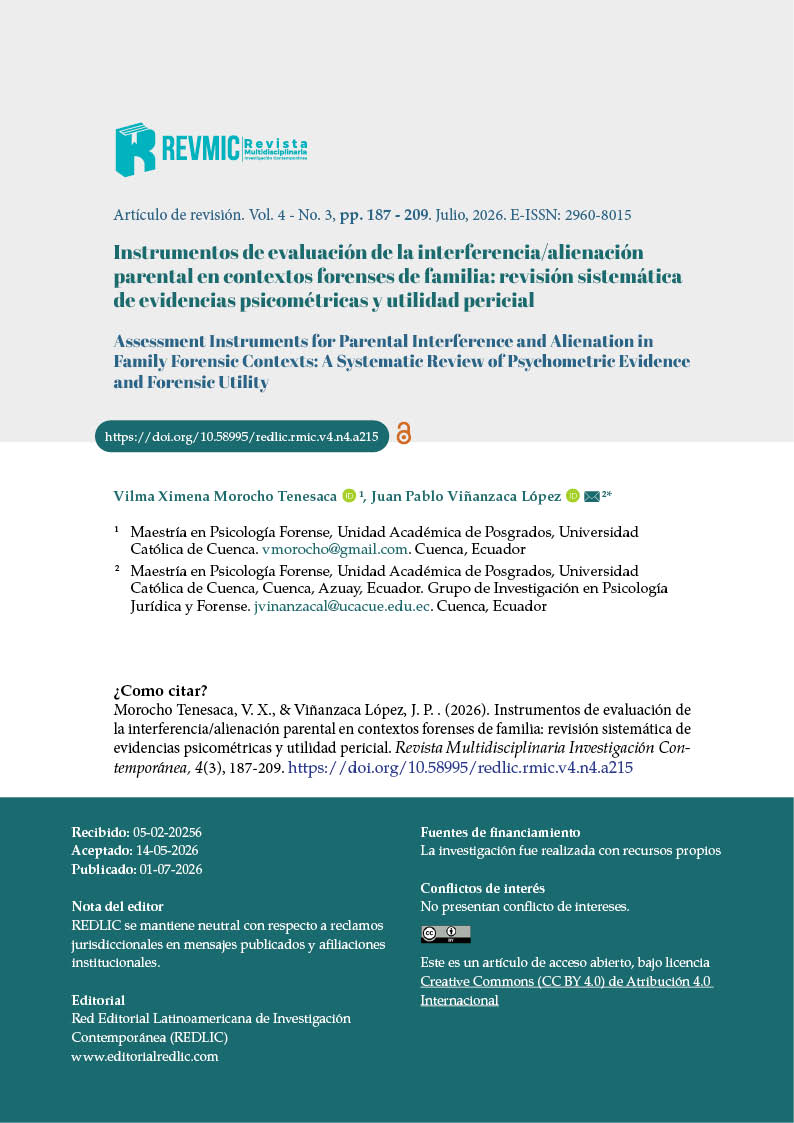
Assessment Instruments for Parental Interference and Alienation in Family Forensic Contexts: A Systematic Review of Psychometric Evidence and Forensic Utility
 Vilma Ximena Morocho Tenesaca
- Juan Pablo Viñanzaca López
Make a Submission
Plantillas

Redes sociales



Indexaciones, directorio y referencias










Keywords
estadisticas
Tendencias
| Nombre | 2026-01-01 — 2026-08-15 | Total |
|---|---|---|
| Envíos recibidos | 75 | 223(46/año) |
| Envíos aceptados | 33 | 128(46/año) |
| Envíos rechazados | 31 | 80(14/año) |
| Envíos rechazados (antes de revisión) | 22 | 61(11/año) |
| Envíos rechazados (después de revisión) | 9 | 19(4/año) |
| Envíos publicados | 36 | 125 (33/año) |
Developed By
ORCID

Visitantes
Visitantes
Latest publications


Browse
Abstract
Assessing parental interference or alienation represents a challenge in clinical and forensic settings due to limitations in available psychometric instruments and the conceptual heterogeneity of the construct, which hinders its application in judicial contexts. The aim of this study was to analyze standardized instruments used for its assessment and to synthesize evidence regarding their characteristics, applications, and measurement properties through a systematic review. The study followed PRISMA 2020 guidelines and the COSMIN framework to evaluate risk of bias and quality of evidence. The search was conducted in PubMed, Scopus, SciELO, APA PsycNet, and Redalyc, complemented by Google Scholar, covering publications from 2000 to 2026. A total of 2,807 records were identified in databases and 200 additional records through manual search. After screening, six studies (100%) were included, primarily involving Likert-type scales targeting adult populations, with a predominance of cross-sectional designs. Analyses mainly focused on internal consistency and structural validity, with limited assessment of temporal stability and criterion validity. Most studies were conducted in general populations, with scarce evidence in clinical-forensic contexts. Methodological quality was moderate, with limitations related to sample size and validation in judicial settings. In conclusion, the available instruments show preliminary psychometric evidence, highlighting the need to strengthen their validation in clinical-forensic contexts to support their use in forensic practice.
Downloads
References
- Armijos y Granizo-Haro, A. L. (2024). Alienación parental y derecho de visitas en el régimen jurídico ecuatoriano. Revista Latinoamericana de Derecho y Ciencias Sociales, 4(5), 112–129. https://doi.org/10.56712/latam.v4i5.1367 DOI: https://doi.org/10.56712/latam.v4i5.1367
- Arnett, J. J. (2008). The neglected 95%: Why American psychology needs to become less American. American Psychologist, 63(7), 602–614. https://doi.org/10.1037/0003-066X.63.7.602 DOI: https://doi.org/10.1037/0003-066X.63.7.602
- Badenes-Ribera, L., et al. (2024). Internal consistency and test–retest reliability: A reliability generalization meta-analysis of the Childhood Trauma Questionnaire–Short Form (CTQ-SF). Child Abuse & Neglect, 154, 106941. https://doi.org/10.1016/j.chiabu.2024.106941 DOI: https://doi.org/10.1016/j.chiabu.2024.106941
- Baker, A. J. L. (2020). Adult children of parental alienation syndrome: Breaking the ties that bind (2nd ed.). W. W. Norton & Company. https://books.google.com.ec/books?id=-AhklZTeuXEC&printsec=frontcover&hl=es#v=onepage&q&f=false
- Bernet, W., & Greenhill, L. L. (2022). The five-factor model for the diagnosis of parental alienation. Journal of the American Academy of Child & Adolescent Psychiatry, 61(5), 591–594. https://doi.org/10.1016/j.jaac.2021.11.026 DOI: https://doi.org/10.1016/j.jaac.2021.11.026
- Bernet, W., von Boch-Galhau, W., Baker, A. J. L., & Morrison, S. L. (2010). Parental alienation, DSM-V, and ICD-11. The American Journal of Family Therapy, 38(2), 76–187. https://doi.org/10.1080/01926180903586583 DOI: https://doi.org/10.1080/01926180903586583
- Byrne, B. M. (2016). Structural equation modeling with AMOS: Basic concepts, applications, and programming (3rd ed.). Routledge. https://www.researchgate.net/publication/361909378_Structural_Equation_Modeling_With_AMOS DOI: https://doi.org/10.4324/9781315757421
- Bornstein, M. H., Jager, J., & Putnick, D. L. (2013). Sampling in developmental science: Situations, shortcomings, solutions, and standards. Developmental Review, 33(4), 357–370. https://doi.org/10.1016/j.dr.2013.08.003 DOI: https://doi.org/10.1016/j.dr.2013.08.003
- Cabrera et al., (2023). Alienación parental y derecho de visitas en el régimen jurídico ecuatoriano. Revista de Derecho de Familia, 15(2), 85–102. https://doi.org/10.33386/593dp.2024.5.2576
- Castaño-Luisa. (2018). Síndrome de Alienación Parental ¿Realidad o ficción? Tesis de grado. Universidad de Cartagena. Colombia. https://repositorio.unicartagena.edu.co/server/api/core/bitstreams/5c83c015-caa2-4118-9dd9 612064c7b559
- De Vet, H. C. W., et al. (2011). Measurement in medicine: A practical guide. Cambridge University Press. https://api.pageplace.de/preview/DT0400.9781139142441_A23866524/preview-9781139142441_A23866524.pdf
- Fidler, B. J., & Bala, N. (2010). Children resisting post-separation contact with a parent: Concepts, controversies, and conundrums. Family Court Review, 48(1), 10–47. https://doi.org/10.1111/j.1744-1617.2009.01287.x DOI: https://doi.org/10.1111/j.1744-1617.2009.01287.x
- Finley, J.-C. A. (2024). Performance validity testing: The need for digital technology and where to go from here. Frontiers in Psychology, 15. https://doi.org/10.3389/fpsyg.2024.1452462 DOI: https://doi.org/10.3389/fpsyg.2024.1452462
- Gomide et al., (2024). Psychometric properties of the parental alienation scale (EAP). Paidéia, 34, e3412. https://doi.org/10.1590/1982-4327e3412 DOI: https://doi.org/10.1590/1982-4327e3430
- Harman, J. J., et al. (2018). Parental alienating behaviors: An unacknowledged form of family violence. Psychological Bulletin, 144(12), 1275–1299. https://doi.org/10.1037/bul0000175 DOI: https://doi.org/10.1037/bul0000175
- Harman, J. J., et.al. (2022). Losses experienced by children alienated from a parent. Current Opinion in Psychology, 43, 7–12. https://doi.org/10.1016/j.copsyc.2021.05.002 DOI: https://doi.org/10.1016/j.copsyc.2021.05.002
- Harman, J. J., et al. (2022). Developmental psychology and the scientific status of parental alienation. Developmental Psychology, 58(10), 1887–1911. https://doi.org/10.1037/dev0001404 DOI: https://doi.org/10.1037/dev0001404
- Heilbrun, K., et al. (2020). Forensic mental health assessment: A casebook (2nd ed.). Oxford University Press.
- Henrich, J., et al. (2010). The weirdest people in the world? Behavioral and Brain Sciences, 33(2–3), 61–83. https://doi.org/10.1017/S0140525X0999152X DOI: https://doi.org/10.1017/S0140525X0999152X
- Kline, P. (2015). A handbook of test construction: Introduction to psychometric design (2nd ed.). Routledge. https://api.pageplace.de/preview/DT0400.9781317444602_A25034282/preview-9781317444602_A25034282.pdf
- Kruk, E., & Harman, J. J. (2024). Parental alienation as a form of family violence: Current perspectives and future directions. Journal of Family Trauma, Child Custody & Child Development. DOI: 10.26536/EVMS9266 DOI: https://doi.org/10.26536/EVMS9266
- Lee-Maturana, S., et.al. (2025). Escala para evaluar alienación parental (AP) en padres y madres alienados: Construcción y validación. Liberabit, 31(1), e947. https://doi.org/10.24265/liberabit.2025.v31n1.947 DOI: https://doi.org/10.24265/liberabit.2025.v31n1.947
- Luby, A., et al. (2020). Psychometric analysis of forensic examiner behavior. Behaviormetrika, 47, 355–384. https://doi.org/10.1007/s41237-020-00116-6 DOI: https://doi.org/10.1007/s41237-020-00116-6
- Mair, P. (2018). Modern psychometrics with R. Springer. https://doi.org/10.1007/978-3-319-93177-7 DOI: https://doi.org/10.32614/CRAN.package.MPsychoR
- Meland, E., et al. (2024). Parental alienation – a valid experience? Scandinavian Journal of Public https://doi.org/10.1177/14034948231168978 DOI: https://doi.org/10.1177/14034948231168978
- Mena et al., (2024). Escala ZICAP II: Evaluación de alienación parental en niños de 9 a 15 años de padres separados en Chile. Ciencias Psicológicas, 15(1), 45–62. https://doi.org/10.22235/cp.v15i1.2159
- Moher, D., et al. (2009). Preferred reporting items for systematic reviews and meta-analyses: The PRISMA statement. PLoS Medicine, 6(7), e1000097. https://doi.org/10.1371/journal.pmed.1000097 DOI: https://doi.org/10.1371/journal.pmed.1000097
- Mokkink, L. B., et al. (2018). COSMIN methodology for systematic reviews of patient-reported outcome measures. Quality of Life Research, 27(5), 1171–1179. https://doi.org/10.1007/s11136-018-1798-3 DOI: https://doi.org/10.1007/s11136-017-1765-4
- Nielsen, L. (2017). Joint versus sole physical custody: Children’s outcomes independent of parent–child relationships, income, and conflict in 60 studies. Journal of Divorce & Remarriage, 59(4), 247–281. https://doi.org/10.1080/10502556.2018.1454204 DOI: https://doi.org/10.1080/10502556.2018.1454204
- Neal, T. M. S., & Grisso, T. (2014). Assessment practices and expert judgment methods in forensic psychology and psychiatry: An international snapshot. Criminal Justice and Behavior, 41(12), 1406–1421. https://doi.org/10.1177/0093854814548449 DOI: https://doi.org/10.1177/0093854814548449
- Neal, T. M. S., et al. (2019). The law meets psychological expertise: Eight best practices to improve forensic psychological assessment. Annual Review of Law and Social Science, 15, 451–470. https://doi.org/10.1146/annurev-lawsocsci-101518-042830
- Page, M. J., et al. (2021). The PRISMA 2020 statement: An updated guideline for reporting systematic reviews. BMJ, 372, n71. https://doi.org/10.1136/bmj.n71 DOI: https://doi.org/10.1136/bmj.n71
- Parkinson, P. (2018). Family law and the indissolubility of parenthood. Cambridge University Press.
- https://doi.org/10.1017/CBO9780511921063 DOI: https://doi.org/10.1017/CBO9780511921063
- Pérez-Agüero, M. C., & Andrade, P. (2013). Construcción y validación de un cuestionario de alienación parental en padres divorciados. Revista Interamericana de Psicología, 47(1), 17–24. https://www.redalyc.org/pdf/284/28426980003.pdf DOI: https://doi.org/10.30849/rip/ijp.v47i1.197
- Portilla-Saavedra, D., et al. (2021). Perspectivas y tendencias actuales del concepto de alienación parental: una revisión sistemática de la literatura. Terapia Psicológica, 39(2), 237–255. https://doi.org/10.4067/S0718-48082021000200237 DOI: https://doi.org/10.4067/s0718-48082021000200237
- Rowlands, G. A. (2019). Parental alienation: A measurement tool. Journal of Divorce & Remarriage, 60(1), 1–21. https://doi.org/10.1080/10502556.2018.1454201 DOI: https://doi.org/10.1080/10502556.2018.1546031
- Simons, D. J., Shoda, Y., & Lindsay, D. S. (2017). Constraints on generality (COG): A proposed addition to all empirical papers. Perspectives on Psychological Science, 12(6), 1123–1128. https://doi.org/10.1177/1745691617708630 DOI: https://doi.org/10.1177/1745691617708630
- Sîrbu, A. G., Vintilă, M., Tisu, L., Ștefănuț, A. M., Tudorel, O. I., Măguran, B., & Tomo, R. A. (2023). Parental alienation—Development and validation of a behavioral anchor scale. Sustainability, 15(1), 1–15. https://doi.org/10.3390/su15010015 DOI: https://doi.org/10.3390/su15010015
- Terwee, C. B., et al (2018). COSMIN methodology for evaluating the content validity of patient-reported outcome measures: A Delphi study. Quality of Life Research, 27(5), 1159–1170. https://doi.org/10.1007/s11136-018-1829-0 DOI: https://doi.org/10.1007/s11136-018-1829-0
- Van de Schoot, R., et al. (2012). A checklist for testing measurement invariance. European Journal of Developmental Psychology, 9(4), 486–492. https://doi.org/10.1080/17405629.2012.686740 DOI: https://doi.org/10.1080/17405629.2012.686740
- Van de Vijver, F. J. R., & Leung, K. (1997). Methods and data analysis for cross-cultural research. Sage. https://assets.cambridge.org/97811070/57791/frontmatter/9781107057791_frontmatter.pdf
- Zicavo, N., Rey-Clericus, R., & Ponce, L. (2021). Escala ZICAP II: Evaluación de alienación parental en niños de 9 a 15 años de padres separados en Chile. Ciencias Psicológicas, 15(1), e2159. https://doi.org/10.22235/cp.v15i1.2159 DOI: https://doi.org/10.22235/cp.v15i1.2159
Published 2026-07-01
Keywords
- scales,
- forensic assessment,
- psychometric properties,
- forensic psychology,
- child custody
- visitation rights ...More
Issue
Section
Copyright (c) 2026 Los autores que publiquen en la revista Multidisciplinaria Investigación Contemporánea aceptan los siguientes términos: 1. Los autores mantienen sus derechos de autor (copyright) y otorgan a la revista Multidisciplinaria Investigación Contemporánea el derecho de la primera publicación de su trabajo, bajo una licencia Creative Commons Attribution 4.0. Esta licencia permite que terceros utilicen el contenido publicado, siempre que se mencione la autoría y la primera publicación en esta revista. 2. Los autores pueden establecer acuerdos adicionales para la distribución no exclusiva de la versión publicada de su artículo en otros lugares, como repositorios institucionales, siempre y cuando se indique claramente que el trabajo fue publicado por primera vez en esta revista. 3. Los autores conservan sus derechos de autor (copyright) y garantizan a la revista Multidisciplinaria Investigación Contemporánea el derecho a publicar el manuscrito a través de los canales que considere apropiados. 4. Se permite y se recomienda a los autores compartir su trabajo en línea (por ejemplo, en repositorios institucionales o páginas web personales), una vez que el manuscrito haya sido aceptado para su publicación. Esto puede conducir a intercambios productivos y a una mayor y más rápida citación del trabajo publicado. Detalle de Licencia CC BY (https://creativecommons.org/licenses/by/4.0/) Usted es libre de: Compartir — copiar y redistribuir el material en cualquier medio o formato para cualquier propósito, incluso comercialmente. Adaptar — remezclar, transformar y construir a partir del material para cualquier propósito, incluso comercialmente. La licenciante no puede revocar estas libertades en tanto usted siga los términos de la licencia Bajo los siguientes términos: Atribución — Usted debe dar crédito de manera adecuada , brindar un enlace a la licencia, e indicar si se han realizado cambios . Puede hacerlo en cualquier forma razonable, pero no de forma tal que sugiera que usted o su uso tienen el apoyo de la licenciante. No hay restricciones adicionales — No puede aplicar términos legales ni medidas tecnológicas que restrinjan legalmente a otras a hacer cualquier uso permitido por la licencia.

This work is licensed under a Creative Commons Attribution 4.0 International License.
How to Cite