Ciencias de Salud- Artículo original
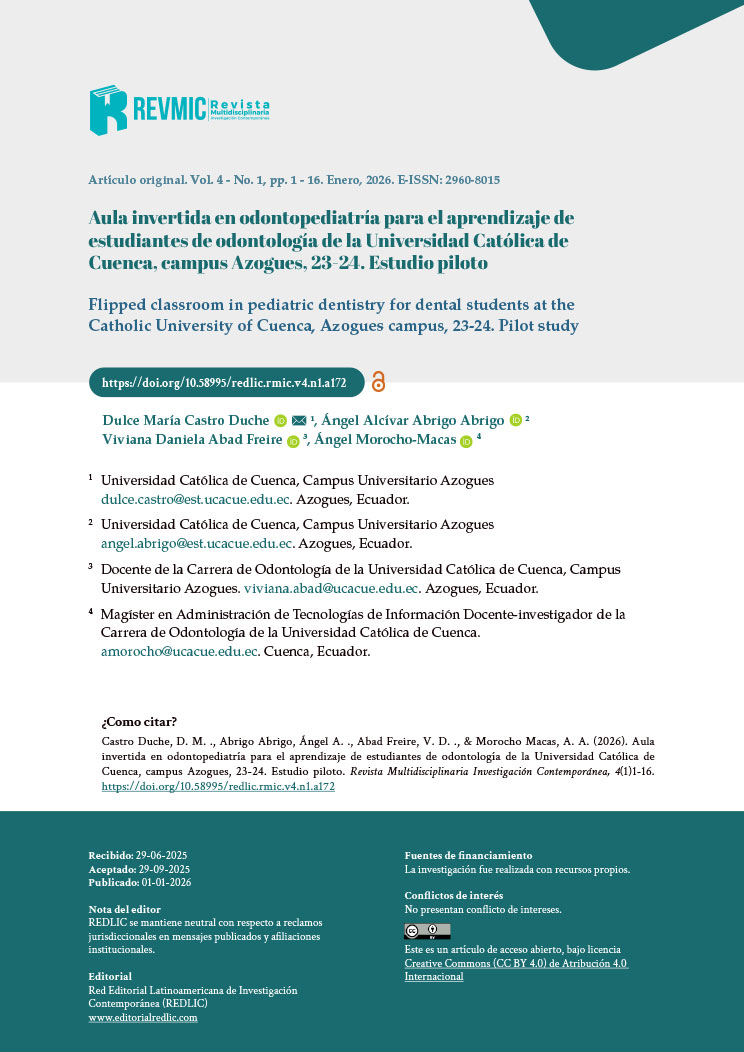
Aula invertida en odontopediatría para el aprendizaje de estudiantes de odontología de la Universidad Católica de Cuenca, campus Azogues, 23-24. Estudio piloto
Flipped classroom in pediatric dentistry for dental students at the Catholic University of Cuenca, Azogues campus, 23-24. Pilot study.
Resumen
El objetivo fue evaluar la efectividad de dos estrategias pedagógicas, la enseñanza tradicional y el modelo del aula invertida, en el proceso de enseñanza-aprendizaje de tratamientos pulpares en odontopediatría, a lo largo del periodo comprendido entre septiembre de 2023 y febrero de 2024. Participaron 21 estudiantes. Se empleó un diseño de investigación observacional y longitudinal, que incorporó cuestionarios administrados antes y después de las sesiones de instrucción. La cohorte experimental utilizó recursos digitales y utilizó una plataforma de aula virtual, mientras que la cohorte de control participó en clases magistrales tradicionales. Si bien ambos grupos mostraron variaciones en sus evaluaciones, no se determinaron diferencias estadísticamente significativas entre las metodologías pedagógicas (p>0.05). Se concluye que, en este contexto específico, el enfoque de clases invertidas no mejora el rendimiento académico; sin embargo, fomenta la autonomía y el aprendizaje activo. Es aconsejable realizar más investigaciones utilizando poblaciones de muestra más grandes y diversas.
The objective was to evaluate the effectiveness of two pedagogical strategies, traditional teaching and the flipped classroom model, in the teaching-learning process of pulp treatments in pediatric dentistry, during the period between September 2023 and February 2024. Twenty-one students participated. An observational and longitudinal research design was used, incorporating questionnaires administered before and after the instruction sessions. The experimental cohort used digital resources and a virtual classroom platform, while the control cohort participated in traditional lectures. Although both groups showed variations in their assessments, no statistically significant differences were found between the teaching methodologies (p>0.05). It is concluded that, in this specific context, the flipped classroom approach does not improve academic performance; however, it does promote autonomy and active learning. Further research using larger and more diverse sample populations is recommended.
Palabras clave
- Aula invertida
- Enseñanza tradicional
- Odontopediatría
- Estudaintes de odontología
Referencias
Vanka A, Vanka S, Wali O. Flipped classroom in dental education: a scoping review. Eur J Dent Educ. 2020;24(2):213–26. doi:10.1111/eje.12593
Mora-Olate ML. Educación como disciplina y como objeto de estudio: aportes para un debate. Desde el Sur. 2020;12(1):201–11. doi:10.21142/des-1201-2020-201
Prieto A, Barbarroja J, Álvarez S, Corell A. Eficacia del modelo de aula invertida (flipped classroom) en la enseñanza universitaria: una síntesis de las mejores evidencias. Rev Educ. 2020;391(1):149–80. doi:10.4438/1988-592X-RE-2020-391-458
van Alten DCD, Phielix C, Janssen J, Kester L. Effects of flipping the classroom on learning outcomes and satisfaction: a meta-analysis. Educ Res Rev. 2019;28:100281. doi:10.1016/j.edurev.2019.05.003
Gallardo NE, Caleya AM, Sánchez ME, Feijóo G. Learning of paediatric dentistry with the flipped classroom model. Eur J Dent Educ. 2022;26(2):302–9. doi:10.1111/eje.12689
Saravia-Rojas MÁ. Aula invertida utilizada en la enseñanza de la estomatología: una aproximación. Rev Estomatol Herediana. 2023;33(2):176–81. doi:10.20453/rev.est.hered.2023.33.2.3
Aguilera-Ruiz C, Manzano-León A, Martínez-Moreno I, Lozano-Segura MC, Casiano-Yanicelli C. El modelo flipped classroom. Rev INFAD Psicol. 2017;4(1):261–70. doi:10.17060/ijodaep.2017.n1.v4.1085
Morán L. Prácticas evaluativas en contextos de aula invertida y aprendizaje móvil. InnovEd. 2021;23(34):98–112. Disponible en: https://revistas.unc.edu.ar/index.php/innoved/article/view/34111
Sola Martínez T, Aznar Díaz I, Romero Rodríguez JM, Rodríguez-García AM. Eficacia del método flipped classroom en la universidad: meta-análisis de la producción científica de impacto. REICE Rev Iberoam Calid Efic Cambio Educ. 2018;17(1):25–41. doi:10.15366/reice2019.17.1.002
Abeysekera L, Dawson P. Motivation and cognitive load in the flipped classroom: definition, rationale and a call for research. High Educ Res Dev. 2015;34(1):1–14. doi:10.1080/07294360.2014.934336
Ortega Castro GA, Reascos Vallejo NC, Erazo Álvarez CA. Aula invertida como estrategia metodológica de enseñanza de semiología en la carrera de odontología. EX. 2022;6(3):73–90. doi:10.36582/ex-2022-3-1-73
Flipped classroom in restorative dentistry: a first test influenced by the COVID-19 pandemic. Oral Health Prev Dent. 2022;20(1):331–8. doi:10.3290/j.ohpd.b3267073
Chang JYF, Wang LH, Lin TC, Cheng FC, Chiang CP. Comparison of learning effectiveness between physical classroom and online learning for dental education during the COVID-19 pandemic. J Dent Sci. 2021;16(4):1281–9. doi:10.1016/j.jds.2021.06.006
Sezer B, Abay E. Looking at the impact of the flipped classroom model in medical education. Scand J Educ Res. 2019;63(6):853–68. doi:10.1080/00313831.2018.1479938
Chisini LA, Conde MCM, Alves AM, Costa FDS. Flipped classroom and the use of role-play in the COVID-19 pandemic: challenges and learning. Braz J Oral Sci. 2022;21:e225368. doi:10.20396/bjos.v21i00.8659956
Basitere M, Rzyankina E, Le Roux P. Reflection on experiences of first-year engineering students with blended flipped classroom online learning during the COVID-19 pandemic: a case study of the mathematics course in the extended curriculum program. Sustainability. 2023;15(6):5491. doi:10.3390/su15065491
Slaven CM, Wells MH, DeSchepper EJ, Dormois L, Vinall CV, Douglas K. Effectiveness of and dental student satisfaction with three teaching methods for behavior guidance techniques in pediatric dentistry. J Dent Educ. 2019;83(8):966–72. doi:10.21815/JDE.019.098
Hinojo Lucena FJ, Aznar Díaz I, Romero Rodríguez JM, Marín Marín JA. Influencia del aula invertida en el rendimiento académico: una revisión sistemática. Campus Virtuales. 2019;8(1):9–18. Disponible en: http://uajournals.com/ojs/index.php/campusvirtuales/article/view/414
Álvarez de Lugo AM. Aula invertida en odontología. Acta Odontol Venez. 2018;56(1):1–2. Disponible en: http://www.actaodontologica.com/ediciones/2018/1/art6.asp
Zheng L, Bhagat KK, Zhen Y, Zhang X. The effectiveness of the flipped classroom on students’ learning achievement and learning motivation: a meta-analysis. Educ Technol Soc. 2020;23(1):1–15. Disponible en: https://www.jstor.org/stable/26915403
Aguirre JVH. Aplicación del aula invertida (flipped classroom) en la formación académica del estudiante de educación universitaria. Rev Investig Educ. 2021;15(2):1–10. Disponible en: https://doi.org/10.13140/RG.2.2.14339.68646
Ledo MV, Michelena NR, Cao NN, Suárez RM, Vidal MNV. Aula invertida: nueva estrategia didáctica. Rev Educ Invest. 2020;10(1):1–8. Disponible en: https://doi.org/10.13140/RG.2.2.30146.84165
Elera Castillo RS, Mera Rodas A, Montenegro Fernández MY, Gonzáles Soto VA. Revisión del impacto del aula invertida como estrategia de aprendizaje. Rev Cient UCSA. 2023;10(2):123–37. doi:10.18004/ucsa/2409-8752/2023.010.002.123
Ventosilla Sosa DN, Santa María Relaiza HR, Ostos De La Cruz F, Flores Tito AM. Aula invertida como herramienta para el logro de aprendizaje autónomo en estudiantes universitarios. Psicol Realid. 2021;9(1):1–10. Disponible en: https://revistas.usil.edu.pe/index.php/pyr/article/view/1043
The impact of flipped learning in surgical education: a mixed-method study. Knowl Manag E-Learn Int J. 2021;13(3):273–89. doi:10.34105/j.kmel.2021.13.015
Barranquero-Herbosa M, Abajas-Bustillo R, Ortego-Maté C. Effectiveness of flipped classroom in nursing education: a systematic review of systematic and integrative reviews. Int J Nurs Stud. 2022;135:104327. doi:10.1016/j.ijnurstu.2022.104327
Binnie RSL, Bonsor SJ. The implementation of a flipped classroom approach at a UK dental school. Br Dent J. 2021;231(7):405–8. doi:10.1038/s41415-021-3478-0
Gadbury-Amyot CC, Redford GJ, Bohaty BS. Dental students’ study habits in flipped/blended classrooms and their association with active learning practices. J Dent Educ. 2017;81(12):1430–5. doi:10.21815/JDE.017.096
Chutinan S, Riedy CA, Park SE. Student performance in a flipped classroom dental anatomy course. Eur J Dent Educ. 2018;22(3):e343–9. doi:10.1111/eje.12300
Chuang HH, Weng CY, Chen CH. Which students benefit most from a flipped classroom approach to language learning? Br J Educ Technol. 2018;49(1):56–68. doi:10.1111/bjet.12530
Publicado
Historial
- Recibido
- 10 oct 2025
- Publicado
- 1 ene 2026
Métricas
126 descargas
últimos 7 meses
Número
Sección
Cómo citar
Licencia
Derechos de autor 2026 Los autores que publiquen en la revista Multidisciplinaria Investigación Contemporánea aceptan los siguientes términos: 1. Los autores mantienen sus derechos de autor (copyright) y otorgan a la revista Multidisciplinaria Investigación Contemporánea el derecho de la primera publicación de su trabajo, bajo una licencia Creative Commons Attribution 4.0. Esta licencia permite que terceros utilicen el contenido publicado, siempre que se mencione la autoría y la primera publicación en esta revista. 2. Los autores pueden establecer acuerdos adicionales para la distribución no exclusiva de la versión publicada de su artículo en otros lugares, como repositorios institucionales, siempre y cuando se indique claramente que el trabajo fue publicado por primera vez en esta revista. 3. Los autores conservan sus derechos de autor (copyright) y garantizan a la revista Multidisciplinaria Investigación Contemporánea el derecho a publicar el manuscrito a través de los canales que considere apropiados. 4. Se permite y se recomienda a los autores compartir su trabajo en línea (por ejemplo, en repositorios institucionales o páginas web personales), una vez que el manuscrito haya sido aceptado para su publicación. Esto puede conducir a intercambios productivos y a una mayor y más rápida citación del trabajo publicado. Detalle de Licencia CC BY (https://creativecommons.org/licenses/by/4.0/) Usted es libre de: Compartir — copiar y redistribuir el material en cualquier medio o formato para cualquier propósito, incluso comercialmente. Adaptar — remezclar, transformar y construir a partir del material para cualquier propósito, incluso comercialmente. La licenciante no puede revocar estas libertades en tanto usted siga los términos de la licencia Bajo los siguientes términos: Atribución — Usted debe dar crédito de manera adecuada , brindar un enlace a la licencia, e indicar si se han realizado cambios . Puede hacerlo en cualquier forma razonable, pero no de forma tal que sugiera que usted o su uso tienen el apoyo de la licenciante. No hay restricciones adicionales — No puede aplicar términos legales ni medidas tecnológicas que restrinjan legalmente a otras a hacer cualquier uso permitido por la licencia.

Esta obra está bajo una licencia internacional Creative Commons Atribución 4.0.
Los autores que publiquen en la revista Multidisciplinaria Investigación Contemporánea aceptan los siguientes términos:
- Los autores mantienen sus derechos de autor (copyright) y otorgan a la revista Multidisciplinaria Investigación Contemporánea el derecho de la primera publicación de su trabajo, bajo una licencia Creative Commons Attribution 4.0. Esta licencia permite que terceros utilicen el contenido publicado, siempre que se mencione la autoría y la primera publicación en esta revista.
- Los autores pueden establecer acuerdos adicionales para la distribución no exclusiva de la versión publicada de su artículo en otros lugares, como repositorios institucionales, siempre y cuando se indique claramente que el trabajo fue publicado por primera vez en esta revista.
- Los autores conservan sus derechos de autor (copyright) y garantizan a la revista Multidisciplinaria Investigación Contemporánea el derecho a publicar el manuscrito a través de los canales que considere apropiados.
- Se permite y se recomienda a los autores compartir su trabajo en línea (por ejemplo, en repositorios institucionales o páginas web personales), una vez que el manuscrito haya sido aceptado para su publicación. Esto puede conducir a intercambios productivos y a una mayor y más rápida citación del trabajo publicado.
Detalle de Licencia CC BY (https://creativecommons.org/licenses/by/4.0/)
Usted es libre de:
- Compartir — copiar y redistribuir el material en cualquier medio o formato para cualquier propósito, incluso comercialmente.
- Adaptar — remezclar, transformar y construir a partir del material para cualquier propósito, incluso comercialmente.
- La licenciante no puede revocar estas libertades en tanto usted siga los términos de la licencia
Bajo los siguientes términos:
- Atribución — Usted debe dar crédito de manera adecuada , brindar un enlace a la licencia, e indicar si se han realizado cambios . Puede hacerlo en cualquier forma razonable, pero no de forma tal que sugiera que usted o su uso tienen el apoyo de la licenciante.
- No hay restricciones adicionales — No puede aplicar términos legales ni medidas tecnológicas que restrinjan legalmente a otras a hacer cualquier uso permitido por la licencia.