
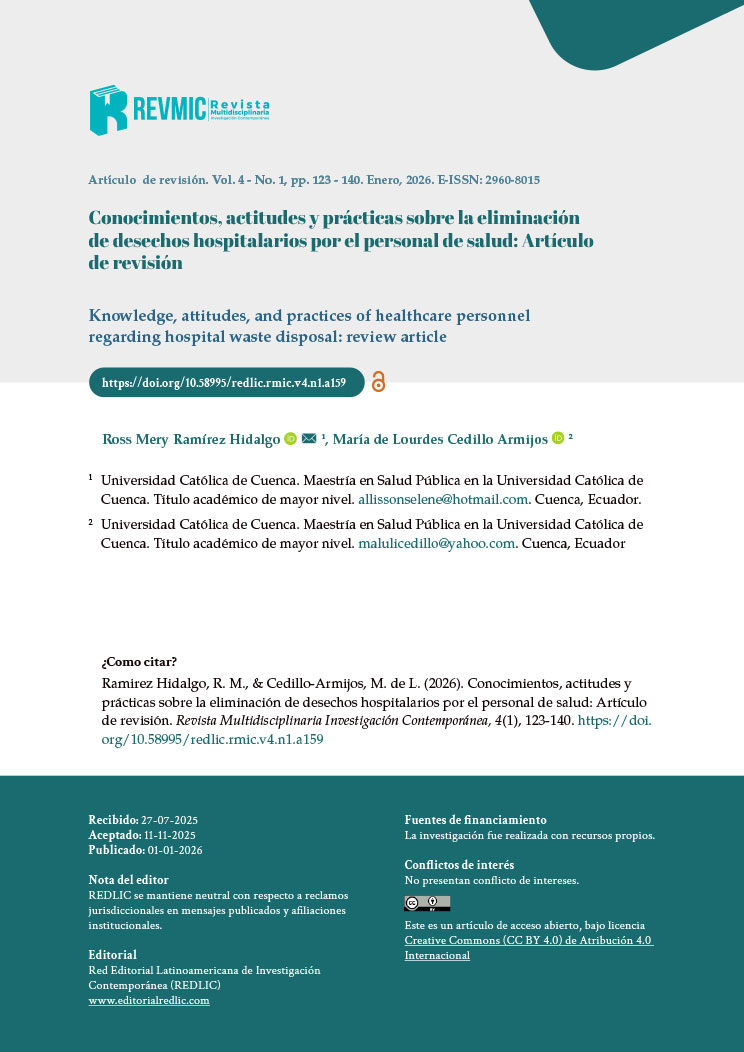
Knowledge, attitudes, and practices of healthcare personnelregarding hospital waste disposal: review article
 Ross Mery Ramirez Hidalgo
- María de Lourdes Cedillo-Armijos
Make a Submission
Plantillas

Redes sociales



Indexaciones, directorio y referencias








Keywords
estadisticas
Tendencias
| Nombre | 2026-01-01 — 2026-08-15 | Total |
|---|---|---|
| Envíos recibidos | 75 | 223(46/año) |
| Envíos aceptados | 33 | 128(46/año) |
| Envíos rechazados | 31 | 80(14/año) |
| Envíos rechazados (antes de revisión) | 22 | 61(11/año) |
| Envíos rechazados (después de revisión) | 9 | 19(4/año) |
| Envíos publicados | 36 | 125 (33/año) |
Developed By
ORCID

Visitantes
Visitantes
Latest publications


Browse
Abstract
The central problem addressed by this research is the deficient management of hazardous healthcare waste, which constitutes a highly critical microbial reservoir that represents a substantial threat to public health, both within the hospital environment and in the community. In this context, the objective of this study is to analyze, through a literature review, the current state of knowledge, attitudes, and practices of health personnel regarding the management of such hospital waste. Information sources included scientific databases such as PubMed, SciELO, Redalyc, Springer, ProQuest, Medigraphic, Google Scholar, as well as documents from the World Health Organization (WHO), the National Institute of Statistics and Census (INEC), and the Ministry of Public Health (MSP). Only articles published in the last five years that were included in indexed scientific journals and met the established methodological criteria were considered, excluding those that did not meet these conditions. The findings lead us to conclude that strict adherence to established protocols for the safe disposal of healthcare waste is essential, with the primary goal of reducing workplace injuries and preventing further illnesses that could compromise the well-being of healthcare workers.
Downloads
References
- Adler-Milstein, J., & Nong, P. (2019). Early experiences with patient generated health data: health system and patient perspectives. Journal of the American Medical Informatics Association, 26(10), 952-959. DOI: https://doi.org/10.1093/jamia/ocz045
- Akni, A., & Chaib, R. (2020). Hospital waste: Effects on public health and the environment. Revue d'Etudes et de Recherches sur les Sytèmes de Santé et l'Environnement, 3(1), 1-13. DOI: https://doi.org/10.1504/IJEWM.2020.109164
- Ali, M., Wang, W., Chaudhry, N., & Geng, Y. (2017). Hospital waste management in developing countries: A mini review. Waste Management & Research, 35(6), 581-592. https://doi.org/10.1177/0734242X17691344 DOI: https://doi.org/10.1177/0734242X17691344
- Chisholm, J. M., Zamxaka, M., Dzingwa, T., Musee, N., & Sikhwivhilu, K. (2021). Sustainability aspects in medical waste management in Africa: Resilient solutions for health and environmental protection. Environmental Science and Pollution Research, 28, 46685–46697. https://doi.org/10.1007/s11356-021-15555-5
- Eren, B. E., & Tuzkaya, G. (2019). Safety assessment in medical waste management by a new hesitant fuzzy AHP-based approach: a case study from Istanbul [Evaluación de la seguridad en la gestión de residuos médicos mediante un nuevo enfoque basado en AHP difuso dubitativo: un estudio de caso de Estambul]. Safety Science, 118, 452-463. https://doi.org/10.1016/j.ssci.2019.05.050 DOI: https://doi.org/10.1016/j.ssci.2019.05.050
- Ferdowsi, A., Ferdosi, M., & Mehrani, M. J. (2010). Incineration or autoclave? A comparative study in the hospital waste management system of Isfahan City, Iran. Iranian Journal of Environmental Health Science & Engineering, 7(4), 327-334.
- Ferronato, N., Ragazzi, M., Gorritty Portillo, M. A., & Torretta, V. (2020). Healthcare waste management in developing cities: An application of indicators in La Paz, Bolivia. Waste Management & Research, 38(8), 902-913. https://doi.org/10.1177/0734242X20919102 DOI: https://doi.org/10.1177/0734242X19883690
- Fitria, N., Damanhuri, E., & Salami, I. R. (2018). Evaluation of Hospital Infectious Waste Management in Bandung City, Indonesia [Evaluación de la gestión de residuos infecciosos hospitalarios en la ciudad de Bandung, Indonesia]. Journal of Environmental and Public Health, 2018, 4860596. https://doi.org/10.1155/2018/4860596 DOI: https://doi.org/10.1088/1755-1315/160/1/012012
- Ghali, C., Ben Fredj, S., Ben Othman, A., Chaari, N., Sakly, A., Ghedira, K., & Cheikhrouhou, F. (2023). Impacts sur la santé et l’environnement de la mauvaise gestion des déchets d’activités de soins: une revue systématique de la littérature [Impacts on health and the environment of poor management of healthcare waste: a systematic review of the literature]. La Tunisie Médicale, 101(2), 101-111.
- Hameed, K., Riaz, O., Nasar-u-Minallah, M., & Munawar, H. (2017). Hospital waste generation rates and its management in different hospitals of Faisalabad, Pakistan. Journal of Ayub Medical College, Abbottabad, 29(3), 495-499.
- Heredia, S., Gavilanes, A., & Heredia, F. (2020). Manejo integral de residuos hospitalarios peligrosos –“caso de estudio Padre Alberto Bufonni, Ecuador”. Perfiles, 1(24), 37-46. DOI: https://doi.org/10.47187/perf.v1i24.77
- INEC. (2023). Módulo de Desechos Sanitarios en Establecimientos de Salud (Boletín Técnico). Instituto Nacional de Estadística y Censos. https://www.ecuadorencifras.gob.ec/documentos/web-inec/Encuestas_Ambientales/Establecimientos_Salud-Residuos_Peligrosos/2020/20231025_Documento_tecnico_RAS_2020_VF_RCB_03.pdf
- Janik-Karpinska, E., Brancaleoni, R., Niemcewicz, M., Wojtas, W., Foco, M., Podogrocki, M., et al. (2023). Healthcare Waste—A Serious Problem for Global Health. Healthcare, 11(2), 242. DOI: https://doi.org/10.3390/healthcare11020242
- Johnson, K. M., González, M. L., Dueñas, L., Gamero, M., Relyea, G., Luque, L. E., et al. (2013). Improving waste segregation while reducing costs in a tertiary-care hospital in a lower–middle-income country in Central America. Waste Management & Research, 31(7), 733-738. DOI: https://doi.org/10.1177/0734242X13484192
- Kenny, J., & Priyadarshini, R. (2021). A review on the methods of disposal of sanitary waste: Environmental & public health impacts. International Journal of Environment and Waste Management, 28(1), 1-19. https://doi.org/10.1504/IJEWM.2021.115206
- Kheirabadi, S., & Sheikhi, A. (2022). Recent advances and challenges in recycling and reusing biomedical materials. Current Opinion in Green and Sustainable Chemistry, 38, 100695. DOI: https://doi.org/10.1016/j.cogsc.2022.100695
- Kheirabadi, S., & Sheikhi, A. (2023a). Application of analytical hierarchy process (AHP) to evaluate safety in medical waste management. MethodsX, 10, 102142. https://doi.org/10.1016/j.mex.2023.102142 DOI: https://doi.org/10.1016/j.mex.2023.102142
- Kheirabadi, S., & Sheikhi, A. (2023b). Management and recycling of post-COVID-19 medical waste: a focus on chemical and mechanical approaches [Gestión y reciclaje de residuos médicos post-COVID-19: un enfoque en los abordajes químicos y mecánicos]. Environmental Science and Pollution Research, 30, 65634–65646. https://doi.org/10.1007/s11356-023-26792-x DOI: https://doi.org/10.1007/s11356-023-26792-x
- Lattanzio, S., Gabrielli, E., Pazzi, M., Perna, F., Grilli, A., & Di Buono, M. (2022). Waste management and the perspective of a green hospital: a systematic narrative review [Gestión de residuos y la perspectiva de un hospital verde: una revisión narrativa sistemática]. Annali di Igiene: Medicina Preventiva e di Comunità, 34(5), 527-543. https://doi.org/10.7416/ai.2022.2514
- Lestari, F., Ayuningsih, S., & Fitria, N. (2023). Hospital Infectious Waste (HIW) Management in Bandung Region: Evaluation of Compliance and Risks. International Journal of Public Health Science (IJPHS), 12(1), 133-140. http://doi.org/10.11591/ijphs.v12i1.21985
- Ministerio de Salud Pública. (2019). Gestión interna de los residuos y desechos generados en los establecimientos de salud. Dirección Nacional de Normatización. http://salud.gob.ec
- Mushtaq, M. H., Noor, F., Mujtaba, M. A., Asghar, S., Yusuf, A. A., Soudagar, M. E. M., et al. (2022). Environmental Performance of Alternative Hospital Waste Management Strategies Using Life Cycle Assessment (LCA) Approach. Sustainability, 14(22), 14942. DOI: https://doi.org/10.3390/su142214942
- OMS. (2024). Desechos de la atención de salud. Organización Mundial de la Salud. www.who.int/es/news-room/fact-sheets/detail/health-care-waste
- OMS/UNICEF. (2023). WASH in health care facilities 2023 data update: special focus on primary health care. Organización Mundial de la Salud. https://washdata.org/reports
- Tesfahun, E., Kumie, A., & Beyene, A. (2016). Developing models for the prediction of hospital healthcare waste generation rate. Waste Management & Research, 34(1), 75-80. DOI: https://doi.org/10.1177/0734242X15607422
- Yang, T., Chu, S., Hu, M., Zhang, H., Ren, Q., & Wang, J. (2023). Medical waste management in pandemics: A review of emerging technologies for safe and secure disposal. Waste Management, 168, 224-239. https://doi.org/10.1016/j.wasman.2023.06.027 DOI: https://doi.org/10.1016/j.wasman.2023.06.027
- Zamparas, M., Kapsalis, V. C., Kyriakopoulos, G. L., Aravossis, K. G., Kanteraki, A. E., Vantarakis, A., et al. (2019). Medical waste management and environmental assessment in the Rio University Hospital, Western Greece. Sustainable Chemistry and Pharmacy, 13, 100163. DOI: https://doi.org/10.1016/j.scp.2019.100163
Published 2026-01-01
Keywords
- sanitary waste,
- waste disposal,
- pollution
Issue
Section
Copyright (c) 2026 Los autores que publiquen en la revista Multidisciplinaria Investigación Contemporánea aceptan los siguientes términos: 1. Los autores mantienen sus derechos de autor (copyright) y otorgan a la revista Multidisciplinaria Investigación Contemporánea el derecho de la primera publicación de su trabajo, bajo una licencia Creative Commons Attribution 4.0. Esta licencia permite que terceros utilicen el contenido publicado, siempre que se mencione la autoría y la primera publicación en esta revista. 2. Los autores pueden establecer acuerdos adicionales para la distribución no exclusiva de la versión publicada de su artículo en otros lugares, como repositorios institucionales, siempre y cuando se indique claramente que el trabajo fue publicado por primera vez en esta revista. 3. Los autores conservan sus derechos de autor (copyright) y garantizan a la revista Multidisciplinaria Investigación Contemporánea el derecho a publicar el manuscrito a través de los canales que considere apropiados. 4. Se permite y se recomienda a los autores compartir su trabajo en línea (por ejemplo, en repositorios institucionales o páginas web personales), una vez que el manuscrito haya sido aceptado para su publicación. Esto puede conducir a intercambios productivos y a una mayor y más rápida citación del trabajo publicado. Detalle de Licencia CC BY (https://creativecommons.org/licenses/by/4.0/) Usted es libre de: Compartir — copiar y redistribuir el material en cualquier medio o formato para cualquier propósito, incluso comercialmente. Adaptar — remezclar, transformar y construir a partir del material para cualquier propósito, incluso comercialmente. La licenciante no puede revocar estas libertades en tanto usted siga los términos de la licencia Bajo los siguientes términos: Atribución — Usted debe dar crédito de manera adecuada , brindar un enlace a la licencia, e indicar si se han realizado cambios . Puede hacerlo en cualquier forma razonable, pero no de forma tal que sugiera que usted o su uso tienen el apoyo de la licenciante. No hay restricciones adicionales — No puede aplicar términos legales ni medidas tecnológicas que restrinjan legalmente a otras a hacer cualquier uso permitido por la licencia.

This work is licensed under a Creative Commons Attribution 4.0 International License.
How to Cite