Ciencias Sociales- Artículo original
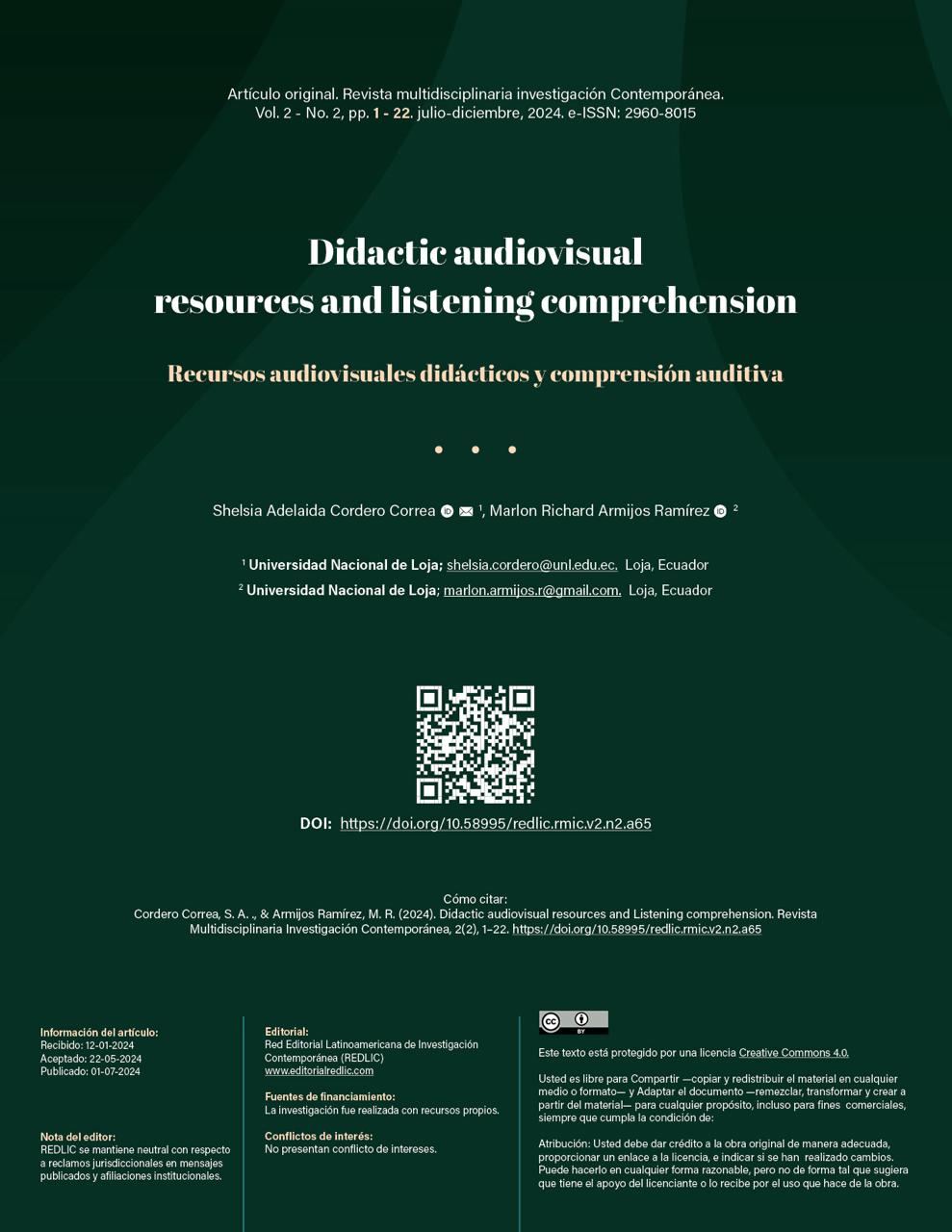
Didactic audiovisual resources and Listening comprehension Recursos audiovisuales didácticos y comprensión auditiva
Didactic audiovisual resources and Listening comprehension
Download
Abstract
Es bien sabido que la habilidad de escuchar es tanto o más importante que la de hablar, ya que una no funciona sin la otra, pues hablar por hablar no tiene ningún mérito si lo que decimos no es recibido por otra persona. El objetivo central de este estudio es mejorar la comprensión auditiva a través de recursos audiovisuales didácticos como videos musicales y audiolibros. Este estudio empleó un enfoque de investigación acción mixta para recopilar datos tanto cuantitativos como cualitativos en estudiantes de educación básica superior de una institución pública en Loja mediante el uso de algunos instrumentos como un pre-test, un post-test y notas de campo. Los datos se analizaron mediante estadística descriptiva. Así, se utilizó un análisis descriptivo para interpretar los resultados del pre-test y post-test, así como un análisis temático para interpretar la información recogida a través de las notas de campo. De este modo, tras la implementación de los recursos audiovisuales, se evidenció un incremento destacado en la comprensión auditiva de los estudiantes, que pasó del 57% al 82%. De igual modo, los resultados indicaron que los estudiantes experimentaron mayor motivación, participación y mejoraron sus sub-habilidades de comprensión auditiva (escuchar para predecir, escuchar para captar lo esencial y escuchar para captar información específica) durante la aplicación de los recursos audiovisuales.
It is well known that the ability of listening is as important if not more important than speaking, because an effective communication requires both components to work harmoniously. Since one does not work without the other, speaking has no merit if what we say is not received by another person. The central objective of this study is to improve listening comprehension through the use of didactic audiovisual resources such as music videos and audiobooks. This study employed a mixed action research approach to collect both quantitative and qualitative data with high school students of a public institution in Loja. The instruments used were a pre-test, a post-test and field notes, and the data were analyzed by using descriptive statistics. A descriptive analysis was used to interpret the results of the pre-test and post-test, as well as a thematic analysis to interpret the information collected through the field notes. Through this, after the implementation of the audiovisual resources, there was an outstanding increase in the students' listening comprehension, which went from 57% to 82%. Similarly, the results indicated that the students experienced more motivation, participation and improved their listening sub-skills such as, listening for predicting, listening for gist and listening for specific information with the use of audiovisual resources.
Keywords
- audiovisual resources
- listening comprehension
- english language learning
- skills
References
Azorin, J. (2016). Mixed methods research: An opportunity to improve our studies and our research skills. European Journal of Management and Business Economics, Vol. 25. Issue 2. Pages 37-38. Obtained from https://lc.cx/jtdU7r
Castellano García, C. (2021). Listening Comprehension in the Teaching-Learning Process of English. {Master's Thesis. Universidad de La Laguna}. Obtained from http://riull.ull.es/xmlui/handle/915/27514
Carlsson, S. E. (2023). Audiovisual poetry or Commercial Salad of Images? FilmSound.org. Carolina, S. G. (June 22, 2021). Obtained from https://repositorio.upse.edu.ec/handle/46000/6334
Collaguazo Vega, W. P. (2021). Audiovisual didactic resources to boost a1 students’ discriminative listening skills. {Master in Pedagogy, Pontificia Universidad Católica del Ecuador}. Obtained from https://n9.cl/8vlrr
Conde, E. (2019). El uso de medios audiovisuales para fortalecer el aprendizaje significativo de los niños de 5 años de la unidad educativa TCRN. Lauro Guerrero, de la ciudad de Loja, periodo 2018-2019. Universidad Nacional de Loja, Loja, Ecuador. Obtained from https://n9.cl/1e2m7
Chamorro Ortega, C. P. (2020). What linguistic ability is more complex to teach in the classroom of English. Ciencias de la Educación, Vol. 6, No. 2. Pages 302-318. Obtained from https://dialnet.unirioja.es/descarga/articulo/7491394.pdf
Fisabilhaq, I. (2021). Improving students’ listening comprehension in procedure text through youtube. {Undergraduate Thesis, LAMPUNG UNIVERSITY}.
Fajry, K., Komariah, E., & Maya, T. (2016). Audio Book: Teaching Listening Comprehension. {Research in English and Education, Syiah Kuala University}. Obtained from https://jim.usk.ac.id/READ/article/view/717
Hâf, F. (June 09, 2020). The Importance of Music Videos. Redbrick. Obtained from Redbrick.
Hardiah, M. (September, 2019). Improving Students Listening Skill by Using Audio Visual Media. Al-Lughah: Jurnal Bahasa, 7, 41. Obtained from https://lc.cx/9bl1Jj
Lankapalli, R. (May 22, 2023). LIS EDUCATION NETWORK. Obtained from Library & Information Science Academic Blog: https://www.lisedunetwork.com/characteristicsand-advantages-of-audio-visual-aids/
Morán Salazar, A. E. (2017). The importance of using audiovisual resources in the teaching of the English language. bachelorThesis. Obtained from http://repositorio.ug.edu.ec/handle/redug/47714
Olszańska, M., & Sekścińska, I. (2018). The importance of audiobooks in English language teaching. {Lomza State University of Applied Sciences}. DOI: https://doi.org/10.34668/PJAS.2018.4.4.04
Ramirez, J. E., & Alvarez, D. F. (2016). Implementation of visual aids on students’ listening comprehension activities. {Degree project, Universidad tecnológica de Pereira}. Obtained from https://hdl.handle.net/11059/6507
Santander, E. R. (January 30, 2018). Incidencia de los medios audiovisuales en el proceso de aprendizaje del inglés. Obtained from
http://hdl.handle.net/11323/38
Syarifah Intan, S. B. (July 13, 2022). ENGLISH EDUCATION JOURNAL. Retrieved May 24, 2023. Obtained from https://doi.org/10.24815/eej.v13i2.25932
Sya’ya, N. W. (2021). The Effectiveness of Students’ Listening Skill by Using Podcasts at The Second Grade of SMK Negeri 6 Balikpapan. Borneo Journal of Language and Education, Vol 1 No 1. DOI: https://doi.org/10.21093/benjole.v1i1.3134
Thuy, D. T. (2021). The effects of Audiovisual Media on Students’ Listening Skills. International Journal of TESOL & Education, 13-21. Obtained from https://i-jte.org/index.php/journal/article/view/3
Vetricia, E. (2022). Dailymotion Application as Teaching Media to Increase Students' Listening Skill. {Thesis, UNIVERSITAS BOSOWA MAKASSAR}. Obtained from https://lc.cx/ubwKIc
Westover, J. H. (August 17, 2020). Forbes. Obtained from Council Post: https://www.forbes.com/sites/forbescoachescouncil/2020/08/17/the-power-of-listening/
Yamaguchi, K. (2020). The influence of audiovisual materials on listening comprehension skills in learning Japanese as a foreign language. {Masters Theses, University of Massachusetts Amherst}. Obtained from https://lc.cx/d3vXLu
Download
Published
History
- Received
- 12 Mar 2024
- Accepted
- 22 May 2024
- Published
- 1 Jul 2024
Metrics
534 downloads
last 7 months
Issue
Section
How to Cite
License
Copyright (c) 2024 Shelsia Adelaida Cordero Correa, Marlon Richard Armijos Ramírez

This work is licensed under a Creative Commons Attribution 4.0 International License.
Los autores que publiquen en la revista Multidisciplinaria Investigación Contemporánea aceptan los siguientes términos:
- Los autores mantienen sus derechos de autor (copyright) y otorgan a la revista Multidisciplinaria Investigación Contemporánea el derecho de la primera publicación de su trabajo, bajo una licencia Creative Commons Attribution 4.0. Esta licencia permite que terceros utilicen el contenido publicado, siempre que se mencione la autoría y la primera publicación en esta revista.
- Los autores pueden establecer acuerdos adicionales para la distribución no exclusiva de la versión publicada de su artículo en otros lugares, como repositorios institucionales, siempre y cuando se indique claramente que el trabajo fue publicado por primera vez en esta revista.
- Los autores conservan sus derechos de autor (copyright) y garantizan a la revista Multidisciplinaria Investigación Contemporánea el derecho a publicar el manuscrito a través de los canales que considere apropiados.
- Se permite y se recomienda a los autores compartir su trabajo en línea (por ejemplo, en repositorios institucionales o páginas web personales), una vez que el manuscrito haya sido aceptado para su publicación. Esto puede conducir a intercambios productivos y a una mayor y más rápida citación del trabajo publicado.
Detalle de Licencia CC BY (https://creativecommons.org/licenses/by/4.0/)
Usted es libre de:
- Compartir — copiar y redistribuir el material en cualquier medio o formato para cualquier propósito, incluso comercialmente.
- Adaptar — remezclar, transformar y construir a partir del material para cualquier propósito, incluso comercialmente.
- La licenciante no puede revocar estas libertades en tanto usted siga los términos de la licencia
Bajo los siguientes términos:
- Atribución — Usted debe dar crédito de manera adecuada , brindar un enlace a la licencia, e indicar si se han realizado cambios . Puede hacerlo en cualquier forma razonable, pero no de forma tal que sugiera que usted o su uso tienen el apoyo de la licenciante.
- No hay restricciones adicionales — No puede aplicar términos legales ni medidas tecnológicas que restrinjan legalmente a otras a hacer cualquier uso permitido por la licencia.