Ciencias Sociales- Artículo de Revisión
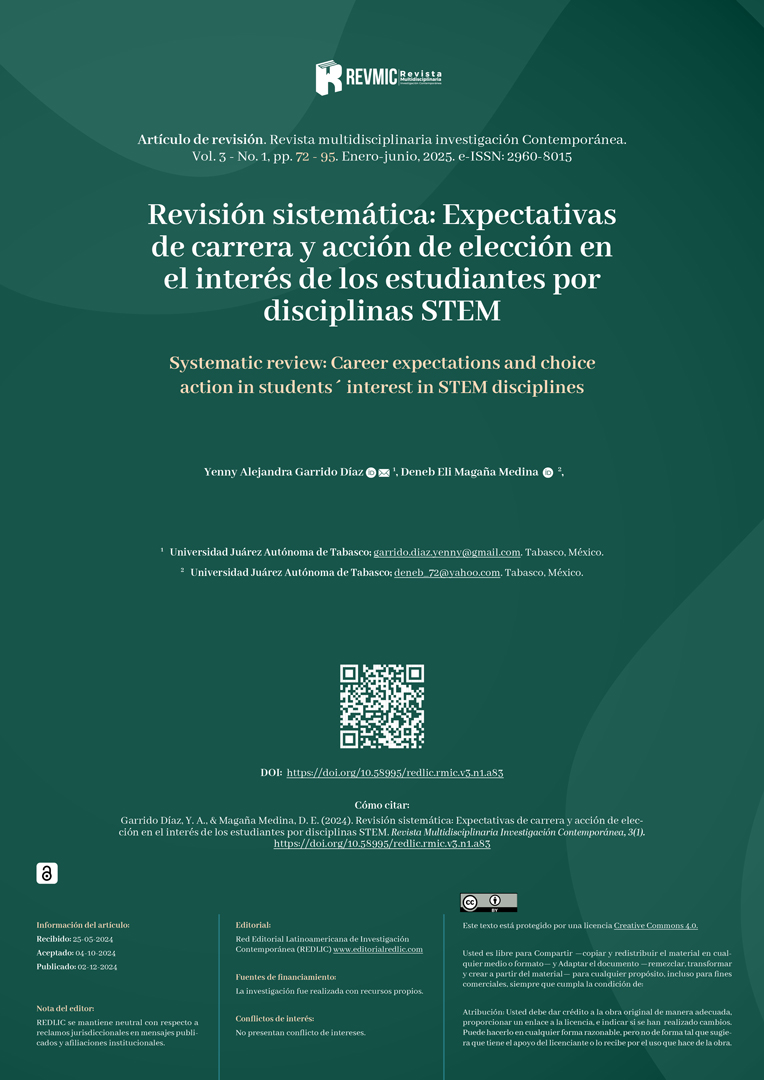
Revisión sistemática: Expectativas de carrera y acción de elección en el interés de los estudiantes por disciplinas STEM
Systematic review: Career expectations and choice action in students´ interest in STEM disciplines
Resumen
La elección de carrera es un proceso complejo influenciado por diversos factores, entre los que destacan las expectativas sobre el futuro profesional. Históricamente se ha encontrado que las disciplinas STEM tienen una subrepresentación en comparación con otras, así mismo se ha notado que del porcentaje de estudiantes que eligen estas disciplinas la mayoría son hombres. El objetivo de esta revisión sistemática fue identificar los estudios empíricos acerca de las expectativas de carrera de los estudiantes y su influencia en la acción de elección carreras asociadas a disciplinas STEM. Esta revisión sistemática se limita a estudios realizados en poblaciones de estudiantes de secundaria y pregrado, publicados entre el año 2018 al 2024, usando bases de datos como SCOPUS, Dialnet, ERIC, Springer, Core y DOAJ. Se consideraron criterios de inclusión y exclusión. Se encontró que son escasos los estudios referentes a las expectativas de carrera y su influencia en la acción de elección de los estudiantes para estas disciplinas.
The choice of a career is a complex process influenced by various factors, with expectations about the professional future being particularly significant. Historically, it has been found that STEM disciplines are underrepresented compared to others. Additionally, it has been observed that most students who choose these disciplines are male. The objective of this systematic review was to identify empirical studies on students' career expectations and their influence on the decision to pursue careers related to STEM disciplines. This systematic review is limited to studies conducted on high school and undergraduate student populations, published between 2018 and 2024, using databases such as SCOPUS, Dialnet, ERIC, Springer, Core, and DOAJ. Inclusion and exclusion criteria were considered. It was found that few studies address career expectations and their influence on students' decision-making regarding these disciplines.
Palabras clave
- elección profesional
- carreras STEM
- educacioón STEM
- estudiantes
Referencias
Abe, E. y Chikoko, V. (2020) Exploring the factors that influence the career decision of STEM students at a university in South Africa. International Journal of STEM Education, 7(1), 1 - 14. https://doi.org/10.1186/s40594-020-00256-x
Alvarenga, C. y Braga, C. (2024) Assessing the effects of gender stereotype in STEM in a Brazilian University. EconomiA, 25(1), 74 – 91. https://doi.org/10.1108/ECON-05-2022-0025
Budge, J., Charles, M., Feniger, Y. y Pinson, H. (2023) The gendering of tech selves: Aspirations for computing jobs among Jewish and Arab/Palestinian adolescents in Israel. Technology in Society, 73, 1 – 9. https://doi.org/10.1016/j.techsoc.2023.102245
Carrasco, E. y Valenzuela, D. (2021) Mujeres que eligen ciencias: autoeficacia, expectativas de resultado, barreras y apoyos percibidos para la elección de carrera universitaria. Calidad en la educación, 54, 271 – 302. https://doi.org/10.31619/caledu.n54.994
Chan, R. (2022) A social cognitive perspective on gender disparities in self-efficacy, interest, and aspirations in science, technology, engineering, and mathematics (STEM): the influence of cultural and gender norms. International Journal of STEM Education, 9 (1), 1 – 13. https://doi.org/10.1186/s40594-022-00352-0
Chatzi, A. y Kourousis, K. (2024) Investigating gender stereotypes in nursing/midwifery and engineering students in Ireland. International Journal of Educational Research Open, 7, 1 – 12. https://doi.org/10.1016/j.ijedro.2024.100367
Chong, Y. y Quek, I. (2022) Navigating the contemporary rites of passage: a typology of STEM professional identity transition. Research in Social Sciences and Technology. 7(3), 86 – 100. https://doi.org/10.46303/ressat.2022.19
Davis, R. y Wilson-Kennedy, Z. (2023) Leveraging cultural wealth, identities, and motivation: how diverse intersectional groups of low-income undergraduate STEM students Persist in the Collegiate STEM Environment. Education Sciences, 13(9), 1 – 19. https://doi.org/10.3390/educsci13090888
Dewsbury, B., Taylor, C., Reid, A. y Viamonte, C. (2019) Career choice among first-generation, minority STEM college students. Journal of Microbiology & Biology Education, 20(3), 1 – 7. https://doi.org/10.1128/jmbe.v20i3.1775
ElSayary, A. (2023) The influence of UAE schools initiatives on high-school students’ STEM career aspirations. EURASIA Journal of Mathematics, Science and Technology Education, 19(2), 1 -14. https://doi.org/10.29333/ejmste/12913
García, S. y Fiorenza, C. (2021). Actividades en física de secundaria y elección de carreras CTIM, en visión de género. Revista de enseñanza de la física, 33, 325 – 333. www.revistas.unc.edu.ar/index.php/revistaEF
González-Pérez, S., Mateos de Cabo, R. y Sáinz, M. (2020) Girls in STEM: Is it a female role-model thing?. Frontiers, 11, 1 – 21. https://doi.org/10.3389/fpsyg.2020.02204
Hwang, S. (2024) Differences in academic persistence intentions among STEM undergraduates in South Korea: Analysis of related and influencing factors. Education Sciences, 14(6), 1 – 24. https://doi.org/10.3390/educsci14060577
Ito, T. y McPherson, E. (2018) Factors influencing high school students' interest in STEM. Frontiers in Psychology, 9, 1 – 13. https://doi.org/10.3389/fpsyg.2018.01535
Jiang, H., Zhang, L. y Zhang, W. (2024) Influence of career awareness on STEM career interests: examining the roles of self-efficacy, outcome expectations, and gender. International Journal of STEM Education, 11(1), 86 -110. https://doi.org/10.1186/s40594-024-00482-7
Kaleva, S., Pursiainen, J., Hakola, M., Rusanen, J. y Muukkonen, H. (2019) Students’ reasons for STEM choices and the relationship of mathematics choice to university. International Journal of STEM Education, 6(1), 1 – 12. https://doi.org/10.1186/s40594-019-0196-x
Kitchenham, B. (2004). Procedures for performing systematic reviews [Informe técnico]. Departamento de Ciencias de la Computación, Universidad de Keele. https://www.inf.ufsc.br/~aldo.vw/kitchenham.pdf
Kızılay, E. y Yamak, H. (2023) Factors affecting high school students’ motivation and career interest in STEM fields and their modeling. Science Insights Education Frontiers, 16(1), 2409 – 2433. https://doi.org/10.15354/sief.23.or256
Küçük, S. y Çoksan, S. (2023) The mediating role of the perception of traditionalist gender roles in career choice on the association between egalitarian gender perception and STEM-related career preference among third (junior-level) and fourth (senior-level) grade high school students. Universal Journal of History and Culture, 5(1), 1 – 15. https://doi.org/10.52613/ujhc.1167573
Landero, S. y Magaña, D.E. (2023). Autoconcepto matemático, mujeres cambiando las matemáticas. En E.M. Hernández, & L. Panke (eds.). Ciencia, género y multidisciplinariedad (pp.459 – 472). Tirant Humanidades
Lee, Y., Capraro, M. y Viruru, R. (2018) The factors motivating students' STEM career aspirations: Personal and societal contexts. International Journal of Innovation in Science and Mathematics Education, 26(5), 36–48. https://core.ac.uk/download/pdf/229407449.pdf
Magaña, D., Hernández-Mena, V., Morales, N. & Escobedo, P. (2023). Apoyo de pares y expectativas de resultado en STEM: desarrollo y validación de un instrumento. Revista Electrónica de Investigación Educativa, 25, 1 – 12. https://doi.org/10.24320/redie.2023.25.e06.4274
Makarova, E., Aeschlimann, B. & Herzog, W. (2019) The gender gap in STEM fields: The impact of the gender stereotype of math and science on secondary students' career aspirations. Frontiers in education, 4, 1 - 11. https://doi.org/10.3389/feduc.2019.00060
Mendeley (2024). Mendeley desktop (Versión 2.117.0) [ Software]. Mendeley Ltd. https://www.mendeley.com/?interaction_required=true
Mitsopoulou, A. y Pavlatou, E. (2021) Factors associated with the development of secondary school students’ interest towards stem studies. Education Sciences, 11(11), 1 – 22. https://doi.org/10.3390/educsci11110746
Organización de las Naciones Unidas para la Educación, la Ciencia y la Cultura [UNESCO] (2022) Distribución de graduados universitarios por campo de estudio. [Base de datos]. UNESCO. https://data.uis.unesco.org/
Organización para la Cooperación y el Desarrollo Económico [OCDE] (2023) PISA 2022 Results. OCDE. https://www.oecd.org/content/dam/oecd/en/publications/reports/2023/11/pisa-2022-results-volume-i-and-ii-country-notes_2fca04b9/mexico_515c0d35/519eaf88-en.pdf
Sahin, A. y Waxman, H. (2020) Characteristics of secondary students who have intentions to choose a STEM major in college: Findings from a three-year study. Eurasia Journal of Mathematics, Science and Technology Education, 16(12), 1 - 18. https://doi.org/10.29333/ejmste/9332
Sellami, A., Santhosh, M., Bhadra, J. y Ahmad, Z. (2023) High school students' STEM interests and career aspirations in Qatar: An exploratory study. Heliyon, 9(3), 1 – 11. https://doi.org/10.1016/j.heliyon.2023.e13898
Sheng, J., Tian, P., Sun, D. y Fan, Y. (2023) Influence of stem value perception on stem career preferences among agricultural and forestry undergraduates. Journal of Baltic Science Education, 22(5), 914 – 928. https://doi.org/10.33225/jbse/23.22.914
Stahl, G., Fugurally, S., Hu, Y., Nguyen, T. y McDonald, S. (2024) “I come from a poor family”: deciphering how working-class young men aspire to and experience their journeys in STEM higher education. The Australian Educational Researcher, 1 – 22. https://doi.org/10.1007/s13384-024-00724-1
Tsakalerou, M., Perveen, A., Ayapbergenov, A. y Rysbekova, A. (2024) The role of environment on women’s perception about their STEM studies: observations from a Global South country. Scientific reports, 14(1), 1 – 11. https://doi.org/10.1038/s41598-023-50571-w
Turner, S., Joeng, J., Sims, M., Dade, S. y Reid, M. (2019) SES, gender, and STEM career interests, goals, and actions: A Test of SCCT. Journal of Career Assessment, 27(1), 134 – 150. https://doi.org/10.1177/1069072717748665
Vázquez, I., Blanco-Blanco, Á. (2019). Factores sociocognitivos asociados a la elección de estudios científico-matemáticos. Un análisis diferencial por sexo y curso en la Educación Secundaria. Revista de Investigación Educativa, 37(1), 269 -286. http://dx.doi.org/10.6018/rie.37.1.303531
Verdín, D., Godwin, A., Kirn, A., Benson, L. y Potvin, G. (2018) Engineering women’s attitudes and goals in choosing disciplines with above and below average female representation. Social sciences, 7(3), 1 – 25. https://doi.org/10.3390/socsci7030044
Verdugo-Castro, S., García-Holgado, A. y Sánchez-Gómez, M. (2022). Opiniones y percepciones sobre los estudios superiores STEM: un estudio de caso exploratorio en España. Education in the Knowledge Society, 23, 1 – 15. https://doi.org/10.14201/eks.27529
Wang, N., Tan, A., Zhou, X., Liu, K., Zeng, F. y Xiang, J. (2023). Gender differences in high school students’ interest in STEM careers: a multi-group comparison based on structural equation model. International Journal of STEM Education, 10, 1 – 32. https://doi.org/10.1186/s40594-023-00443-6
Wong, B., Murray, Ó., Chiu, Y. y Horsburgh, J. (2022) End of the road? The career intentions of under-represented STEM students in higher education. International Journal of STEM Education, 9(1), 1 – 12. https://doi.org/10.1186/s40594-022-00366-8
Wrigley-Asante, C., Godfred, C. y Kusi, L. (2022) Career aspirations and influencing factors among male and female students studying Science Technology Engineering and Mathematics (STEM) subjects in Ghana. Ghana Journal of Geography, 14(1), 1 – 18. https://dx.doi.org/10.4314/gjg.v14i1.5
Xu, C. y Lastrapes, R. (2022) Impact of STEM sense of belonging on career interest: The role of STEM attitudes. Journal of Career Development, 49(6), 1215 – 1229. https://doi.org/10.1177/0894845321103
Zhapa, F., Vega, C. y Vega L. (2023). Una Revisión Teórica de la Gestión Educativa y el Involucramiento de Padres de Familia en los Procesos Formativos: Nivel de involucramiento de los padres de familia a los procesos formativos de sus hijos. Investigación Contemporánea.1(1),1-23. https://doi.org/10.58995/redlic.ic.v1.n1.a4
Publicado
Historial
- Recibido
- 27 ago 2024
- Aceptado
- 21 nov 2024
- Publicado
- 10 ene 2025
Métricas
836 descargas
últimos 7 meses
Número
Sección
Cómo citar
Licencia
Derechos de autor 2024 Los autores que publiquen en la revista Multidisciplinaria Investigación Contemporánea aceptan los siguientes términos: 1. Los autores mantienen sus derechos de autor (copyright) y otorgan a la revista Multidisciplinaria Investigación Contemporánea el derecho de la primera publicación de su trabajo, bajo una licencia Creative Commons Attribution 4.0. Esta licencia permite que terceros utilicen el contenido publicado, siempre que se mencione la autoría y la primera publicación en esta revista. 2. Los autores pueden establecer acuerdos adicionales para la distribución no exclusiva de la versión publicada de su artículo en otros lugares, como repositorios institucionales, siempre y cuando se indique claramente que el trabajo fue publicado por primera vez en esta revista. 3. Los autores conservan sus derechos de autor (copyright) y garantizan a la revista Multidisciplinaria Investigación Contemporánea el derecho a publicar el manuscrito a través de los canales que considere apropiados. 4. Se permite y se recomienda a los autores compartir su trabajo en línea (por ejemplo, en repositorios institucionales o páginas web personales), una vez que el manuscrito haya sido aceptado para su publicación. Esto puede conducir a intercambios productivos y a una mayor y más rápida citación del trabajo publicado.

Esta obra está bajo una licencia internacional Creative Commons Atribución 4.0.
Los autores que publiquen en la revista Multidisciplinaria Investigación Contemporánea aceptan los siguientes términos:
- Los autores mantienen sus derechos de autor (copyright) y otorgan a la revista Multidisciplinaria Investigación Contemporánea el derecho de la primera publicación de su trabajo, bajo una licencia Creative Commons Attribution 4.0. Esta licencia permite que terceros utilicen el contenido publicado, siempre que se mencione la autoría y la primera publicación en esta revista.
- Los autores pueden establecer acuerdos adicionales para la distribución no exclusiva de la versión publicada de su artículo en otros lugares, como repositorios institucionales, siempre y cuando se indique claramente que el trabajo fue publicado por primera vez en esta revista.
- Los autores conservan sus derechos de autor (copyright) y garantizan a la revista Multidisciplinaria Investigación Contemporánea el derecho a publicar el manuscrito a través de los canales que considere apropiados.
- Se permite y se recomienda a los autores compartir su trabajo en línea (por ejemplo, en repositorios institucionales o páginas web personales), una vez que el manuscrito haya sido aceptado para su publicación. Esto puede conducir a intercambios productivos y a una mayor y más rápida citación del trabajo publicado.
Detalle de Licencia CC BY (https://creativecommons.org/licenses/by/4.0/)
Usted es libre de:
- Compartir — copiar y redistribuir el material en cualquier medio o formato para cualquier propósito, incluso comercialmente.
- Adaptar — remezclar, transformar y construir a partir del material para cualquier propósito, incluso comercialmente.
- La licenciante no puede revocar estas libertades en tanto usted siga los términos de la licencia
Bajo los siguientes términos:
- Atribución — Usted debe dar crédito de manera adecuada , brindar un enlace a la licencia, e indicar si se han realizado cambios . Puede hacerlo en cualquier forma razonable, pero no de forma tal que sugiera que usted o su uso tienen el apoyo de la licenciante.
- No hay restricciones adicionales — No puede aplicar términos legales ni medidas tecnológicas que restrinjan legalmente a otras a hacer cualquier uso permitido por la licencia.