Ciencias de Salud- Artículo original
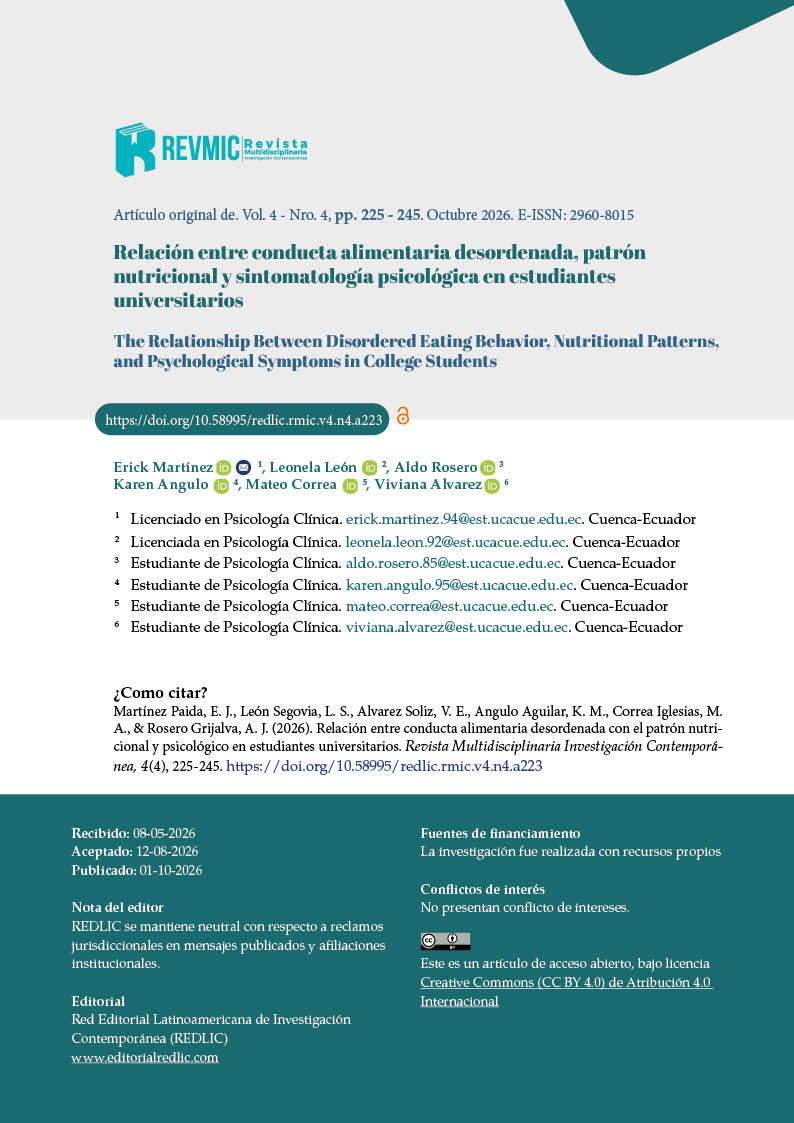
Relación entre conducta alimentaria desordenada con el patrón nutricional y psicológico en estudiantes universitarios
The Relationship Between Disordered Eating Behavior and Nutritional and Psychological Patterns Among College Students
Resumen
Introducción: La conducta alimentaria desordenada en universitarios se relaciona con ansiedad, depresión y deficiencias nutricionales, evidenciando la necesidad de investigar integralmente estos factores. Objetivo: La investigación tuvo como objetivo determinar la relación entre el patrón alimenticio de vitaminas y minerales, la sintomatología de ansiedad y depresión, y la conducta alimentaria desordenada en estudiantes universitarios. Métodos: Estudio cuantitativo, observacional, no experimental, transversal y correlacional. Participaron 322 estudiantes seleccionados mediante muestreo no probabilístico intencional. Se aplicaron el FFQ, el DASS-21 y el EDI-3, y se realizaron pruebas t, ANOVA y correlaciones de Pearson. Resultados: No se encontraron diferencias estadísticamente significativas según sexo ni carrera. La CAD se asoció positivamente con la ansiedad y la depresión. El patrón de consumo de vitaminas y minerales se asoció inversamente con la CAD y con la sintomatología ansiosa y depresiva. Conclusiones: La investigación deja en evidencia la relevancia de la ingesta dietética para el bienestar psicológico y aporta resultados aplicables al contexto ecuatoriano y latinoamericano, respaldando la evaluación conjunta de la alimentación, la CAD y el bienestar psicológico en universitarios, con resultados que pueden orientar acciones de detección temprana y prevención.
Introduction: Disordered eating behavior among college students is associated with anxiety, depression, and nutritional deficiencies, highlighting the need for comprehensive research into these factors. Objective: The objective of this study was to determine the relationship between dietary intake of vitamins and minerals, symptoms of anxiety and depression, and disordered eating behavior among college students. Methods: This was a quantitative, observational, non-experimental, cross-sectional, and correlational study. A total of 322 students selected through purposive non-probabilistic sampling participated. The FFQ, DASS-21, and EDI-3 were administered, and t-tests, ANOVA, and Pearson’s correlations were performed. Results: No statistically significant differences were found based on gender or major. CAD was positively associated with anxiety and depression. Vitamin and mineral intake patterns were inversely associated with CAD and with anxiety and depressive symptoms. Conclusions: This study highlights the importance of dietary intake for psychological well-being and provides findings applicable to the Ecuadorian and Latin American contexts, supporting the joint assessment of diet, CAD, and psychological well-being among college students, with results that can guide early detection and prevention efforts.
Palabras clave
- conducta alimentaria desordenada
- vitaminas
- minerales
- ansiedad
- depresión
Referencias
Abbaspour, R., Weisbrodt, S. E., Nauhria, S., Chan, M., Rawji, A. K., Jazi, P. B., & Maity, S. (2025). Plant-based and plant-predominant diets among healthcare students: A systematic review. Cureus, 17(7), e87294. https://doi.org/10.7759/cureus.87294
Aidoud, A., Elahcene, O., Bravo, R., & Ugartemendia, L. (2021). Nutritional status and dietary behaviours of Northern Algeria university students. Acta Universitatis Sapientiae, Alimentaria, 14(1), 1–13. https://doi.org/10.2478/ausal-2021-0001
Alhaj, O. A., Fekih-Romdhane, F., Sweidan, D. H., Saif, Z., Khudhair, M. F., Ghazzawi, H., Nadar, M. S., Alhajeri, S. S., Levine, M. P., & Jahrami, H. (2022). The prevalence and risk factors of screen-based disordered eating among university students: A global systematic review, meta-analysis, and meta-regression. Eating and Weight Disorders–Studies on Anorexia, Bulimia and Obesity, 27(8), 3215–3243. https://doi.org/10.1007/s40519-022-01452-0
Alsheweir, A., Goyder, E., Alnooh, G., & Caton, S. J. (2023). Prevalence of eating disorders and disordered eating behaviours amongst adolescents and young adults in Saudi Arabia: A systematic review. Nutrients, 15(21), 4643. https://doi.org/10.3390/nu15214643
American Psychiatric Association. (2022). Diagnostic and statistical manual of mental disorders (5th ed., text rev.). American Psychiatric Association Publishing. https://doi.org/10.1176/appi.books.9780890425787
Aparicio-Martínez, P., Perea-Moreno, A. J., Martínez-Jiménez, M. P., Redel-Macías, M. D., Pagliari, C., & Vaquero-Abellán, M. (2019). Social media, thin-ideal, body dissatisfaction and disordered eating attitudes: An exploratory analysis. International Journal of Environmental Research and Public Health, 16(21), 4177. https://doi.org/10.3390/ijerph16214177
Benítez, A., Sánchez, S., Bermejo, M. L., Franco-Reynolds, L., García-Herraiz, M. A., & Cubero, J. (2019). Análisis del riesgo de sufrir trastornos alimentarios en jóvenes universitarios de Extremadura (España). Enfermería Global, 18(2), 124–143. https://doi.org/10.6018/eglobal.18.2.313421
Bhardwaj, M., & Bal, B. S. (2023). The importance of eating behaviour: A systematic review. International Journal of Advanced Academic Studies, 5(6), 21–23. https://doi.org/10.33545/27068919.2023.v5.i6a.996
Castro, A., Matute Uloa, G., Morales Pin, N., & Zambrano Arauz, P. (2023). Problemas emergentes de salud mental en adolescentes ecuatorianos: Una revisión bibliográfica. Polo del Conocimiento, 8(9), 976–1020. https://doi.org/10.23857/pc.v8i9.6064
Cheah, W. L., Shin, E. C. V., & Hazmi, H. (2024). Examining gender difference in disordered eating behaviour and its associated factors among college and university students in Sarawak. Nutrition and Health, 30(3), 587–595. https://doi.org/10.1177/02601060221132597
Cheng, Y., Huang, Y., Huang, W., & Zhang, L. (2020). Vitamin D supplementation improves depressive symptoms: A systematic review and meta-analysis of randomized controlled trials. Journal of Affective Disorders, 271, 1–10. https://doi.org/10.1016/j.jad.2020.03.132
Ciarma, J. L., & Mathew, J. M. (2017). Social anxiety and disordered eating: The influence of stress reactivity and self-esteem. Eating Behaviors, 26, 177–181. https://doi.org/10.1016/j.eatbeh.2017.03.011
Da Luz, F. Q., Mohsin, M., Jana, T. A., Marinho, L. S., Santos, E. D., Lobo, I., Pascoareli, L., Gaeta, T., Ferrari, S., Teixeira, P. C., Cordás, T., & Hay, P. (2023). An examination of the relationships between eating-disorder symptoms, difficulties with emotion regulation, and mental health in people with binge eating disorder. Behavioral Sciences, 13(3), 234. https://doi.org/10.3390/bs13030234
Da, W., Kang, M., Wang, H., Qin, L., Che, Y., Li, Y., Mao, T., Feng, J., Cheng, B., Liu, H., Jia, Y., Liu, L., Wen, Y., & Zhang, F. (2026). Associations of dietary mineral intakes with the risk of six common mental disorders: A prospective cohort study. Journal of Affective Disorders, 392, 120271. https://doi.org/10.1016/j.jad.2025.120271
Daniel, L., Haile, D., & Egata, G. (2023). Disordered eating behaviours and body shape dissatisfaction among adolescents with type 1 diabetes: A cross-sectional study. Journal of Eating Disorders, 11(1), 169. https://doi.org/10.1186/s40337-023-00876-y
de Matos, A. P., Rodrigues, P. R. M., Fonseca, L. B., Ferreira, M. G., & Muraro, A. P. (2021). Prevalence of disordered eating behaviors and associated factors in Brazilian university students. Nutrition and Health, 27(2), 231–241. https://doi.org/10.1177/0260106020971136
Dong, H., Asmolovaite, V., Marseal, N., & Mearbon, M. (2022). Vitamin D status and dietary intake in young university students in the UK. Nutrition & Food Science, 52(4), 616–626. https://doi.org/10.1108/NFS-07-2021-0201
Eck, K. M., & Byrd-Bredbenner, C. (2021). Disordered eating concerns, behaviors, and severity in young adults clustered by anxiety and depression. Brain and Behavior, 11(12), e2367. https://doi.org/10.1002/brb3.2367
Eliashevich, S. O., Araukho, D. D. N., & Drapkina, O. M. (2023). Eating behavior: Disorders and how to assess them. Cardiovascular Therapy and Prevention, 22(8), 3663. https://doi.org/10.15829/1728-8800-2023-3663
Ernst, M., Werner, A. M., Tibubos, A. N., Beutel, M. E., de Zwaan, M., & Brähler, E. (2021). Gender-dependent associations of anxiety and depression symptoms with eating disorder psychopathology in a representative population sample. Frontiers in Psychiatry, 12, 645654. https://doi.org/10.3389/fpsyt.2021.645654
Escolar-Llamazares, M., Martínez-Martín, M., Medina-Gómez, M., González-Alonso, M., Mercado-Val, E., & Lara-Ortega, F. (2023). Sociodemographic variables and body mass index associated with the risk of eating disorders in Spanish university students. European Journal of Investigation in Health, Psychology and Education, 13(3), 595–612. https://doi.org/10.3390/ejihpe13030046
Fernández-Aranda, F., Granero, R., & Jiménez-Murcia, S. (2023). Eating disorders and addictive behaviors: Implications for human health. Nutrients, 15(17), 3718. https://doi.org/10.3390/nu15173718
Gaibor-González, I., & Moreta-Herrera, R. (2020). Dispositional optimism, anxiety, depression and stress in a sample of Ecuador: Inter-gender differences and prediction analysis. Actualidades en Psicología, 34(129), 17–31. https://doi.org/10.15517/ap.v34i129.35148
Gutiérrez-Espinoza, H., Celi-Lalama, D., Padilla-Sánchez, H., Flores-Santy, L. F., Smaili, S. M., Araya-Quintanilla, F., Arce-Alvarez, A., Ríos-Riquelme, M., & López-Gil, J. F. (2025). Proportion of disordered eating among Latin American university students: A multicountry cross-sectional study. Journal of Affective Disorders, 391, 120050. https://doi.org/10.1016/j.jad.2025.120050
Hao, M., Fang, Y., Yan, W., Gu, J., Hao, Y., & Wu, C. (2022). Relationship between body dissatisfaction, insufficient physical activity, and disordered eating behaviors among university students in southern China. BMC Public Health, 22(1), 2054. https://doi.org/10.1186/s12889-022-14515-9
Jiménez-Limas, K., Miranda-Barrera, V. A., Muñoz-Díaz, K. F., Novales-Huidobro, S. R., & Chico-Barba, G. (2022). Body dissatisfaction, distorted body image and disordered eating behaviors in university students: An analysis from 2017–2022. International Journal of Environmental Research and Public Health, 19(18), 11482. https://doi.org/10.3390/ijerph191811482
Jo, D., Hill, M. L., & Masuda, A. (2025). Difficulty in emotion regulation and self-concealment as mediators of the link between psychological distress and disordered eating behavior in emerging adult women. Behavioral Sciences, 15(9), 1259. https://doi.org/10.3390/bs15091259
Keck, M. M., Vivier, H., Cassisi, J. E., Dvorak, R. D., Dunn, M. E., Neer, S. M., & Ross, E. J. (2020). Examining the role of anxiety and depression in dietary choices among college students. Nutrients, 12(7), 2061. https://doi.org/10.3390/nu12072061
Kinnear, A., Siegel, J. A., Masson, P. C., & Bodell, L. P. (2023). Functions of disordered eating behaviors: A qualitative analysis of the lived experience and clinician perspectives. Journal of Eating Disorders, 11(1), 141. https://doi.org/10.1186/s40337-023-00854-4
Kris-Etherton, P. M., Petersen, K. S., Hibbeln, J. R., Hurley, D., Kolick, V., Peoples, S., Rodriguez, N., & Woodward-Lopez, G. (2021). Nutrition and behavioral health disorders: Depression and anxiety. Nutrition Reviews, 79(3), 247–260. https://doi.org/10.1093/nutrit/nuaa025
Lizana-Calderón, P., Cruzat-Mandich, C., Díaz-Castrillón, F., Alvarado, J. M., & Compte, E. J. (2022). Psychometric properties of the Eating Disorder Inventory-3 (EDI-3) in Chilean youth. Frontiers in Psychology, 13, 806563. https://doi.org/10.3389/fpsyg.2022.806563
Mendieta Martínez, M. J., Laurencio Díaz, D. I., Jijón Durán, J. A., Mendieta Martínez, N. A., & Mejía Pinto, M. C. (2025). Relación psicológica y clínica entre trastornos de la conducta alimentaria y trastornos de ansiedad: Retos y avances en el tratamiento integral. RECIMUNDO, 9(1), 571–585. https://doi.org/10.26820/recimundo/9
Moreta-Herrera, R., Zambrano Estrella, J., Sánchez-Vélez, H., & Naranjo-Vaca, S. (2021). Salud mental en universitarios del Ecuador: Síntomas relevantes, diferencias por género y prevalencia de casos. Pensamiento Psicológico, 19, 1–12. https://doi.org/10.11144/javerianacali.ppsi19.smue
Nagata, J. M., Grandis, A., Bojorquez-Ramirez, P., Nguyen, A., Downey, A. E., Ganson, K. T., Patel, K. P., Machen, V. I., Buckelew, S. M., & Garber, A. K. (2022). Assessment of vitamin D among male adolescents and young adults hospitalized with eating disorders. Journal of Eating Disorders, 10(1), 90. https://doi.org/10.1186/s40337-022-00627-5
Neumark-Sztainer, D., Wall, M., Larson, N. I., Eisenberg, M. E., & Loth, K. (2011). Dieting and disordered eating behaviors from adolescence to young adulthood: Findings from a 10-year longitudinal study. Journal of the American Dietetic Association, 111(7), 1004–1011. https://doi.org/10.1016/j.jada.2011.04.012
Pereira, R. F., & Alvarenga, M. (2007). Disordered eating: Identifying, treating, preventing, and differentiating it from eating disorders. Diabetes Spectrum, 20(3), 141–148. https://doi.org/10.2337/diaspect.20.3.141
Proskuryakova, L. A., & Lobykina, E. N. (2019). Assessment of risk for disordered eating behavior and the specific features of nutrition in students with different levels of trait anxiety. Profilakticheskaya Meditsina, 22(6), 80–86. https://doi.org/10.17116/profmed20192206180
Punzi, C., Tieri, P., Girelli, L., & Petti, M. (2023). Network-based validation of the psychometric questionnaire EDI-3 for the assessment of eating disorders. Scientific Reports, 13(1), 1578. https://doi.org/10.1038/s41598-023-28743-5
Ramón-Arbués, E., Gea-Caballero, V., Granada-López, J. M., Juárez-Vela, R., Pellicer-García, B., & Antón-Solanas, I. (2020). The prevalence of depression, anxiety and stress and their associated factors in college students. International Journal of Environmental Research and Public Health, 17(19), 7001. https://doi.org/10.3390/ijerph17197001
Ramón-Arbués, E., Martínez Abadía, B., Granada López, J. M., Echániz Serrano, E., Pellicer García, B., Juárez Vela, R., Guerrero Portillo, S., & Sáez Guinoa, M. (2019). Conducta alimentaria y su relación con el estrés, la ansiedad, la depresión y el insomnio en estudiantes universitarios. Nutrición Hospitalaria, 36(6), 1339–1345. https://doi.org/10.20960/nh.02641
Reivan Ortiz, G. G., Maraver-Capdevila, L., & Granero, R. (2025). Predicting metabolic and cardiovascular health from nutritional patterns and psychological state among overweight and obese young adults: A neural network approach. Nutrients, 17(20), 2651. https://doi.org/10.3390/nu17162651
Reivan Ortiz, G. G., Campoverde, X., Vinañzaca, J., Estrada, J., Yanza, R., & Granero, R. (2024). Factors increasing the risk for food addiction in Ecuadorian students. Frontiers in Psychiatry, 14, 1214266. https://doi.org/10.3389/fpsyt.2023.1214266
Ricca, V., Castellini, G., Fioravanti, G., Lo Sauro, C., Rotella, F., Ravaldi, C., Lazzeretti, L., & Faravelli, C. (2012). Emotional eating in anorexia nervosa and bulimia nervosa. Comprehensive Psychiatry, 53(3), 245–251. https://doi.org/10.1016/j.comppsych.2011.04.062
Rodríguez-Suárez, B., Caperos, J. M., & Martínez-Huertas, J. Á. (2022). Efecto de la exposición a ideales de delgadez en las redes sociales sobre la autoestima y la ansiedad. Psicología Conductual, 30(3), 677–691. https://doi.org/10.51668/bp.8322305s
Sakae, K., Suka, M., & Yanagisawa, H. (2020). Polaprezinc (zinc-L-carnosine complex) as an add-on therapy for binge eating disorder and bulimia nervosa, and the possible involvement of zinc deficiency in these conditions: A pilot study. Journal of Clinical Psychopharmacology, 40(6), 599–606. https://doi.org/10.1097/JCP.0000000000001284
Sander, J., Moessner, M., & Bauer, S. (2021). Depression, anxiety and eating disorder-related impairment: Moderators in female adolescents and young adults. International Journal of Environmental Research and Public Health, 18(5), 2779. https://doi.org/10.3390/ijerph18052779
Sifre, N., Deringer, R., Prapkree, L., & Palacios, C. (2024). Disordered eating attitudes and their association with age, BMI, stress, and diet in college students. International Journal of Environmental Research and Public Health, 21(6), 766. https://doi.org/10.3390/ijerph21060766
Silva, I., Meireles, A. L., Chagas, C. M. dos S., Cardoso, C. S., Oliveira, H. N. de, Freitas, E. D. de, Vidigal, F. de C., Nobre, L. N., Silva, L. S. da, Paula, W. de, & Ferreira, L. G. (2025). Emotional eating and its relationship with symptoms of anxiety, depression, and stress during the COVID-19 pandemic: A multicenter study in college students. International Journal of Environmental Research and Public Health, 22(3), 354. https://doi.org/10.3390/ijerph22030354
Solomou, S., Logue, J., Reilly, S., & Perez-Algorta, G. (2023). A systematic review of the association of diet quality with the mental health of university students: Implications in health education practice. Health Education Research, 38(1), 28–68. https://doi.org/10.1093/her/cyac035
Suárez-González, K. D., Solís-Manzano, A. M., Padilla-Samaniego, M. V., Sandoval-Tamayo, V. P., & Morales-Caluña, E. R. (2025). Relationship between diet, sociodemographic factors, and body composition in students from UNEMI and ESPOCH. Frontiers in Public Health, 13, 1621661. https://doi.org/10.3389/fpubh.2025.1621661
Suna, G., & Ayaz, A. (2022). Is poor sleep quality related to disordered eating behavior and mental health among university students? Sleep and Biological Rhythms, 20(3), 345–352. https://doi.org/10.1007/s41105-022-00374-9
Todisco, P., Meneguzzo, P., Vogazianos, P., Garolla, A., Antoniades, A., & Tozzi, F. (2020). Relation between vitamin D and impulse behaviours in patients with eating disorder: A pilot observational study. European Eating Disorders Review, 28(5), 587–593. https://doi.org/10.1002/erv.2740
Tokarchuk, A., Abenavoli, L., Kobyliak, N., Khomenko, M., Revun, M., Dolgaia, N., Molochek, N., Tsyryuk, O., Garnytska, A., Konakh, V., Pellicano, R., Fagoonee, S., Ostapchenko, L., & Falalyeyeva, T. (2022). Nutrition program, physical activity and gut microbiota modulation: A randomized controlled trial to promote a healthy lifestyle in students with vitamin D3 deficiency. Minerva Medica, 113(4), 683–694. https://doi.org/10.23736/S0026-4806.22.07992-7
Wiklund, C. A., Igudesman, D., Kuja-Halkola, R., Bälter, K., Thornton, L. M., & Bulik, C. M. (2022). Intake and adherence to energy and nutrient recommendations among women and men with binge-type eating disorders and healthy controls. Clinical Nutrition ESPEN, 48, 186–195. https://doi.org/10.1016/j.clnesp.2022.02.111
Yaqoob, A., Majeed, I., Khalid, H., Hussain, S., Shahid, M. H., Majeed, F., Hassan, O., Haq, I., & Qing, F. (2022). Risk factors for eating disorders among Chinese and international university students: A comparative cross-sectional study. Central European Journal of Public Health, 30(4), 241–247. https://doi.org/10.21101/cejph.a6998
Yoon, C., Mai, D., Kinariwala, K., Ledoux, T., Betts, R., & Johnston, C. (2023). Sex and ethnic/racial differences in disordered eating behaviors and intuitive eating among college students. Frontiers in Psychology, 14, 1221816. https://doi.org/10.3389/fpsyg.2023.1221816
Zhang, H., Cheng, J., Zheng, B., & Huang, X. (2025). Exploring causal link of 25-hydroxyvitamin D with eating disorder risk via bidirectional Mendelian randomization. Medicine, 104(30), e43539. https://doi.org/10.1097/MD.0000000000043539
Zielińska, M., Łuszczki, E., & Dereń, K. (2023). Dietary nutrient deficiencies and risk of depression: A review article, 2018–2023. Nutrients, 15(11), 2433. https://doi.org/10.3390/nu15112433
Publicado
Historial
- Recibido
- 9 may 2026
- Aceptado
- 15 ago 2026
- Publicado
- 1 oct 2026
Métricas
129 descargas
últimos 7 meses
Número
Sección
Cómo citar
Licencia
Derechos de autor 2026 Los autores que publiquen en la revista Multidisciplinaria Investigación Contemporánea aceptan los siguientes términos: 1. Los autores mantienen sus derechos de autor (copyright) y otorgan a la revista Multidisciplinaria Investigación Contemporánea el derecho de la primera publicación de su trabajo, bajo una licencia Creative Commons Attribution 4.0. Esta licencia permite que terceros utilicen el contenido publicado, siempre que se mencione la autoría y la primera publicación en esta revista. 2. Los autores pueden establecer acuerdos adicionales para la distribución no exclusiva de la versión publicada de su artículo en otros lugares, como repositorios institucionales, siempre y cuando se indique claramente que el trabajo fue publicado por primera vez en esta revista. 3. Los autores conservan sus derechos de autor (copyright) y garantizan a la revista Multidisciplinaria Investigación Contemporánea el derecho a publicar el manuscrito a través de los canales que considere apropiados. 4. Se permite y se recomienda a los autores compartir su trabajo en línea (por ejemplo, en repositorios institucionales o páginas web personales), una vez que el manuscrito haya sido aceptado para su publicación. Esto puede conducir a intercambios productivos y a una mayor y más rápida citación del trabajo publicado. Detalle de Licencia CC BY (https://creativecommons.org/licenses/by/4.0/) Usted es libre de: Compartir — copiar y redistribuir el material en cualquier medio o formato para cualquier propósito, incluso comercialmente. Adaptar — remezclar, transformar y construir a partir del material para cualquier propósito, incluso comercialmente. La licenciante no puede revocar estas libertades en tanto usted siga los términos de la licencia Bajo los siguientes términos: Atribución — Usted debe dar crédito de manera adecuada , brindar un enlace a la licencia, e indicar si se han realizado cambios . Puede hacerlo en cualquier forma razonable, pero no de forma tal que sugiera que usted o su uso tienen el apoyo de la licenciante. No hay restricciones adicionales — No puede aplicar términos legales ni medidas tecnológicas que restrinjan legalmente a otras a hacer cualquier uso permitido por la licencia.

Esta obra está bajo una licencia internacional Creative Commons Atribución 4.0.
Los autores que publiquen en la revista Multidisciplinaria Investigación Contemporánea aceptan los siguientes términos:
- Los autores mantienen sus derechos de autor (copyright) y otorgan a la revista Multidisciplinaria Investigación Contemporánea el derecho de la primera publicación de su trabajo, bajo una licencia Creative Commons Attribution 4.0. Esta licencia permite que terceros utilicen el contenido publicado, siempre que se mencione la autoría y la primera publicación en esta revista.
- Los autores pueden establecer acuerdos adicionales para la distribución no exclusiva de la versión publicada de su artículo en otros lugares, como repositorios institucionales, siempre y cuando se indique claramente que el trabajo fue publicado por primera vez en esta revista.
- Los autores conservan sus derechos de autor (copyright) y garantizan a la revista Multidisciplinaria Investigación Contemporánea el derecho a publicar el manuscrito a través de los canales que considere apropiados.
- Se permite y se recomienda a los autores compartir su trabajo en línea (por ejemplo, en repositorios institucionales o páginas web personales), una vez que el manuscrito haya sido aceptado para su publicación. Esto puede conducir a intercambios productivos y a una mayor y más rápida citación del trabajo publicado.
Detalle de Licencia CC BY (https://creativecommons.org/licenses/by/4.0/)
Usted es libre de:
- Compartir — copiar y redistribuir el material en cualquier medio o formato para cualquier propósito, incluso comercialmente.
- Adaptar — remezclar, transformar y construir a partir del material para cualquier propósito, incluso comercialmente.
- La licenciante no puede revocar estas libertades en tanto usted siga los términos de la licencia
Bajo los siguientes términos:
- Atribución — Usted debe dar crédito de manera adecuada , brindar un enlace a la licencia, e indicar si se han realizado cambios . Puede hacerlo en cualquier forma razonable, pero no de forma tal que sugiera que usted o su uso tienen el apoyo de la licenciante.
- No hay restricciones adicionales — No puede aplicar términos legales ni medidas tecnológicas que restrinjan legalmente a otras a hacer cualquier uso permitido por la licencia.