Ciencias Sociales- Artículo de Revisión
Desregulación Emocional Como Factor del Trastorno Obsesivo Compulsivo: Una Revisión Sistemática
Emotional Dysregulation as a Factor in Obsessive Compulsive Disorder: A Systematic Review.
Resumen
El Trastorno Obsesivo Compulsivo (TOC) se caracteriza por pensamientos intrusivos recurrentes que generan respuestas conductuales o mentales repetitivas. Este estudio describe la relación entre el TOC y la Desregulación Emocional (DsE), definida como la dificultad para gestionar adecuadamente las emociones, y que constituye un factor clave en la severidad de los síntomas. A través de una revisión sistemática en Scopus, Web of Science y Google Scholar, utilizando el método PRISMA, se analizaron 8 artículos validados con STROBE y CONSORT. Los resultados destacan que las formas más comunes de DsE en el TOC incluyen la poca claridad emocional, no aceptación de las emociones, conductas impulsivas por mal manejo emocional y evitación emocional. Se concluye que la falta de claridad y aceptación emocional son los principales factores que agravan las obsesiones y compulsiones. Por ello, se recomienda abordar la DsE como un elemento central en las intervenciones psicoterapéuticas para tratar el TOC.
Obsessive Compulsive Disorder (OCD) is characterized by recurrent intrusive thoughts that generate repetitive behavioral or mental responses. This study describes the relationship between OCD and Emotional Dysregulation (ED), defined as the difficulty to adequately manage emotions, which is a key factor in symptom severity. Through a systematic review in Scopus, Web of Science and Google Scholar, using the PRISMA method, 8 articles validated with STROBE and CONSORT were analyzed. The results highlight that the most common forms of ED in OCD include poor emotional clarity, non-acceptance of emotions, impulsive behaviors due to emotional mismanagement, and emotional avoidance. It is concluded that lack of emotional clarity and emotional acceptance are the main factors that aggravate obsessions and compulsions. Therefore, it is recommended to address the ED as a central element in psychotherapeutic interventions to treat OCD.
Palabras clave
- Trastorno Obsesivo Compulsivo,
- regulación emocional
- desregulación emocional
Referencias
Aldao, A., Nolen, S., & Schweizer, S. (2010). Emotion-regulation strategies across psychopathology: A meta-analytic review. Clinical Psychology Review, 30(2), 217-237. https://doi.org/10.1016/j.cpr.2009.11.004
American Psychiatric Association. (2013). Diagnostic and statistical manual of mental disorders, 5th. ed. https://doi.org/10.1176/appi.books.9780890425596
Angelakis, I., Gooding, P., Tarrier, N., & Panagioti, M. (2015). Suicidality in obsessive compulsive disorder (OCD): A systematic review and meta-analysis. Clinical Psychology Review, 39, 1–15. https://doi.org/10.1016/j.cpr.2015.03.002
Bloch, L., Moran, E. K., & Kring, A. M. (2010). On the need for conceptual and definitional clarity in emotion regulation research on psychopathology. Emotion regulation and psychopathology: A transdiagnostic approach to etiology and treatment, 88-104. https://esilab.berkeley.edu/wp-content/uploads/2017/12/bloch-et-al.pdf
Campbell, M., Piaggio, G., Elbourne, D., & Altman, D. (2012). Declaración de Consort 2010: extensión a los ensayos aleatorios por grupos. Métodos de investigación e informes, 1(1), 1-21. https://doi.org/10.1136/bmj.e5661
Cobos-Carbó, A., & Augustovski, F. (2011). Declaración CONSORT 2010: actualización de la lista de comprobación para informar ensayos clínicos aleatorizados de grupos paralelos. Medicina Clínica, 137(5), 213-215. https://doi.org/10.1016/j.medcli.2010.09.034
Colman, M., Millar, J., Patil, B., Finnegan, D., Russell, A., Higson-Sweeney, N., Da Silva Aguiar, M., & Fraser, D. S. (2024). A systematic review and narrative synthesis of the use and effectiveness of extended reality technology in the assessment, treatment and study of obsessive compulsive disorder. Journal Of Obsessive-Compulsive And Related Disorders, 42, 100893. https://doi.org/10.1016/j.jocrd.2024.100893
Del Casale, A., Sorice, S., Padovano, A., Simmaco, M., Ferracuti, S., Lamis, D. A., Rapinesi, C., Sani, G., Girardi, P., Kotzalidis, G. D., & Pompili, M. (2019). Psychopharmacological Treatment of Obsessive-Compulsive Disorder (OCD). Current Neuropharmacology, 17(8), 710-736. https://doi.org/10.2174/1570159x16666180813155017
Dryman, T., & Heimberg, R. (2018). Emotion regulation in social anxiety and depression: A systematic review of expressive suppression and cognitive reappraisal. Clinical psychology, 65(1), 17-42. https://doi.org/10.1016/j.cpr.2018.07.004
Eichholz, A., Schwartz, C., Meule, A., Heese, J., Neumüller, J., & Voderholzer, U. (2020). Self‐compassion and emotion regulation difficulties in obsessive–compulsive disorder. Clinical psychology & psychotherapy, 27(5), 630-639 https://doi.org/10.1002/cpp.2451
Fawcett, E. J., Power, H., & Fawcett, J. M. (2020). Women are at greater risk of OCD tan men: A meta-analytic review of OCD prevalence worldwide. Journal of Clinical Psychiatry, 81(4), Article 13075. https://doi.org/10.4088/jcp.19r13085
Ferreira, S., Couto, B., Souza , M., Vieira, R., Sousa, N., Picó, M., & Morgado, P. (2021). Stress influences the effect of obsessive-compulsive symptoms on emotion regulation. Frontiers in psychiatry, 11(12), 594541.https://doi.org/10.3389/fpsyt.2020.594541
Gratz, K., & Roemer, L. (2004). Multidimensional assessment of emotion regulation and dysregulation: Development, factor structure, and initial validation of the difficulties in emotion regulation scale. Journal of psychopathology and behavioral assessment, 1(26), 41-54. https://doi.org/10.1023/B:JOBA.0000007455.08539.94
Gross, J. (1999). Emotion and emotion regulation. Handbook of personality; Theory and research, 1(2), 525-552. https://doi.org/https://shre.ink/8AIX
Hervás, G. (2011). Psicopatología de la regulación emocional: El papel de los déficits emocionales en los trastornos clínicos. Psicología Conductual, 19, 347-372. http://webprueba2.quned.es/archivos_publicos/webex_actividades/5413/psicopatologiadelaregulacionemocionalelpapeldelosdeficitemocionales.pdf
Hervás, G., & Moral, G. (2017). Regulación emocional aplicada al campo clínico. Formación continuada a distancia, 30. https://www.ucm.es/data/cont/docs/1368-2018-05-11-FOCAD%20FINAL%20COMPLETO.pdf
Hollander, E., Stein, D., Fineberg, N., Marteau, F., & Legault, M. (2010). Quality of life outcomes in patients with obsessive-compulsive disorder: relationship to treatment response and symptom relapse. Journal of Clinical Psychiatry, 71(6), 784-792. https://doi.org/0.4088/JCP.09m05911blu
Huppert, J. D., & Foa, E. B. (2005). Severe OCD. Encyclopedia of Cognitive Behavior Therapy, 347-349. https://link.springer.com/book/10.1007/b99240
Jacob, M., Morelen, D., Suveg, C., Brown, A., & Whiteside, S. (2010). Emotional, behavioral, and cognitive factors that differentiate obsessive-compulsive disorder and other anxiety disorders in youth. Anxiety, Stress & Coping, 25(12), 229-237. https://doi.org/10.1080/10615806.2011.571255
John, O., & Gross, J. (2004). Healthy and unhealthy emotion regulation: Personality processes, individual differences, and life span development. Journal of personality, 72(6), 1301-1334. https://doi.org/10.1111/j.1467-6494.2004.00298.x
McKay, D., Sookman, D., Neziroglu, F., Wilhelm, S., Stein, D. J., Kyrios, M., Matthews, K., & Veale, D. (2014). Efficacy of cognitive-behavioral therapy for obsessive–compulsive disorder. Psychiatry Research, 225(3), 236-246. https://doi.org/10.1016/j.psychres.2014.11.058
McKenzie, M., Donovan, C., Mathieu, S., Hyland, W., & Farrell, L. (2020). Variability in emotion regulation in paediatric obsessive-compulsive disorder: Associations with symptom presentation and response to treatment. Journal of Obsessive-Compulsive and Related Disorders, 24(1), 100502. https://doi.org/10.1016/j.jocrd.2019.100502
McKenzie, M. L., Donovan, C. L., Zimmer-Gembeck, M. J., Waters, A. M., Mathieu, S. L., & Farrell, L. J. (2020). Examining parent-report of Children’s emotion regulation in paediatric OCD: Associations with symptom severity, externalising behaviour and family accommodation. Journal Of Obsessive-Compulsive And Related Disorders, 25, 100508. https://doi.org/10.1016/j.jocrd.2020.100508
Moral, G., & Hervás, G. (2017). Regulación emocional aplicada al campo clínico. Formación Continuada a Distancia Consejo General de la Psicología de España, 2(3), 1-40. https://doi.org/ISSN 1989-3906
Naji, F., Ali, H., Abasi, I., & Noori, M. (2022). Mediating Role of Difficulties in Emotion Regulation and Experiential Avoidance in the Relationship Between Attachment Styles and Severity of Relationship Obsessive-compulsive Disorder Symptoms. Iranian Journal of PSYCHIATRY AND CLINICAL PSYCHOLOGY, 28(3), 1-18. https://doi.org/10.32598/ijpcp.28.3.4175.1
Öst, L., Enebrink, P., Finnes, A., Ghaderi, A., Havnen, A., Kvale, G., Salomonsson, S., & Wergeland, G. J. (2022). Cognitive behavior therapy for obsessive-compulsive disorder in routine clinical care: A systematic review and meta-analysis. Behaviour Research And Therapy, 159, 104170. https://doi.org/10.1016/j.brat.2022.104170
Öst, L., Havnen, A., Hansen, B., & Kvale, G. (2015). Cognitive behavioral treatments of obsessive–compulsive disorder. A systematic review and meta-analysis of studies published 1993–2014. Clinical Psychology Review, 40, 156-169. https://doi.org/10.1016/j.cpr.2015.06.003
Pampaloni, I., Sabina, E., Claire, F., Govender, A., Mohamed, H., Chandler, A., . . . Pallanrti, S. (2022). The global assessment of OCD. Comprehensive Psychiatry, 118(152342), 20. https://doi.org/10.1016/j.comppsych.2022.152342
Pittenger, C., & Bloch, M. H. (2014). Pharmacological Treatment of Obsessive-Compulsive Disorder. Psychiatric Clinics Of North America, 37(3), 375-391. https://doi.org/10.1016/j.psc.2014.05.006
Purdon, C. (2021). Obsessive-compulsive disorder. In A. Wenzel (Ed.), Handbook of cognitive behavioral therapy: Applications (pp. 67–97). American Psychological Association. https://doi.org/10.1037/0000219-003
Schulz, K. F., Altman, D. G., Moher, D., & for the CONSORT Group. (2010). CONSORT 2010 Statement: updated guidelines for reporting parallel group randomised trials. BMJ, 340(mar23 1), c332–c332. https://doi.org/10.1136/bmj.c332
See, C., Tan, J., & Sundermann, O. (2022). A systematic review on the links between emotion regulation difficulties and obsessive-compulsive disorder. Journal of Psychiatric Research, 154(1), 341-353. https://doi.org/10.1016/j.jpsychires.2022.07.023
Seixas, R., Pignault, A., & Houssemand, C. (2021). Emotion regulation questionnaire-adapted and individual differences in emotion regulation. Europe's Journal of Psychology, 17(1), 70. https://doi.org/10.5964/ejop.2755
Shameli, L., Honarmand, M. M., Naa’mi, A., & Davodi, I. (2019). The Effectiveness of Emotion-Focused Therapy on Emotion Regulation Styles and Severity of Obsessive-Compulsive Symptoms in Women With Obsessive-Compulsive Disorder. Iranian Journal Of Psychiatry And Clinical Psychology, 356-369. https://doi.org/10.32598/ijpcp.24.4.456
Skapinakis, P., Caldwell, D. M., Hollingworth, W., Bryden, P., Fineberg, N. A., Salkovskis, P., Welton, N. J., Baxter, H., Kessler, D., Churchill, R., & Lewis, G. (2016). Pharmacological and psychotherapeutic interventions for management of obsessive-compulsive disorder in adults: a systematic review and network meta-analysis. The Lancet Psychiatry, 3(8), 730-739. https://doi.org/10.1016/s2215-0366(16)30069-4
Stein, D., Costa, D., Lochner, C., Euripedes, M., Janardhan, R., Shavitt, R., . . . Simpson, B. (2019). Obsessive–compulsive disorder. Nature Reviews Disease Primers, 5(52), 20. https://doi.org/10.1038/s41572-019-0102-3
Sibrava, N. J., Boisseau, C. L., Mancebo, M. C., Eisen, J. L., & Rasmussen, S. A. (2011). Prevalence and clinical characteristics of mental rituals in a longitudinal clinical sample of obsessive-compulsive disorder. Depression And Anxiety, 28(10), 892-898. https://doi.org/10.1002/da.20869
Urrútia, G., & Bonfill, X. (2010). Declaración PRISMA: una propuesta para mejorar la publicación de revisiones sistemáticas y metaanálisis. Medicina Clínica, 135(11), 507–511. https://doi:10.1016/j.medcli.2010.01.015
Vahid, K., Ardestani, S., Sharifibastan, F., & Malyeri, S. (2020). Difficulties in emotion regulation and symptom dimensions in patients with obsessive-compulsive disorder. ResearchGate, 39(2), 15. https://doi.org/10.1007/s12144-018-9859-x
Veale, D., & Roberts, A. (2014). Obsessive-compulsive disorder. BMJ, 348(apr07 6), g2183. https://doi.org/10.1136/bmj.g2183
Visted, E., Vollestad, J., & Birkeland, M. (2018). Emotion Regulation in Current and Remitted Depression: A Systematic Review and Meta-Analysis. Frontiers in Psycology, 9(756), 1-20. https://doi.org/10.3389/fpsyg.2018.00756
Yap, K., Morgán, C., Moriarty, A., Dowling, N., Blair-West, S., & Gelgec, R. (2018). Emotion regulation difficulties in obsessive‐compulsive disorder. Journal of clinical psychology, 74(4), 695-709. https://doi.org/10.1002/jclp.22553
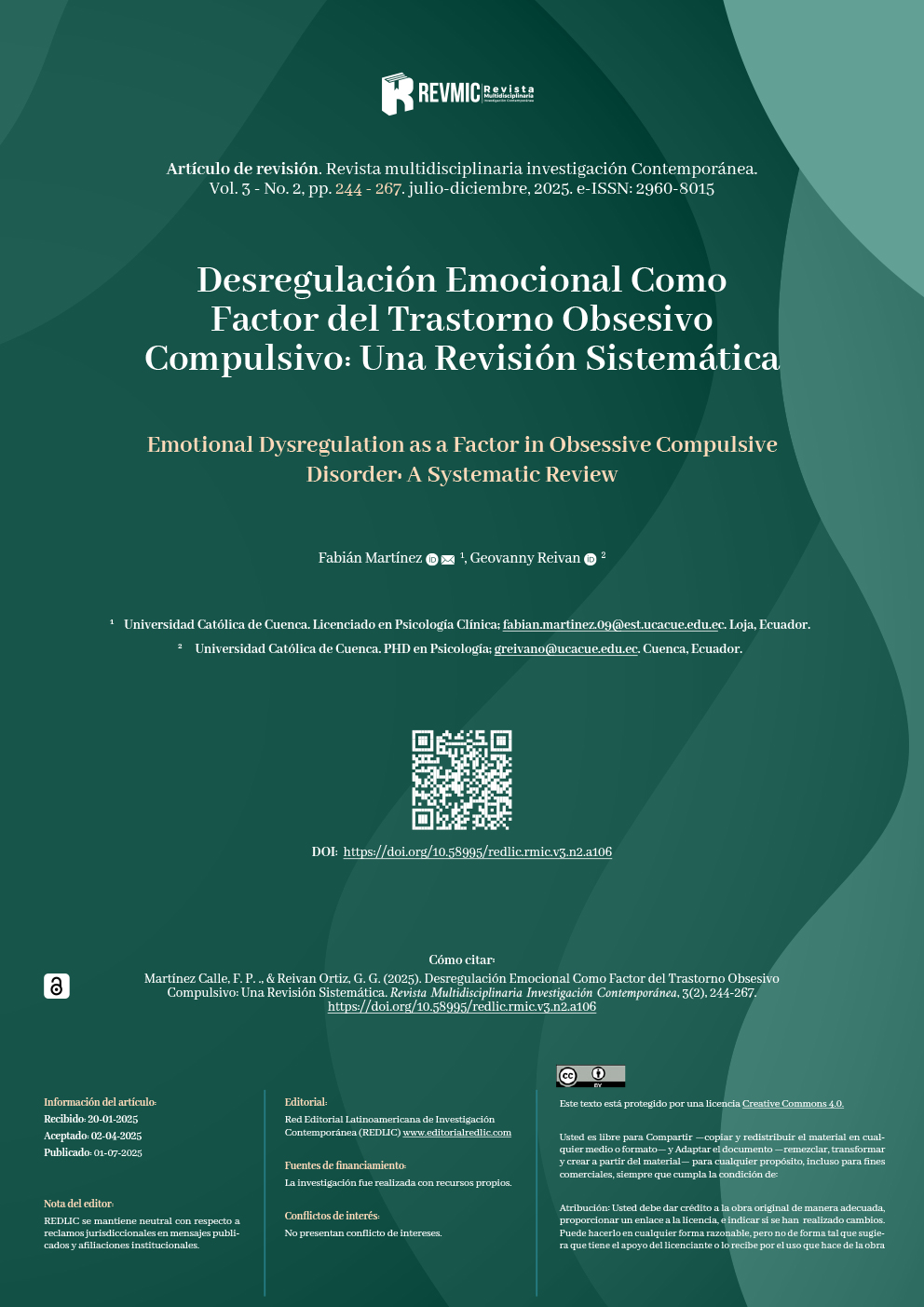
Publicado
Historial
- Recibido
- 20 feb 2025
- Aceptado
- 2 abr 2025
- Publicado
- 1 jul 2025
Métricas
1 257 descargas
últimos 7 meses
Número
Sección
Cómo citar
Licencia
Derechos de autor 2025 Los autores que publiquen en la revista Multidisciplinaria Investigación Contemporánea aceptan los siguientes términos: 1. Los autores mantienen sus derechos de autor (copyright) y otorgan a la revista Multidisciplinaria Investigación Contemporánea el derecho de la primera publicación de su trabajo, bajo una licencia Creative Commons Attribution 4.0. Esta licencia permite que terceros utilicen el contenido publicado, siempre que se mencione la autoría y la primera publicación en esta revista. 2. Los autores pueden establecer acuerdos adicionales para la distribución no exclusiva de la versión publicada de su artículo en otros lugares, como repositorios institucionales, siempre y cuando se indique claramente que el trabajo fue publicado por primera vez en esta revista. 3. Los autores conservan sus derechos de autor (copyright) y garantizan a la revista Multidisciplinaria Investigación Contemporánea el derecho a publicar el manuscrito a través de los canales que considere apropiados. 4. Se permite y se recomienda a los autores compartir su trabajo en línea (por ejemplo, en repositorios institucionales o páginas web personales), una vez que el manuscrito haya sido aceptado para su publicación. Esto puede conducir a intercambios productivos y a una mayor y más rápida citación del trabajo publicado.

Esta obra está bajo una licencia internacional Creative Commons Atribución 4.0.
Los autores que publiquen en la revista Multidisciplinaria Investigación Contemporánea aceptan los siguientes términos:
- Los autores mantienen sus derechos de autor (copyright) y otorgan a la revista Multidisciplinaria Investigación Contemporánea el derecho de la primera publicación de su trabajo, bajo una licencia Creative Commons Attribution 4.0. Esta licencia permite que terceros utilicen el contenido publicado, siempre que se mencione la autoría y la primera publicación en esta revista.
- Los autores pueden establecer acuerdos adicionales para la distribución no exclusiva de la versión publicada de su artículo en otros lugares, como repositorios institucionales, siempre y cuando se indique claramente que el trabajo fue publicado por primera vez en esta revista.
- Los autores conservan sus derechos de autor (copyright) y garantizan a la revista Multidisciplinaria Investigación Contemporánea el derecho a publicar el manuscrito a través de los canales que considere apropiados.
- Se permite y se recomienda a los autores compartir su trabajo en línea (por ejemplo, en repositorios institucionales o páginas web personales), una vez que el manuscrito haya sido aceptado para su publicación. Esto puede conducir a intercambios productivos y a una mayor y más rápida citación del trabajo publicado.
Detalle de Licencia CC BY (https://creativecommons.org/licenses/by/4.0/)
Usted es libre de:
- Compartir — copiar y redistribuir el material en cualquier medio o formato para cualquier propósito, incluso comercialmente.
- Adaptar — remezclar, transformar y construir a partir del material para cualquier propósito, incluso comercialmente.
- La licenciante no puede revocar estas libertades en tanto usted siga los términos de la licencia
Bajo los siguientes términos:
- Atribución — Usted debe dar crédito de manera adecuada , brindar un enlace a la licencia, e indicar si se han realizado cambios . Puede hacerlo en cualquier forma razonable, pero no de forma tal que sugiera que usted o su uso tienen el apoyo de la licenciante.
- No hay restricciones adicionales — No puede aplicar términos legales ni medidas tecnológicas que restrinjan legalmente a otras a hacer cualquier uso permitido por la licencia.