Ciencias de la Salud- Articulo de Revisión
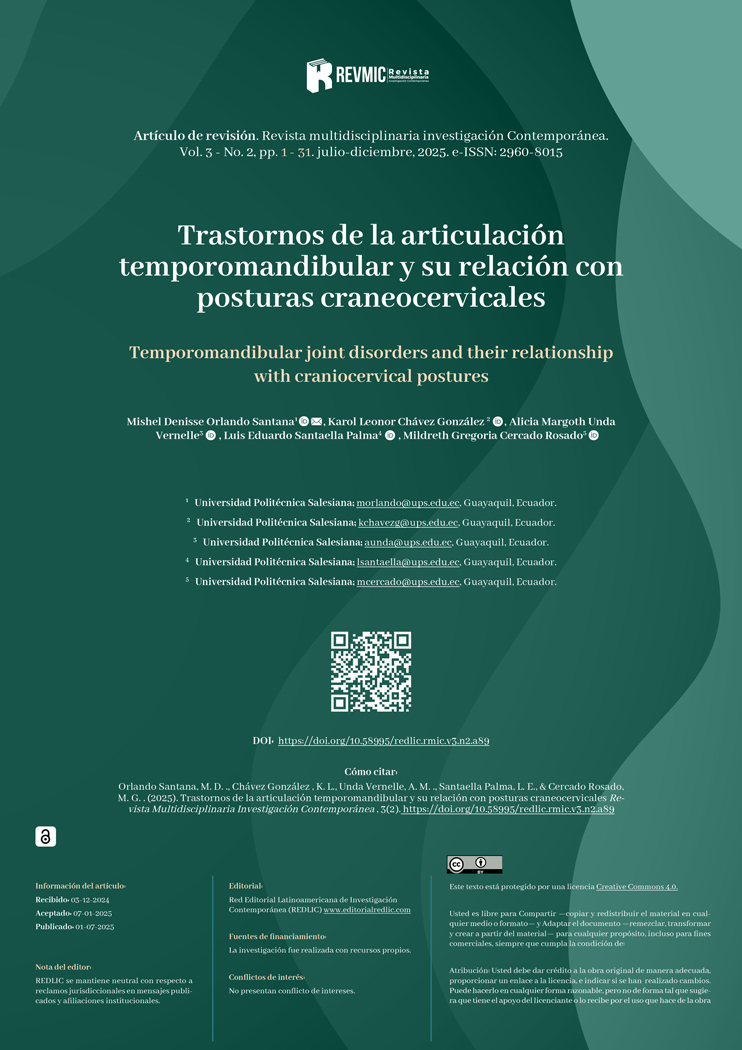
Trastornos de la articulación temporomandibular y su relación con posturas craneocervicales
Temporomandibular joint disorders and their relationship with craniocervical postures
Resumen
Introduction: The temporomandibular joint is a bilateral synovial joint between the mandibular condyle and the mandibular fossa of the temporal bone. Objective: The objective of this research is to analyze the association between temporomandibular joint disorders and alterations in craniocervical postures. Methodology: A narrative review was carried out. The information was collected in the databases: Scopus, PubMed, Web of Science, Google Scholar, during August 2024 to November 2024. Conclusions: The posture in which the head is located influences the position of the cervical spine and an alteration in this can cause problems in dental occlusion. Among the abnormal cervical postures, the following postures stand out: kyphotic, lordotic and flattened. Craniocervical dysfunction is an anomaly in which the head is positioned forward with respect to the axial axis of the body and is usually associated with the appearance of temporomandibular disorders.
Introduction: The temporomandibular joint is a bilateral synovial joint between the mandibular condyle and the mandibular fossa of the temporal bone. Objective: The objective of this research is to analyze the association between temporomandibular joint disorders and alterations in craniocervical postures. Methodology: A narrative review was carried out. The information was collected in the databases: Scopus, PubMed, Web of Science, Google Scholar, during August 2024 to November 2024. Conclusions: The posture in which the head is located influences the position of the cervical spine and an alteration in this can cause problems in dental occlusion. Among the abnormal cervical postures, the following postures stand out: kyphotic, lordotic and flattened. Craniocervical dysfunction is an anomaly in which the head is positioned forward with respect to the axial axis of the body and is usually associated with the appearance of temporomandibular disorders.
Palabras clave
- epidemiología
- odontología
- rehabilitación
- salud
- trastornos
- articulación temporomandibular
- posturas craneocervicales
Referencias
Sang, S., Ameli, N., Almeida, F. T., & Friesen, R. (2024). Association between clinical symptoms and MRI image findings in symptomatic temporomandibular joint (TMJ) disease: A systematic review. Journal of Cranio-Maxillofacial Surgery. 53(7):835-42. https://doi.org/10.1016/j.jcms.2024.04.006
Connelly, S. T., Tartaglia, G. M., & Silva, R. G. (2019). Contemporary Management of Temporomandibular Disorders. Springer Nature Switzerland AG.
Pope, T., Bloem, H., Beltran, J., Morrison, W., Wilson, D. (2023). Musculoskeletal Imaging. Springer Nature Switzerland AG.
Blakley, B. W., & Blakley, J. E. (2023). Functional Illness of the Head and Neck. Springer Nature Switzerland AG
Restrepo, C. C., Quintero, Y., Tamayo, M., & Tamayo, V. (2008). Efecto de la posición craneocervical en las funciones orales fisiológicas. CES Odontología, 21(1), 71-75. https://revistas.ces.edu.co/index.php/odontologia/article/view/55/45
Vargas, M. (2012). Anatomía y exploración física de la columna cervical y torácica. Medicina Legal de Costa Rica, 29(2), 77-92. https://www.scielo.sa.cr/scielo.php?script=sci_arttext&pid=S1409-00152012000200009
Sgarbi, T. (2018). Unión cráneo-cervical – anatomía normal ycorrelación con imágenes. Revista Argentina de Radiologìa, 82(4), 161-167. https://doi.org/10.1055/s-0038-1656541
Aguilar et al. (2024). Recursos imagenológicos para el diagnóstico y seguimiento de las alteraciones del paciente con disfunción del sistema cráneo-cérvico mandibular. Reporte Imagenol Dentomaxilofacial, 3(1): e2024030102-e2024030102.. https://doi.org/10.60094/RID.20240301-32
Ramírez, M., Rodulfo, E., Urgilés, C., Herrera, K., Ludizaca, D. (2021). Asociación entre postura cráneo cervical y maloclusiones. Revista KIRU, 18(1), 55-64. https://doi.org/10.24265/kiru.2021.v18n1.08
García, A. (2020). Modelo Físico Biomecánico de cráneo y raquis cervical apto para estudio de movimientos y fuerzas musculares. Trabajo de Titulación, Universidad Politécnica de Madrid. Obtenido de https://oa.upm.es/66087/1/TFG_ALEJANDRO_DE_SANTIAGO_GARCIA_VALDECASAS.pdf
León, Y., Cabrera, M., Guiracocha, E. (2024). Relación entre posición de las vértebras cervicales y la maloclusión clase II. Revisión de la literatura. Anatomía Digital, 7(1.3), 112-131. https://doi.org/10.33262/anatomiadigital.v7i1.3.3008
Van den Wyngaert,T. (2023). Clinical Atlas of Bone SPECT/CT. Springer Nature Switzerland.
Dimitroulis, G. (2024). The rationale for temporomandibular joint surgery: A review based on a TMJ surgical classification. Journal of Oral and Maxillofacial Surgery, Medicine, and Pathology, 36(4), 433-437. https://doi.org/10.1016/j.ajoms.2023.10.012
Elledge, R. (2024). Classifications for the temporomandibular joint (TMJ): A systematic review of the literature. Journal of Cranio-Maxillo-Facial Surgery, 52:890–894. https://doi.org/10.1016/j.jcms.2024.04.010
Andrade, G. (2016). La postura humana y su reeducación. Revista Cubana de Medicina Física y Rehabilitación;8(2):231-240. https://www.medigraphic.com/pdfs/revcubmedfisreah/cfr-2016/cfr162h.pdf
Pesantes, J., (2021). Asciación entre la postura craneocervical y los trastornos temporomandibulares. Una revisión de la literatura. Trabajo de grado. Universidad de Católica. https://dspace.ucacue.edu.ec/handle/ucacue/11286
Kendall, F. P., Mac Creary, E. K., & Provance, P. G. (2007). Músculos: pruebas funcionales, postura y dolor. Marbán.
Oliveira, C., Navarro, R., Ruiz, J. A., Brito, E. (2007). Biomecánica de la columna vertebral. https://accedacris.ulpgc.es/bitstream/10553/5983/1/0514198_00012_0005.pdf
Limaylla, R. (2018).Transtornos temporomandibulares y alteraciones postulares de la columna cervical. Odontología Sanmarquina, 11(2): 66-69. https://doi.org/10.15381/os.v11i2.3027
Bautista, Aida., Sánchez, F., Pérez, Andrés., Ambrosio, E. (2022). Asociación entre disfunción cráneocervical y trastornos temporomandibulares en adultos jóvenes. Revista Estomatológica Herediana, 32(2), 129-135. https://dx.doi.org/10.20453/reh.v32i2.4208
Tomás J, Castillo C, Villarroel G, Giner A &Felipe N. (2022) Efecto del síndrome de cabeza adelantada en el desarrollo de trastornos temporomandibulares. Rev Cient Odontol (Lima), 10(4): e133. https://doi.org/10.21142/2523-2754-1004-2022-133
Villalón P, Frugone R, Palomino H. (2004). Algunas Mediciones Radiográficas Cráneo - Cervicales según Biotipo de Ricketts. Revista dental de Chile. ; 95(3): 11-17. https://dialnet.unirioja.es/servlet/articulo?codigo=9384483
Publicado
Historial
- Recibido
- 3 dic 2024
- Aceptado
- 7 ene 2025
- Publicado
- 1 jul 2025
Métricas
722 descargas
últimos 7 meses
Número
Sección
Cómo citar
Licencia
Derechos de autor 2025 Los autores que publiquen en la revista Multidisciplinaria Investigación Contemporánea aceptan los siguientes términos: 1. Los autores mantienen sus derechos de autor (copyright) y otorgan a la revista Multidisciplinaria Investigación Contemporánea el derecho de la primera publicación de su trabajo, bajo una licencia Creative Commons Attribution 4.0. Esta licencia permite que terceros utilicen el contenido publicado, siempre que se mencione la autoría y la primera publicación en esta revista. 2. Los autores pueden establecer acuerdos adicionales para la distribución no exclusiva de la versión publicada de su artículo en otros lugares, como repositorios institucionales, siempre y cuando se indique claramente que el trabajo fue publicado por primera vez en esta revista. 3. Los autores conservan sus derechos de autor (copyright) y garantizan a la revista Multidisciplinaria Investigación Contemporánea el derecho a publicar el manuscrito a través de los canales que considere apropiados. 4. Se permite y se recomienda a los autores compartir su trabajo en línea (por ejemplo, en repositorios institucionales o páginas web personales), una vez que el manuscrito haya sido aceptado para su publicación. Esto puede conducir a intercambios productivos y a una mayor y más rápida citación del trabajo publicado.

Esta obra está bajo una licencia internacional Creative Commons Atribución 4.0.
Los autores que publiquen en la revista Multidisciplinaria Investigación Contemporánea aceptan los siguientes términos:
- Los autores mantienen sus derechos de autor (copyright) y otorgan a la revista Multidisciplinaria Investigación Contemporánea el derecho de la primera publicación de su trabajo, bajo una licencia Creative Commons Attribution 4.0. Esta licencia permite que terceros utilicen el contenido publicado, siempre que se mencione la autoría y la primera publicación en esta revista.
- Los autores pueden establecer acuerdos adicionales para la distribución no exclusiva de la versión publicada de su artículo en otros lugares, como repositorios institucionales, siempre y cuando se indique claramente que el trabajo fue publicado por primera vez en esta revista.
- Los autores conservan sus derechos de autor (copyright) y garantizan a la revista Multidisciplinaria Investigación Contemporánea el derecho a publicar el manuscrito a través de los canales que considere apropiados.
- Se permite y se recomienda a los autores compartir su trabajo en línea (por ejemplo, en repositorios institucionales o páginas web personales), una vez que el manuscrito haya sido aceptado para su publicación. Esto puede conducir a intercambios productivos y a una mayor y más rápida citación del trabajo publicado.
Detalle de Licencia CC BY (https://creativecommons.org/licenses/by/4.0/)
Usted es libre de:
- Compartir — copiar y redistribuir el material en cualquier medio o formato para cualquier propósito, incluso comercialmente.
- Adaptar — remezclar, transformar y construir a partir del material para cualquier propósito, incluso comercialmente.
- La licenciante no puede revocar estas libertades en tanto usted siga los términos de la licencia
Bajo los siguientes términos:
- Atribución — Usted debe dar crédito de manera adecuada , brindar un enlace a la licencia, e indicar si se han realizado cambios . Puede hacerlo en cualquier forma razonable, pero no de forma tal que sugiera que usted o su uso tienen el apoyo de la licenciante.
- No hay restricciones adicionales — No puede aplicar términos legales ni medidas tecnológicas que restrinjan legalmente a otras a hacer cualquier uso permitido por la licencia.