Ciencias de la Educación- Artículo Original
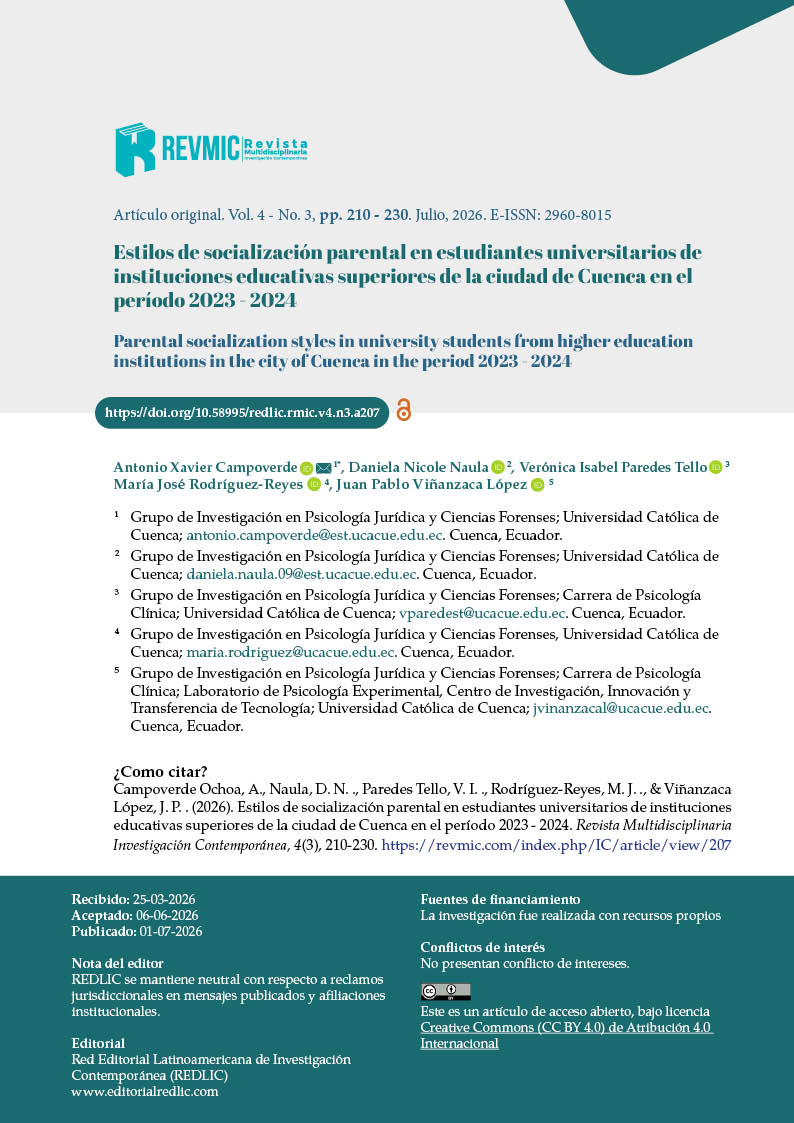
Parental socialization styles in university students from higher education institutions in the city of Cuenca in the period 2023 - 2024
Estilos de socialización parental en estudiantes universitarios de instituciones educativas superiores de la ciudad de Cuenca en el período 2023 - 2024
Abstract
Introduction: Parental socialization styles comprise attitudes and practices that parents use in raising their children, influencing their social-emotional development. Objective: To determine the prevalence of parental socialization styles as perceived by university students at higher education institutions in the city of Cuenca. Methodology: A non-experimental, observational study was conducted with a quantitative approach, descriptive scope, and cross-sectional design. A total of 405 emerging adults participated, who were administered the Parental Socialization Styles in Adolescence Scale (ESPA-29). Results: The authoritarian style was the most perceived in fathers (29.4%), while the authoritative style predominated in mothers (40.5%). In addition, positive correlations were found between the dimensions of both parents and differences according to gender in the perception of the maternal style. Conclusions: There is consistency between the parenting practices of both figures, although the perception of maternal parenting varies according to the gender of the children.
Introducción: Los estilos de socialización parental comprenden actitudes y prácticas que los padres emplean en la crianza de sus hijos, influyendo en su desarrollo socioemocional. Objetivo: Determinar la prevalencia de estilos de socialización parental percibidos por estudiantes universitarios de instituciones de educación superior de la ciudad de Cuenca. Metodología: Se realizó un estudio observacional, no experimental, con enfoque cuantitativo, alcance descriptivo y corte transversal. Participaron 405 adultos emergentes, a quienes se aplicó la Escala de Estilos de Socialización Parental en la Adolescencia (ESPA-29). Resultados: El estilo autoritario fue el más percibido en el padre (29,4 %), mientras que en la madre predominó el autorizativo (40,5 %). Además, se hallaron correlaciones positivas entre dimensiones de ambos padres y diferencias según el sexo en la percepción del estilo materno. Conclusiones: Existe coherencia entre prácticas parentales de ambas figuras, aunque la percepción de la crianza materna varía según el sexo de los hijos.
Keywords
- Prevalence
- Parental Socialization Styles
- University Students
- Breeding
References
Ante-Morillo, G., & Almeida-Marquez, L. (2024). Estilos de Socialización Parental y el Riesgo de Consumo de Drogas en Adolescentes. Psicología UNEMI, 8(15), 44–54. https://doi.org/10.29076/issn.2602-8379vol8iss15.2024pp44-54p
Baumrind, D. (1967). Child care practices anteceding three patterns of preschool behavior. Genetic Psychology Monographs, 75(1), 43–88. https://psycnet.apa.org/record/1967-05780-001
Baumrind, D. (1971). Current patterns of parental authority. Developmental Psychology, 4(1), 1–103. https://doi.org/10.1037/H0030372
Carrillo, S., Bermúdez, M. E., Suárez, L., Gutiérrez, M. C., & Delgado, X. (2016). Father’s Perceptions of their Role and Involvement in the Family: A Qualitative Study in a Colombian Sample / Percepciones del padre sobre su rol e involucramiento en la familia: un estudio cualitativo en una muestra colombiana. Revista Costarricense de Psicología, 35(2), 101–118. https://doi.org/10.22544/RCPS.V35I02.03
Cortés, S. S. L., Chacón, P. W. L., Kanan, C. E. G., Gómez, A. C., Beltrán, Z. I., & Beltrán, B. I. (2020). Estilos de Socialización Parental y Autoestima en el Embarazo Adolescente. Revista Electrónica de Psicología Iztacala, 23(3), 1121–1131. https://view.genially.com/6806d98291437469d27a7dae/interactive-content-parental
Cuadri, C., García-Perales, J., Martínez, I., & Veiga, F. H. (2025). Relationship Between Parenting Styles and Personality in Older Spanish Adolescents. Behavioral Sciences 2025, Vol. 15, 15(3), 339. https://doi.org/10.3390/BS15030339
Cui, M., Graber, J. A., Metz, A., & Darling, C. A. (2016). Parental indulgence, self-regulation, and young adults’ behavioral and emotional problems. Journal of Family Studies, 25(3), 233–249. https://doi.org/10.1080/13229400.2016.1237884
Espinoza-García, A. (2020). Estilos de socialización parental en una muestra de adolescentes chilenos. Revista de Psicología Clínica Con Niños y Adolescentes, 7(1), 46–51. https://doi.org/10.21134/rpcna.2020.07.1.6
Fuentes, M. C., Garcia, O. F., Alcaide, M., Garcia-Ros, R., & Garcia, F. (2022). Analyzing when parental warmth but without parental strictness leads to more adolescent empathy and self-concept: Evidence from Spanish homes. Frontiers in Psychology, 13. https://doi.org/10.3389/fpsyg.2022.1060821
García, F., & Gracia, E. (2013). The Indulgent Parenting Style and Developmental Outcomes in South European and Latin American Countries. 419–433. https://doi.org/10.1007/978-94-007-7503-9_31
Garcia, F., Serra, E., Garcia, O. F., Martinez, I., & Cruise, E. (2019). A Third Emerging Stage for the Current Digital Society? Optimal Parenting Styles in Spain, the United States, Germany, and Brazil. International Journal of Environmental Research and Public Health 2019, Vol. 16, 16(13). https://doi.org/10.3390/IJERPH16132333
Garcia, O. F., Fuentes, M. C., Gracia, E., Serra, E., & Garcia, F. (2020). Parenting warmth and strictness across three generations: Parenting styles and psychosocial adjustment. International Journal of Environmental Research and Public Health, 17(20), 1 – 18. https://doi.org/10.3390/ijerph17207487
Garcia, O. F., Lopez-Fernandez, O., & Serra, E. (2021). Raising Spanish Children With an Antisocial Tendency: Do We Know What the Optimal Parenting Style Is? Journal of Interpersonal Violence, 36(13–14), 6117–6144. https://doi.org/10.1177/0886260518818426
García-Buelga, Ó. F., Serra-Desfilis, E., Zacarés-González, J. J., & García, F. (2018). Parenting styles and short- and long-term socialization outcomes: A study among Spanish adolescents and older adults.
Guaicha, A. M. (2024). Estilos de crianza como factores de riesgo para depresión y ansiedad en población infantil [Tesis de grado, Universidad Católica de Cuenca]. https://dspace.ucacue.edu.ec/server/api/core/bitstreams/d081c281-f6eb-46e1-a408-7614bcc95243/content
Guallpa-Sinchi, N. C., & Loja-Cárdenas, B. L. (2015). Estilos de crianza de los padres de estudiantes con bajo rendimiento [Tesis de grado, Universidad de Cuenca]. http://dspace.ucuenca.edu.ec/handle/123456789/21872
Lansford, J. E., Rothenberg, W. A., Riley, J., Uribe Tirado, L. M., Yotanyamaneewong, S., Alampay, L. P., Al-Hassan, S. M., Bacchini, D., Bornstein, M. H., Chang, L., Deater-Deckard, K., Di Giunta, L., Dodge, K. A., Gurdal, S., Liu, Q., Long, Q., Malone, P. S., Oburu, P., Pastorelli, C., … Steinberg, L. (2021). Longitudinal Trajectories of Four Domains of Parenting in Relation to Adolescent Age and Puberty in Nine Countries. Child Development, 92(4), e493–e512. https://doi.org/10.1111/CDEV.13526
Loke, H.-L., & Low, C.-S. (2021). Relationship Between Parenting Style, Psychological Well-Being and Academic Performance Among University Students. Department of Social Science, Faculty of Social Sciences and Humanities, Kolej Universiti Tunku Abdul Rahman, 1–12. https://www.researchgate.net/publication/357074163_Relationship_Between_Parenting_Style_Psychological_Well-Being_and_Academic_Performance_Among_University_Students
López, V. V., Cruz, H., Parentales, P., Bienestar, Y., En, P., & Adolescentes, L. (2025). Prácticas parentales y bienestar psicológico psicológico en los adolescentes. PsicoSophia, 6(1), 14–30. https://doi.org/10.37354/rpsiso.2024.6.1.042
Males-Villegas, S. M. (2022). Estilos de socialización parental en adolescentes ecuatorianos durante la pandemia COVID-19. Polo Del Conocimiento, 7(66), 650–663. https://doi.org/10.23857/pc.v7i1.3500
Martinez, I., Garcia, F., Veiga, F., Garcia, O. F., Rodrigues, Y., & Serra, E. (2020). Parenting styles, internalization of values, and self-esteem: A cross-cultural study in Spain, Portugal and Brazil. International Journal of Environmental Research and Public Health, 17(7), 13–29. https://doi.org/10.3390/ijerph17072370
Martinez, I., & Garcia, J. F. (2008). Internalization of values and self-esteem among Brazilian teenagers from authoritative, indulgent, authoritarian, and neglectful homes. Uv.EsI Martinez, JF GarciaADOLESCENCE-SAN DIEGO-, 2008•uv.Es, 43(169), 650–663. https://www.uv.es/~garpe/C_/A_/C_A_0034.pdf
Martinez-Escudero, J. A., Villarejo, S., Garcia, O. F., & Garcia, F. (2020). Parental Socialization and Its Impact across the Lifespan. Behavioral Sciences, 10(6), 101. https://doi.org/10.3390/bs10060101
Matamet-Montoya, S. E., & Núñez-Fernández, C. V. (2018). Estilos de Socialización Parental y Dependencia Emocional en Adolescentes de 5to de Secundaria [Tesis de grado, Universidad Católica de Santa María]. https://repositorio.ucsm.edu.pe/items/df61f18f-fa6f-4b7e-b7b8-c28d69511b88
Mayorga-Muñoz, C., Jimenez-Figueroa, A., Riquelme-Segura, L., Abrigo-Muñoz, A., & Nogués-Solano, I. (2024). Psychometric properties of adaptation scale parental socialization styles in chilean adolescents; [Propiedades psicométricas de adaptación escala estilos de socialización parental en adolescentes chilenos]. Terapia Psicologica, 42(2), 253–271. https://doi.org/10.4067/s0718-48082024000200253
Musitu, G., & García, F. (2001). ESPA29 Escala de Socialización Parental en la Adolescencia (TEA ediciones, Ed.; 2nd ed., Vol. 285). TEA. https://www.researchgate.net/publication/242530506_ESPA29_Escala_de_Estilos_de_Socializacion_Parental_en_la_Adolescencia
Orellana, M. F. (2017). Percepción de los adolescentes de un centro de adicciones sobre los estilos de socialización de sus padres/madres [Tesis de grado, Universidad de Cuenca]. http://dspace.ucuenca.edu.ec/handle/123456789/27326
Palacios, I., Garcia, O. F., Alcaide, M., & Garcia, F. (2022). Positive parenting style and positive health beyond the authoritative: Self, universalism values, and protection against emotional vulnerability from Spanish adolescents and adult children. Frontiers in Psychology, 13, 1066282. https://doi.org/10.3389/FPSYG.2022.1066282/TEXT
Pinquart, M. (2017). Associations of parenting dimensions and styles with externalizing problems of children and adolescents: An updated meta-analysis. Developmental Psychology, 53(5), 873–932. https://doi.org/10.1037/DEV0000295
Pinquart, M., & Kauser, R. (2018). Do the associations of parenting styles with behavior problems and academic achievement vary by culture? Results from a meta-analysis. Cultural Diversity & Ethnic Minority Psychology, 24(1), 75–100. https://psycnet.apa.org/buy/2017-15641-001
Puetate, M. F., & Vásquez, F. A. (2022). Los estilos de socialización parental y su relación con el uso problemático de internet en adolescentes. Ciencia Latina Revista Científica Multidisciplinar, 6(3), 1324–1341. https://doi.org/10.37811/cl_rcm.v6i3.2299
Ramírez, M. L. G., Sánchez, A. P. S., Santamaria, F. M. S., Silva, N. J. S., & Hoyos, S. I. (2024). Estilos de Crianza Parental e Inteligencia Emocional en la Etapa de la Niñez: Una revisión Sistemática de la Literatura. Ciencia Latina Revista Científica Multidisciplinar, 8(3), 6994–7021. https://doi.org/10.37811/CL_RCM.V8I3.11895
Rodríguez, R. L. (2024). Estilos de Socialización Parental Post Ruptura de Pareja entre Progenitores de la UJFMNA de Cuenca, Periodo 2024 [Tesis de grado, Universidad Politécnica Salesiana]. https://dspace.ups.edu.ec/bitstream/123456789/29029/1/UPS-CT011780.pdf
Salamanca-Ramos, E., Chávez-Ávila, P., & Carmona-Parra, J. A. (2017). Perception of parental authority among adolescent school children who are victims of displacement; [Percepção da autoridade parental em adolescentes escolarizados víctimas de deslocamento]; [Percepción de la autoridad parental en adolescentes escolarizados víctimas de desplazamiento]. Aquichan, 17(4), 437 – 447. https://doi.org/10.5294/aqui.2017.17.4.7
Sánchez-Urrea, A., Izquierdo-Rus, T., Baena-Morales, S., & Gómez-Mármol, A. (2024). The Self-Concept and Its Relationship with Parental Socialization and Environment in Primary School Students. Behavioral Sciences, 14(7), 518. https://doi.org/10.3390/bs14070518
Vaca, G. L., Sacoto, M. F. M., Mosquera, E. D., Moreta-Herrera, R., & Mayorga, M. N. (2020). Propiedades psicométricas del Parental Bonding Instrument (PBI) en jóvenes universitarios ecuatorianos. Psicología, Conocimiento y Sociedad, 10(3), 93–118. https://revista.psico.edu.uy/revpsicologia/article/view/722
Waller, F., Prandstetter, K., Jansen, E., Nikolova, G., Lachman, J. M., Hutchings, J., & Foran, H. M. (2023). Screen use: Its association with caregiver mental health, parenting, and children’s ADHD symptoms. Family Relations, 72(5), 2499–2515. https://doi.org/10.1111/FARE.12869
Wang, C. H. C., & Phinney, J. S. (1998). Differences in child rearing attitudes between immigrant Chinese mothers and Anglo-American mothers. Early Development and Parenting, 7(4), 181–189. https://onlinelibrary.wiley.com/doi/10.1002/(SICI)1099-0917(199812)7:4%3C181::AID-EDP169%3E3.0.CO;2-Y
Published
History
- Received
- 25 Mar 2026
- Accepted
- 18 Apr 2026
- Published
- 1 Jul 2026
Metrics
108 downloads
last 7 months
Issue
Section
How to Cite
License
Copyright (c) 2026 Los autores que publiquen en la revista Multidisciplinaria Investigación Contemporánea aceptan los siguientes términos: 1. Los autores mantienen sus derechos de autor (copyright) y otorgan a la revista Multidisciplinaria Investigación Contemporánea el derecho de la primera publicación de su trabajo, bajo una licencia Creative Commons Attribution 4.0. Esta licencia permite que terceros utilicen el contenido publicado, siempre que se mencione la autoría y la primera publicación en esta revista. 2. Los autores pueden establecer acuerdos adicionales para la distribución no exclusiva de la versión publicada de su artículo en otros lugares, como repositorios institucionales, siempre y cuando se indique claramente que el trabajo fue publicado por primera vez en esta revista. 3. Los autores conservan sus derechos de autor (copyright) y garantizan a la revista Multidisciplinaria Investigación Contemporánea el derecho a publicar el manuscrito a través de los canales que considere apropiados. 4. Se permite y se recomienda a los autores compartir su trabajo en línea (por ejemplo, en repositorios institucionales o páginas web personales), una vez que el manuscrito haya sido aceptado para su publicación. Esto puede conducir a intercambios productivos y a una mayor y más rápida citación del trabajo publicado. Detalle de Licencia CC BY (https://creativecommons.org/licenses/by/4.0/) Usted es libre de: Compartir — copiar y redistribuir el material en cualquier medio o formato para cualquier propósito, incluso comercialmente. Adaptar — remezclar, transformar y construir a partir del material para cualquier propósito, incluso comercialmente. La licenciante no puede revocar estas libertades en tanto usted siga los términos de la licencia Bajo los siguientes términos: Atribución — Usted debe dar crédito de manera adecuada , brindar un enlace a la licencia, e indicar si se han realizado cambios . Puede hacerlo en cualquier forma razonable, pero no de forma tal que sugiera que usted o su uso tienen el apoyo de la licenciante. No hay restricciones adicionales — No puede aplicar términos legales ni medidas tecnológicas que restrinjan legalmente a otras a hacer cualquier uso permitido por la licencia.

This work is licensed under a Creative Commons Attribution 4.0 International License.
Los autores que publiquen en la revista Multidisciplinaria Investigación Contemporánea aceptan los siguientes términos:
- Los autores mantienen sus derechos de autor (copyright) y otorgan a la revista Multidisciplinaria Investigación Contemporánea el derecho de la primera publicación de su trabajo, bajo una licencia Creative Commons Attribution 4.0. Esta licencia permite que terceros utilicen el contenido publicado, siempre que se mencione la autoría y la primera publicación en esta revista.
- Los autores pueden establecer acuerdos adicionales para la distribución no exclusiva de la versión publicada de su artículo en otros lugares, como repositorios institucionales, siempre y cuando se indique claramente que el trabajo fue publicado por primera vez en esta revista.
- Los autores conservan sus derechos de autor (copyright) y garantizan a la revista Multidisciplinaria Investigación Contemporánea el derecho a publicar el manuscrito a través de los canales que considere apropiados.
- Se permite y se recomienda a los autores compartir su trabajo en línea (por ejemplo, en repositorios institucionales o páginas web personales), una vez que el manuscrito haya sido aceptado para su publicación. Esto puede conducir a intercambios productivos y a una mayor y más rápida citación del trabajo publicado.
Detalle de Licencia CC BY (https://creativecommons.org/licenses/by/4.0/)
Usted es libre de:
- Compartir — copiar y redistribuir el material en cualquier medio o formato para cualquier propósito, incluso comercialmente.
- Adaptar — remezclar, transformar y construir a partir del material para cualquier propósito, incluso comercialmente.
- La licenciante no puede revocar estas libertades en tanto usted siga los términos de la licencia
Bajo los siguientes términos:
- Atribución — Usted debe dar crédito de manera adecuada , brindar un enlace a la licencia, e indicar si se han realizado cambios . Puede hacerlo en cualquier forma razonable, pero no de forma tal que sugiera que usted o su uso tienen el apoyo de la licenciante.
- No hay restricciones adicionales — No puede aplicar términos legales ni medidas tecnológicas que restrinjan legalmente a otras a hacer cualquier uso permitido por la licencia.