Ciencias Sociales- Artículo de Revisión
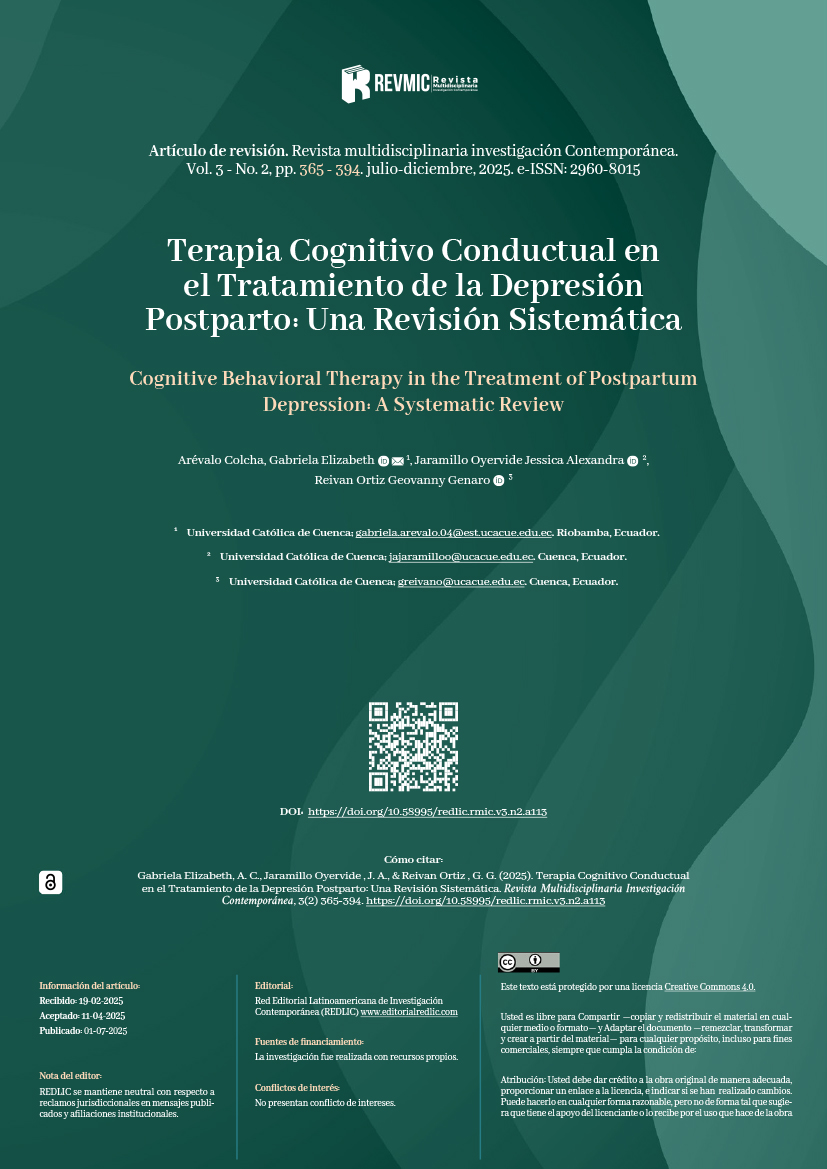
Cognitive Behavioral Therapy in the Treatment of Postpartum Depression: A Systematic Review
Terapia Cognitivo Conductual en el Tratamiento de la Depresión Postparto: Una Revisión Sistemática.
Abstract
Postpartum depression (PPD) is a psychological condition that occurs in women during and after childbirth, characterized by symptoms of sadness, anxiety, and difficulties adequately caring for their baby. Studies suggest that cognitive-behavioral therapy (CBT) is most effective if it focuses on changing one's own thoughts. The following provides an explanation of the effectiveness of CBT in the treatment of postpartum depression through a systematic review. This is the main objective of the article. Searches were conducted in the Web of Science, Scopus, and PubMed databases, considering studies published between 2019 and 2024. The PRISMA and CONSORT methodology was applied to assess the quality of the selected studies. As a result, 17 articles were analyzed, most of which conclude that cognitive-behavioral therapy is effective in reducing the symptoms of postpartum depression. It is concluded that this therapy, in its various modalities, promotes maternal adaptation and improves the mother-child relationship, making it necessary to adapt its application to the context and individual needs of each mother.
La depresión posparto es una afección psicológica que se presenta en las mujeres durante y después del parto, caracterizado por síntomas de tristeza, ansiedad y dificultades para cuidar adecuadamente del bebé. Estudios sugieren que la terapia cognitivo-conductual (TCC) es más efectiva si se centra en cambiar los propios pensamientos. A continuación se proporciona una explicación de la eficacia de la TCC en el tratamiento de la depresión posparto a través de una revisión sistemática. Siendo este el principal objetivo del artículo. Se realizaron búsquedas en las bases de datos Web of Science, Scopus y PubMed, considerando estudios publicados entre 2019 y 2024. Se aplicó la metodología PRISMA y CONSORT para evaluar la calidad de los estudios seleccionados. Como resultado, se analizaron 17 artículos que en su mayoría concluyen que la terapia cognitivo-conductual es efectiva en la reducción de los síntomas de la depresión posparto. Se concluye que esta terapia, en sus diversas modalidades, favorece la adaptación materna y mejora la relación madre-hijo, siendo necesario adaptar su aplicación al contexto y necesidades individuales de cada madre.
Keywords
- cognitive- behavioral therapy
- efficacy
- postpartum depression
- systematic review
References
Acuña, A., Ramírez, E., & Azofeifa, M. (2021). Depresión postparto. Revista Médica Sinergia, 6(9), 1-7. doi:10.31434/rms.v6i9.712. https://revistamedicasinergia.com/index.php/rms/article/view/712
Alimoari, Z., Jafari, E., Brostrom, A., Ohayon, M., Ying-Lin, C., Griffirts, M., . . . Jernelov, S. (2022). Effects of cognitive behavioral therapy for insomnia (CBT-I) on quality of life: A systematic review and meta-analysis. Sleeps Medicine Reviews, 64(1), 1-12. doi:10.1016/j.smrv.2022.101646. https://pubmed.ncbi.nlm.nih.gov/35653951/
Alverenga, P., Nunez, L., Pereira, H., & Gil, I. (2018). Variáveis sociodemográficas e saúde mental materna em contexto de vulnerabilidade social. Psicologia, saúde & doenças, 19(3), 776-778. doi:10.15309/18psd190324. https://www.semanticscholar.org/paper/Vari%C3%A1veis-sociodemogr%C3%A1ficas-e-sa%C3%BAde-mental-materna-Alvarenga-Souto/4c9b950e02d2f5dd4adcd0bd1c0d91e897fc72a7
Amani, B., Merza, D., Savoy, C., Streiner, D., Bieling, P., Ferro, M., & Lishout, B. (2021). Peer-Delivered Cognitive-Behavioral Therapy for Postpartum Depression: A Randomized Controlled Trial. The Journal of the Clinical Psychiatry, 83(1). Obtenido de https://www.psychiatrist.com/jcp/mental/peer-delivered-cognitive-behavioral-therapy-postpartum-depression-randomized-controlled-trial/
Branquinho, M., Canavarro, M. C., & Fonseca, A. (2022). A Blended Cognitive–Behavioral Intervention for the Treatment of Postpartum Depression: A Case Study. Clinical Case Studies, 21(5), 438–456. https://doi.org/10.1177/15346501221082616
Branquinho, M., Canavarro, M. C., & Fonseca, A. (2023). Be a Mom Coping with Depression: A Feasibility Study of a Blended Cognitive-Behavioral Intervention for Postpartum Depression. International Journal of Cognitive Therapy, 16(4), 618–645. https://doi.org/10.1007/s41811-023-00182-0
Bahar, A., Merza, D., Savoy, C., Strainer, D., Bielig, P., Ferro, M., & Lieshout, B. (2021). Terapia cognitivo-conductual administrada por pares para la DPP: un ensayo controlado aleatorio. Focus on Women and Mental Health, 3(1), 1-9. https://www.psychiatrist.com/jcp/mental/peer-delivered-cognitive-behavioral-therapy-postpartum-depression-randomized-controlled-trial/
Bryce, S., Sloan, E. P., & Rosell, S. (2016). Cognitive remediation in schizophrenia: A methodological appraisal of systematic reviews and meta-analyses. Journal of Psychiatric Research, 75(1), 91-106. Doi: 10.1016/j.jpsychires.2016.01.00
Carona, C., Pereira, M., Araújo-Pedrosa, A., Canavarro, M. C., & Fonseca, A. (2023). The efficacy of being a mom, a web-based intervention to prevent Postpartum depression: Examining mechanisms of change in a randomized controlled trial. JMIR Mental Health, 10, e39253. https://doi.org/10.2196/39253
Chen, Q., Li, W., Xiong, J., & Zheng, X. (2022). Prevalence and Risk Factors Associated with Postpartum Depression during the COVID-19 Pandemic: A Literature Review and Meta-Analysis. International Journal Research Public Health, 14(9), 1-12. doi:10.3390/ijerph19042219. https://pubmed.ncbi.nlm.nih.gov/35206407/
Cuncha, M., Ferreira, J., Silva, R., Fraga, D., & Marabotti, F. (2022). Síntomas de la DPP y su asociación con características socioeconómicas y de apoyo social. Pesquisa Anna Nery, 26(1), 1-8. doi:10.1590/2177-9465-EAN-2021-0265. https://www.scielo.br/j/ean/a/wvn5x49ZqbgzhKGs4pqPnqb/
Darcy, A., Beaudette, A., Chiauzzi, E., Daniels, J., Goodwin, K., Mariano, T. Y., Wicks, P., & Robinson, A. (2023). Anatomy of a Woebot® (WB001): agent guided CBT for women with postpartum depression. Expert Review of Medical Devices, 20(12), 1035–1049. https://doi.org/10.1080/17434440.2023.2280686
Donis, J. (2013). Tipos de diseños de los estudios clínicos y epidemiológicos. Avances de Biomedicina, 2(2), 76-99. https://www.redalyc.org/pdf/3313/331327989005.pdf
Duffecy, J., Grekin, R., Hinkel, H., Gallivan, N., Nelson, G., & O’Hara, M. W. (2019). A group-based online intervention to prevent postpartum depression (Sunnyside): Feasibility randomized controlled trial. JMIR Mental Health, 6(5), e10778. https://doi.org/10.2196/10778
Duffecy, J., Grekin, R., Long, J. D., Mills, J. A., & O’Hara, M. (2022). Randomized controlled trial of Sunnyside: Individual versus group-based online interventions to prevent postpartum depression. Journal of Affective Disorders, 311, 538–547. https://doi.org/10.1016/j.jad.2022.05.123
Erbe D., Eichert HC, Riper H., Ebert DD (2017). Combinación de intervenciones presenciales e internet para el tratamiento de trastornos mentales en adultos: Revisión sistemática. Journal of Medical Internet Research , 19(9), Artículo e306. https://doi.org/10.2196/jmir.6588
Ebert DD, Van Daele T., Nordgreen T., Karekla M., Compare A., Zarbo C., Brugnera A., Overland S., Trebbi G., Jensen KL, Kaehlke F., Baumeister H., Taylor J. (2018). Intervenciones psicológicas basadas en internet y móviles: Aplicaciones, eficacia y potencial para mejorar la salud mental. Informe del grupo de trabajo de e-Salud de la EFPA. European Psychologist , 23(2), 167–187. https://doi.org/10.1027/1016-9040/a000318Franco, P., Olhaberry, M., Cuijpers, P., Kelders, S., & Muzard, A. (2023). App-based intervention for reducing depressive symptoms in postpartum women: Protocol for a feasibility randomized controlled trial. Internet Interventions, 32. https://doi.org/10.1016/j.invent.2023.100616
Fonseca A., Gorayeb R., Canavarro MC (2015). Conductas de búsqueda de ayuda de las mujeres para síntomas depresivos durante el período perinatal: Correlatos sociodemográficos y clínicos, y barreras percibidas para la búsqueda de ayuda profesional. Midwifery , 31(12), 1177–1185. https://doi.org/10.1016/j.midw.2015.09.002
Goodman JH (2009). Actitudes, preferencias y barreras percibidas de las mujeres para el tratamiento de la depresión perinatal. Birth , 36(1), 60–69. https://doi.org/10.1111/j.1523-536X.2008.00296.xGonzález, A., Casado, P., Molero, M., Santos, R., & López, I. (2019). Associated factors for postpartum depression. Revista Archivo Médico de Camagüey, 23(6), 770-779. Obtenido de http://scielo.sld.cu/pdf/amc/v23n6/1025-0255-amc-23-06-770.pdf
Hou, Y., Hu, P., Zhang, Y., Lu, Q., Wang, D., Yin, L., Chen, Y., & Zou, X. (2014). Cognitive behavioral therapy in combination with systemic family therapy improves mild to moderate postpartum depression. Revista Brasileira de Psiquiatria, 36(1), 47–52. https://doi.org/10.1590/1516-4446-2013-1170
Husain, N., Lunat, F., Lovell, K., Sharma, D., Zaidi, N., Bokhari, A., Syed, A., Tomenson, B., Islam, A., Chaudhry, N., & Waheed, W. (2023). Exploratory RCT of a group psychological intervention for postnatal depression in British mothers of South Asian origin – ROSHNI-D. Acta Psychologica, 238. https://doi.org/10.1016/j.actpsy.2023.103974
Jannati, N., Mazhari, S., Ahmadian, Leila, & Mirzaee, M. (2020). Efectividad de un programa de terapia cognitivo-conductual basado en aplicaciones para la DPP en la atención primaria: un ensayo controlado aleatorio. Revista Internacional de Tecnología Médica, 141(1), 12-19. doi:10.1016/j.ijmedinf.2020.104145
Jannati, N., Mazhari, S., Ahmadian, L., Mirzaei, & Moghaddam. (2020). Effectiveness of an app-based cognitive behavioral therapy program for postpartum depression in primary care: A randomized controlled trial. International Journal of Medical Informatics, 141(1), 1-9. Doi: 10.1016/j.ijmedinf.2020.104145
Jidong, D. E., Ike, T. J., Murshed, M., Francis, C., Mwankon, S. B., Jidong, J. E., Pwajok, J. Y., Nyam, P. P., & Husain, N. (2024). Postnatal depression in British mothers of African and Caribbean origin: a randomized controlled trial of learning through play plus culturally adapted cognitive behavior therapy compared with psychoeducation. Frontiers in psychiatry, 15. https://doi.org/10.3389/fpsyt.2024.1383990
Johann, A., Feige, B., Hertenstein, E., Nissen, C., Benz, F., Steiments, L., & Baglioni, C. (2023). The Effects of Cognitive Behavioral Therapy for Insomnia on Multidimensional Perfectionism. Behavior Therapy, 54(2), 386-399. Doi: 10.1016/j.beth.2022.10.001
Kariotaki, E., & Efthimiou, O. C. (2021). Question What are the patient-specific relative outcomes of guided vs unguided internet-based cognitive behavioral therapy (iCBT) for depression over the short and the long term? JAMA Psychiatry, 78(4), 361-371. doi:10.1001/jamapsychiatry.2020.4364
Krzeczkowski, J. E., Schmidt, L. A., & Van Lieshout, R. J. (2021). Changes in infant emotion regulation following maternal cognitive behavioral therapy for postpartum depression. Depression and Anxiety, 38(4), 412–421. https://doi.org/10.1002/da.23130
Leysihoud, V., Ryan, Layton, H., Feller, A., Ferro, M., Biscaro, A., & Bieling, P. (2020). Enfermera de salud pública administró terapia cognitiva conductual (TCC) grupal para la DPP: un estudio piloto. Public Health Nursing, 27(1), 50-55. doi:10.1111/phn.12664
Liu, H., & Yang, Y. (2021). Effects of a psychological nursing intervention on prevention of anxiety and depression in the postpartum period: a randomized controlled trial. Annals of General Psychiatry, 20(1). https://doi.org/10.1186/s12991-020-00320-4
Li, X., Laplante, D., Paquin, V., Lafortune, S., Elgbeili, G., & KIng, S. (2022). Effectiveness of cognitive behavioral therapy for perinatal maternal depression, anxiety, and stress: A systematic review and meta-analysis of randomized controlled trials. Clinical Psychology Review, 92(1), 2-18. Doi: 10.1016/j.cpr.2022.102129
Merza, D., Layton, H., Savoy, C., Babiy, Z., Campbell, M., Bieling, P. J., Brown, J. S. L., & Van Lieshout, R. J. (2023). Online Peer-Delivered 1-Day Cognitive Behavioral Therapy–Based Workshops for Postpartum Depression: A Pilot Study. Journal of Clinical Psychiatry, 84(1). https://doi.org/10.4088/JCP.22br14574
Milgrom, J., Danaher, B., Seeley, J., Holt, C., Holt, C., Ericksen, J., . . . Gau, J. (2021). Internet and Face-to-face Cognitive Behavioral Therapy for Postnatal Depression Compared with Treatment as Usual: Randomized Controlled Trial of MumMoodBooster. Journal of Medical Internet Research, 23(12), https://doi.org/10.2196/17185
Molina, I., Ferré, C., & Vargas, C. (2021). Cuidado de enfermería con terapia cognitiva conductual en la depresión postparto. Dialnet: Archivos de la Memoria, 18(1), 1-9. Obtenido de https://dialnet.unirioja.es/servlet/articulo?codigo=8245034
Monteiro, F., Carona, C., Antunes, P., Canavarro, M. C., & Fonseca, A. (2024). Economic evaluation of Be a mom, a web-based intervention to prevent postpartum depression in high-risk women alongside a randomized controlled trial. Journal of Affective Disorders, 357, 163–170. https://doi.org/10.1016/j.jad.2024.05.013
Mónaco, R. (2019). Ir al punto", definir plazos y objetivos. Tiempos y palabras en los tratamientos cognitivo-conductuales en Buenos Aires, Argentina. Runa, 40(1), 65-82. doi:10.34096/runa.v40i1.4639
Ntow, K., Krzeczkowski, J., Bahar, A., Saboya, C., & Schmidt, L. V. (2021). Rendimiento materno e infantil en la tarea cara a cara después de la terapia cognitivo-conductual materna para la DPP. Revista de trastornos afectivos, 278(1). doi:10.1016/j.jad.2020.09.101
Nishi, D., Imamura, K., Watanabe, K., Obikane, E., Sasaki, N., Yasuma, N., Sekiya, Y., Matsuyama, Y., & Kawakami, N. (2022). The preventive effect of internet-based cognitive behavioral therapy for prevention of depression during pregnancy and in the postpartum period (iPDP): a large scale randomized controlled trial. https://doi.org/10.1111/pcn.13458
Pérez, G., Ortiz, D., Niño, A., Gómez, L., & Bayona, K. (2021). Eficacia de las intervenciones no farmacológicas en la prevención de la depresión postparto: una revisión sistemática. Médica UIS, 34(1), 73-90. doi:10.18273/revmed.v34n1-2021008
Pettman, D., O’Mahen, H., Blomberg, O., Svanberg, A. S., von Essen, L., & Woodford, J. (2023). Effectiveness of cognitive behavioural therapy-based interventions for maternal perinatal depression: a systematic review and meta-analysis. BMC Psychiatry, 23(1). https://doi.org/10.1186/s12888-023-04547-9
Pinheiro, R., Trettim, J., de Matos, M., Pinheiro, K., da Silva, R., Martins, C., da Cunha, G., Coelho, F., Motta, J., Coelho, F., Ghisleni, G., Nedel, F., Ardais, A., Stigger, R., Quevedo, L., & Souza, L. (2021). Brief cognitive behavioral therapy in pregnant women at risk of postpartum depression: Pre-post therapy study in a city in southern Brazil. Journal of Affective Disorders, 290, 15–22. https://doi.org/10.1016/j.jad.2021.04.031
Titzler I., Saruhanjan K., Berking M., Riper H., Ebert DD (2018). Barreras y facilitadores para la implementación de la psicoterapia combinada para la depresión: Un estudio piloto cualitativo desde la perspectiva de los terapeutas. Internet Interventions , 12, 150–164. https://doi.org/10.1016/j.invent.2018.01.002
Qin, X., Liu, C., Zhu, W., Chen, Y., & Wang, Y. (2022). Preventing Postpartum Depression in the Early Postpartum Period Using an App-Based Cognitive Behavioral Therapy Program: A Pilot Randomized Controlled Study. International Journal of Environmental Research and Public Health, 19(24). https://doi.org/10.3390/ijerph192416824
Roman, M., Constantine, T., & Bostan, C. (2020). The efficiency of online cognitive-behavioral therapy for postpartum depressive symptomatology: a systematic review and meta-analysis. Women and Health, 60(1), 1-16. doi:10.1080/03630242.2019.1610824
Solis, M., Pineda, A., & Chacón, J. (2019). Abordaje clínico y manejo de la depresiónpostparto. Revista Médica Sinergia, 4(6), 90-99. doi:10.31434/rms.v4i6.248
Seo, J. M., Kim, S. J., Na, H., Kim, J. H., & Lee, H. (2022). Effectiveness of a Mobile Application for Postpartum Depression Self-Management: Evidence from a Randomised Controlled Trial in South Korea. Healthcare (Switzerland), 10(11). https://doi.org/10.3390/healthcare10112185
Simhi, M., Sarid, O., Rowe, H., Fisher, J., & Cwikel, J. (2021). A cognitive—behavioral intervention for postpartum anxiety and depression: Individual phone vs. group format. Journal of Clinical Medicine, 10(24). https://doi.org/10.3390/jcm10245952
Stamou, G., Garcia-Palacios, A., Woodford, B. J., Suso-Ribera, C., & Botella, C. (2021). The Combination of Cognitive-Behavioural Therapy with Virtual Reality for the Treatment of Postnatal Depression in a Brief Intervention Context: A Single-Case Study Trial. Journal of Healthcare Engineering, 2021. https://doi.org/10.1155/2021/5514770
Suchan, V., Peynenburg, V., Thiessen, D., Nugent, M., Dear, B., Titov, N., & Hadjistavropoulos, H. (2022). Transdiagnostic Internet-Delivered Cognitive Behavioral Therapy for Symptoms of Postpartum Anxiety and Depression: Feasibility Randomized Controlled Trial. JMIR Formative Research, 6(9). https://doi.org/10.2196/37216
Sweerde, T., Bisdounis, L., Kile, S., Lancee, J., & Straten, A. (2019). Cognitive behavioral therapy for insomnia: A meta-analysis of long-term effects in controlled studies. Sleep Medicine Review, 48(1), 1-12. Doi: 10.1016/j.smrv.2019.08.002
Villegas, N., Paniagua, A., & Vargas, J. (2019). Generalidades y características de la depresión postparto. Revista Médica Sinergia, 4(7), 1-9. doi:10.31434/rms. v4i7.261
Van Lieshout, R. J., Layton, H., Savoy, C. D., Brown, J. S. L., Ferro, M. A., Streiner, D. L., Bieling, P. J., Feller, A., & Hanna, S. (2021). Effect of Online 1-Day Cognitive Behavioral Therapy-Based Workshops plus Usual Care vs Usual Care Alone for Postpartum Depression: A Randomized Clinical Trial. JAMA Psychiatry, 78(11), 1200–1207. https://doi.org/10.1001/jamapsychiatry.2021.2488
Van Lieshout, R. J., Layton, H., Savoy, C. D., Haber, E., Feller, A., Biscaro, A., Bieling, P. J., & Ferro, M. A. (2022). Public Health Nurse-delivered Group Cognitive Behavioural Therapy for Postpartum Depression: A Randomized Controlled Trial. Canadian Journal of Psychiatry, 67(6), 432–440. https://doi.org/10.1177/07067437221074426
Van Lieshout, R. J., Layton, H., Savoy, C. D., Xie, F., Brown, J. S. L., Huh, K., Bieling, P. J., Streiner, D. L., Ferro, M. A., & Haber-Evans, E. (2023). In-person 1-day cognitive behavioral therapy-based workshops for postpartum depression: a randomized controlled trial. Psychological Medicine, 53(14), 6888–6898. https://doi.org/10.1017/S0033291723000454
Wang, F., Zhu, H., Yang, X., & Liao, F. (2022). Effects of internet-based cognitive behavioral therapy on postpartum depression A protocol for systematic review and meta-analysis. Registros OSF https://doi.org/10.17605/OSF.IO/EQJDH
Published
History
- Received
- 19 Mar 2025
- Accepted
- 11 Apr 2025
- Published
- 19 Apr 2025
Metrics
1 202 downloads
last 7 months
Issue
Section
How to Cite
License
Copyright (c) 2025 Los autores que publiquen en la revista Multidisciplinaria Investigación Contemporánea aceptan los siguientes términos: 1. Los autores mantienen sus derechos de autor (copyright) y otorgan a la revista Multidisciplinaria Investigación Contemporánea el derecho de la primera publicación de su trabajo, bajo una licencia Creative Commons Attribution 4.0. Esta licencia permite que terceros utilicen el contenido publicado, siempre que se mencione la autoría y la primera publicación en esta revista. 2. Los autores pueden establecer acuerdos adicionales para la distribución no exclusiva de la versión publicada de su artículo en otros lugares, como repositorios institucionales, siempre y cuando se indique claramente que el trabajo fue publicado por primera vez en esta revista. 3. Los autores conservan sus derechos de autor (copyright) y garantizan a la revista Multidisciplinaria Investigación Contemporánea el derecho a publicar el manuscrito a través de los canales que considere apropiados. 4. Se permite y se recomienda a los autores compartir su trabajo en línea (por ejemplo, en repositorios institucionales o páginas web personales), una vez que el manuscrito haya sido aceptado para su publicación. Esto puede conducir a intercambios productivos y a una mayor y más rápida citación del trabajo publicado.

This work is licensed under a Creative Commons Attribution 4.0 International License.
Los autores que publiquen en la revista Multidisciplinaria Investigación Contemporánea aceptan los siguientes términos:
- Los autores mantienen sus derechos de autor (copyright) y otorgan a la revista Multidisciplinaria Investigación Contemporánea el derecho de la primera publicación de su trabajo, bajo una licencia Creative Commons Attribution 4.0. Esta licencia permite que terceros utilicen el contenido publicado, siempre que se mencione la autoría y la primera publicación en esta revista.
- Los autores pueden establecer acuerdos adicionales para la distribución no exclusiva de la versión publicada de su artículo en otros lugares, como repositorios institucionales, siempre y cuando se indique claramente que el trabajo fue publicado por primera vez en esta revista.
- Los autores conservan sus derechos de autor (copyright) y garantizan a la revista Multidisciplinaria Investigación Contemporánea el derecho a publicar el manuscrito a través de los canales que considere apropiados.
- Se permite y se recomienda a los autores compartir su trabajo en línea (por ejemplo, en repositorios institucionales o páginas web personales), una vez que el manuscrito haya sido aceptado para su publicación. Esto puede conducir a intercambios productivos y a una mayor y más rápida citación del trabajo publicado.
Detalle de Licencia CC BY (https://creativecommons.org/licenses/by/4.0/)
Usted es libre de:
- Compartir — copiar y redistribuir el material en cualquier medio o formato para cualquier propósito, incluso comercialmente.
- Adaptar — remezclar, transformar y construir a partir del material para cualquier propósito, incluso comercialmente.
- La licenciante no puede revocar estas libertades en tanto usted siga los términos de la licencia
Bajo los siguientes términos:
- Atribución — Usted debe dar crédito de manera adecuada , brindar un enlace a la licencia, e indicar si se han realizado cambios . Puede hacerlo en cualquier forma razonable, pero no de forma tal que sugiera que usted o su uso tienen el apoyo de la licenciante.
- No hay restricciones adicionales — No puede aplicar términos legales ni medidas tecnológicas que restrinjan legalmente a otras a hacer cualquier uso permitido por la licencia.